
Atkore's Strategic Divestiture and Its Implications for Electrical Infrastructure Focus
Atkore Inc. has embarked on a strategic overhaul in 2025, divesting non-core assets to sharpen its focus on electrical infrastructure and enhance shareholder value. The company's moves, including the sale of its Northwest Polymers Recycling Business and mechanical tube product line, reflect a broader effort to streamline operations amid challenging market conditions. However, the financial results for the year underscore the complexities of balancing portfolio rationalization with operational efficiency and profitability.
Strategic Divestitures and Rationale
Atkore's divestitures are part of a deliberate strategy to reallocate capital toward its core markets. In February 2025, the company sold its Northwest Polymers Recycling Business, a post-industrial and post-commercial plastic recycler acquired in 2022, to align with its electrical infrastructure focus. Separately, in late 2025, AtkoreATKR-- offloaded its Tectron mechanical tube product line and manufacturing facility in De Pere, Wisconsin, to Lock Joint Tube, a steel tubing manufacturer. These transactions, along with the potential sale of its HDPE (High-Density Polyethylene) pipe and conduit business, aim to reduce operational complexity and redirect resources to higher-margin segments.
The rationale for these moves is clear: Atkore seeks to optimize its capital structure and improve long-term shareholder value. By exiting markets like telecommunications (served by the HDPE business) and mechanical tubing, the company is narrowing its scope to electrical infrastructure, a sector it views as more resilient and aligned with growth trends such as data centers and renewable energy.
Financial Performance and Shareholder Value
Despite these strategic shifts, Atkore's 2025 financial results were mixed. For the full year, net sales declined 11.0% to $2.85 billion, driven by lower average selling prices and divestitures. Adjusted EBITDA fell nearly 50% to $386.4 million, while the company reported a net loss of $15.2 million compared to a $472.9 million profit in 2024. These declines were exacerbated by a 49.4% drop in Q4 adjusted EBITDA to $70.9 million and a 4.6% year-over-year sales decline in the Electrical segment, which accounts for 70% of revenue.
Yet, Atkore has prioritized shareholder returns. The company returned $144 million through share repurchases and dividends in 2025 and generated $402.8 million in operating cash flow. Additionally, it expanded its strategic alternatives review to include potential mergers or sales of the entire company, signaling a commitment to maximizing value.
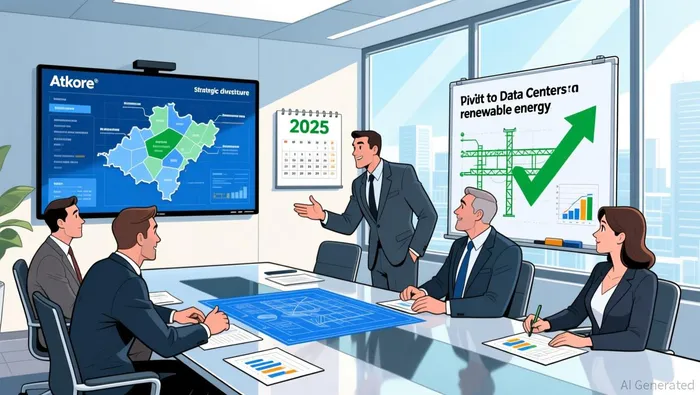 Portfolio rationalization has yielded some operational efficiency gains. Atkore reported $9.3 million in cost savings from divestitures in 2025, and plans to consolidate three manufacturing facilities by 2026 and reduce headcount. These measures are expected to improve adjusted EBITDA and margins in 2027 compared to 2026. However, the broader financial environment-marked by compressed gross margins (from 33.7% in 2024 to 23.7% in 2025) and higher input costs)-has offset some of these benefits.
The Safety & Infrastructure segment, however, demonstrated resilience, with a 4% revenue increase and an 80% jump in adjusted EBITDA to $26.8 million. This segment's performance highlights the potential for growth in areas like industrial safety equipment, which aligns with Atkore's strategic focus.
Challenges and Future Outlook
Atkore's Q4 2025 results underscore the challenges of its transition. The Electrical segment's adjusted EBITDA margin plummeted from 25.8% to 12.7%, driven by pricing pressures and input costs. Analysts had expected $1.26 in adjusted earnings per share but received only $0.69, a significant miss.
Looking ahead, Atkore projects modest recovery in 2026, with net sales between $3.0 and $3.1 billion and adjusted EBITDA of $340–$360 million. The company anticipates $50 million in unmitigated headwinds from lower prices and input costs, with Q1 2026 expected to be the weakest period. CEO Bill Waltz has expressed optimism about growth in data centers and renewable energy, sectors where Atkore's electrical infrastructure expertise could provide a competitive edge.
Conclusion
Atkore's strategic divestitures reflect a calculated effort to realign its portfolio with core competencies and market opportunities. While 2025 financial results were disappointing, the company's focus on cost savings, operational restructuring, and shareholder returns suggests a long-term commitment to value creation. The success of this strategy will depend on its ability to navigate near-term challenges, capitalize on growth in electrical infrastructure, and execute its strategic alternatives review effectively. For investors, the key question remains whether Atkore can transform its portfolio into a sustainable, high-margin business amid a volatile industrial landscape.







Comentarios
Aún no hay comentarios