
Atkore's Q1 2026 Guidance: A Catalyst for a Reassessment?
The immediate catalyst is clear. AtkoreATKR-- will release its Q1 2026 results before the market opens on Tuesday, February 3, 2026. The core event, however, is not the earnings report itself, but the updated guidance that preceded it. The company slashed its Q1 EPS outlook to a range of $0.55 to $0.75, a figure that sits well below the consensus estimate of $0.97. This guidance cut follows a stark Q4 2025 where the company posted a net loss of $54.42 million, a dramatic reversal from the prior-year net income of $73.12 million.
This setup creates a classic event-driven test. The lowered guidance forces a near-term reassessment: does it signal a sustainable downturn in the business, or is the market's reaction overdone, creating a temporary mispricing? The magnitude of the miss is significant, with the Q1 guidance gap representing a nearly 40% shortfall against the Street's expectation. This gap will be the first hard data point on whether the company's recent struggles are a one-quarter anomaly or the start of a longer-term trend. The event is now on the calendar, and the stock's reaction to the February 3 print will reveal whether the market sees a fundamental reset or a buying opportunity in the noise.
Assessing the Fundamentals: A Weak Quarter and a Weakening Trend
The guidance cut is a direct reflection of a business in clear distress. The fourth quarter of fiscal 2025 was a stark reversal, with the company posting a net loss of $54.42 million after a prior-year net income of $73.12 million. The core operational damage is severe. Net sales fell 4.6% year-over-year to $752.01 million, but the real pressure hit the bottom line. Adjusted EBITDA collapsed nearly 50% to $70.9 million from $140.1 million a year ago.
The reasons are twofold and structural. First, the company is facing significant pricing pressure, with lower average selling prices accounting for a $53.6 million drag on sales. Second, raw material costs are rising, adding another $12.3 million in pressure. This squeeze has devastated margins, with gross profit plunging and gross margins contracting from 27.4% to 19.7%. The Q4 loss was also inflated by $66.7 million in non-cash impairments to long-lived assets and $18.9 million in goodwill impairments, which, while not affecting cash flow, signal deep underlying asset value concerns.
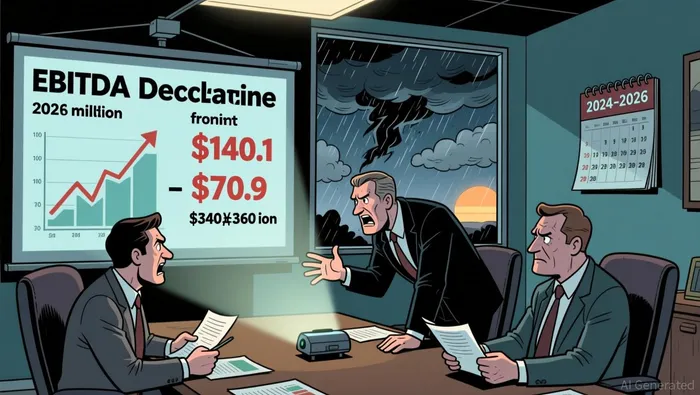
The sustainability of this downturn is now the central question. The company's own full-year 2026 outlook confirms the trend is expected to persist. Its adjusted EPS guidance range of $5.05 to $5.55 sits below the Street's estimate of $5.41. More importantly, the full-year adjusted EBITDA outlook of $340-$360 million implies a continued struggle to regain the scale of the prior year's $386.4 million. This isn't just a one-quarter blip; it's a multi-quarter reset in profitability and cash generation. The event-driven opportunity hinges on whether the market has already priced in this prolonged weakness, or if the deterioration is accelerating beyond current expectations.
Valuation and Market Reaction: Finding the Mispricing
The market has already priced in the bad news, but the question is whether it has priced it in correctly. Shares rose 2.4% to open at $66.69 on the day of the guidance announcement. This counterintuitive move suggests the initial reaction was one of relief that the worst was out in the open, or perhaps a technical bounce. However, the stock's subsequent path will reveal if the new, weaker outlook is fully reflected.
Valuation metrics tell a mixed story. The stock trades at a trailing P/E of 21.12, a premium that no longer fits a company posting a Q4 loss and slashing its full-year EPS forecast. A forward P/E based on the lowered FY26 guidance would be significantly lower, likely in the teens or below. This gap between trailing and forward multiples highlights the disconnect: the market is still valuing the company based on past performance, not its new reality.
Analyst sentiment reflects this tension. The consensus rating is a 'Hold' with an average price target of $79.57. That target implies about 20% upside from current levels, but it also acknowledges the near-term challenges. The target is built on a full-year EPS that is still above the company's own guidance range, suggesting analysts see a potential recovery later in the year or a beat on the low end of the guidance band. For now, the market is being cautious, and the stock's price action suggests it is waiting for the February 3 print to confirm whether the guidance cut is a floor or a starting point for further deterioration.
The bottom line is that the mispricing opportunity, if it exists, is not in the immediate post-announcement pop. It lies in the gap between the current valuation and the cash flow trajectory implied by the new outlook. The stock's reaction to the Q1 results will be the true test of whether the market has correctly assessed the new, weaker fundamentals.
Catalysts and Risks: What to Watch on February 3rd
The event is now live. On Tuesday, February 3, the market will get its first hard numbers on the new, weaker Atkore. The primary catalyst is the actual Q1 EPS and revenue versus the company's own guidance and the Street's higher expectations. The company's Q1 EPS guidance range is $0.55 to $0.75, a figure that sits well below the consensus estimate of $0.97. More importantly, the Street is looking for earnings of $1.07 per share for the quarter. A print at the low end of the guidance range or below would confirm the worst-case scenario, while a beat-even modest-could signal the downturn is stabilizing.
Management commentary will be critical for interpreting the numbers. Watch for details on the HDPE business impairments, which accounted for $66.7 million in non-cash charges last quarter. Any update on the progress of the recent Tectron tube divestiture will also be a key signal. This restructuring move is meant to streamline operations and focus capital, so management's tone on its integration and impact on margins will reveal whether the company is successfully turning the corner or still bleeding.
The key risks are clear. First, further cost pressures could force another guidance cut later in the year. Second, the company's own full-year EPS guidance of $5.05 to $5.55 sits below the Street's $5.41 estimate. A weak Q1 that fails to set a solid foundation would make hitting that range look increasingly difficult. Finally, any hint of additional asset impairments beyond the HDPE and goodwill charges would be a major red flag, suggesting deeper, unresolved problems in the business.
The bottom line is that the February 3 print will be a binary test. It will confirm whether the market's cautious stance is justified or if the stock has oversold the bad news. A miss would likely trigger another sell-off, while a beat could spark a relief rally. The setup is now defined; the event will reveal if the thesis holds.





Comentarios
Aún no hay comentarios