
ASTER's Whale Accumulation: Breakout or Bearish Trap? A Technical and Behavioral Deep Dive
The Whale Signal: Confidence or Deception?
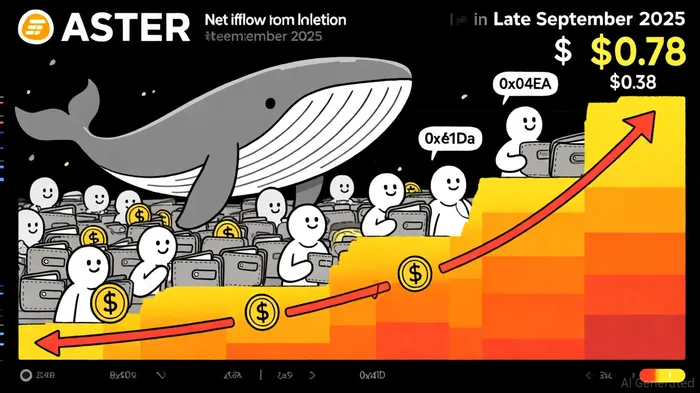
In late September 2025, on-chain data revealed a seismic shift in ASTER's ecosystem. Three major wallets—0x04EA, 0xe1Da, and 0x841D—moved over $10 million in ASTER tokens within 24 hours. The largest single withdrawal, 7.04 million tokens ($4.66 million), came from 0x04EA, while 0x841D swapped 2.22 million APX tokens for ASTER, signaling strategic asset conversion[2][3][6]. These movements, tracked by platforms like Lookonchain, suggest whales are locking in long-term positions, reducing exchange liquidity, and potentially driving upward pressure[4].
Technical Validation: Momentum or Mirage?
ASTER's price surged from $0.38 to $0.78 in September 2025, with RSI and MACD indicators pointing to bullish momentum[1]. The token now faces resistance at $1.30–$1.40 and support near $0.95–$1.00. If it breaks above $1.40, analysts project a potential run to $1.50–$1.60[1]. However, caution is warranted. Historical patterns in tokens like XRPXRP-- show that whale accumulation often precedes surges but can also mask bearish traps. For example, EthereumETH-- whales accumulated $1.1 billion in ETH in September 2025, yet the token formed a head-and-shoulders pattern, hinting at a temporary dip before a larger rally[3].
Behavioral Correlation: Past vs. Present
Historical whale activity in XRP offers a cautionary mirror. In late 2024, XRP's price jumped 400% after whale flows turned positive, aligning with a falling wedge breakout[1]. Similarly, ASTER's rebrand from APX, Binance's endorsement, and a 1:1 token swap have fueled FOMO-driven buying[6]. However, the October 1 unlock of 70.4 million ASTER tokens could introduce selling pressure, testing whether whales maintain their bullish conviction[5].
Post-October 1: Accumulation or Distribution?
Post-October 1, on-chain data shows continued accumulation. Wallets like 0x04EA and 0x841D have moved millions in ASTER, with no signs of distribution[2][4]. This aligns with broader altcoin trends, where whale behavior often precedes institutional inflows. Yet, the risk of a bearish trap remains if volume wanes or RSI diverges from price action[1].
Strategic Positioning for Investors
- Breakout Play: For risk-tolerant investors, a breakout above $1.40 could justify a long position, targeting $1.50–$1.60. Use RSI divergence as a sell signal.
- Bearish Trap Hedge: Short-term traders should monitor the $0.95–$1.00 support zone. A failure to hold here could trigger a retest of $0.54[1].
- Whale Watch: Track wallet movements via Lookonchain. Sudden large withdrawals to exchanges may signal distribution.
Conclusion
ASTER's whale accumulation and technical indicators paint a mixed picture. While the current buildup mirrors historical breakout patterns, the risk of a bearish trap persists. Investors must balance optimism with vigilance, using on-chain data and technical signals to navigate the volatility. As the October 1 unlock looms, the market will test whether this is a genuine breakout or a temporary illusion.






Comentarios
Aún no hay comentarios