
The ASTER Token Bull Case: Whale Activity as a Catalyst for Institutional Adoption
The ASTER Token Bull Case: Whale Activity as a Catalyst for Institutional Adoption
The ASTER token, native to the Aster decentralized perpetual exchange (DEX), has emerged as a compelling case study in how on-chain whale behavior and tokenomics can drive institutional adoption. Over the past six months, the token has seen a confluence of large-scale accumulation, strategic airdrop allocations, and deflationary mechanisms that position it as a strong contender in the DeFi space. Let's break down the evidence.
Whale Accumulation: A Signal of Institutional Confidence
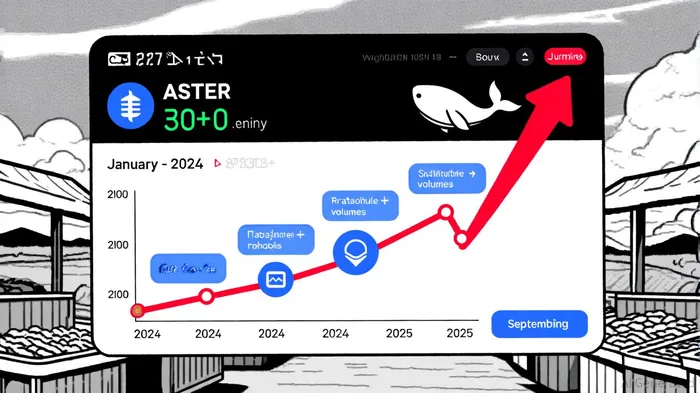
Whale activity has been a defining feature of ASTER's recent trajectory. In the past 24 hours alone, three major wallets—0x04EA, 0xe1Da, and 0x841D—moved over $10 million in ASTER, with one whale acquiring 7.14 million tokens ($10.5 million) via wallets 0x2204 and 0xAF37, netting a $6 million unrealized profit[1]. Another whale turned a $300,000 investment into a $7 million profit by purchasing 3.24 million ASTER tokens at $0.0922 per coin[5]. These moves are notNOT-- isolated; they reflect a broader trend of capital rotation from HYPE into ASTER, with one whale swapping $17 million in HYPE for ASTER[1].
Such accumulation patterns are typically interpreted as long-term strategic positioning. Whales often act as “market makers” in crypto, and their inflows into ASTER suggest growing confidence in the token's utility and governance model. This is further reinforced by the token's 24-hour trading volume of $35.86 billion, surpassing Hyperliquid and signaling a shift in institutional capital toward Aster's ecosystem[5].
Tokenomics: A Framework for Scarcity and Growth
ASTER's tokenomics are designed to balance growth incentives with scarcity. The total supply of 8 billion tokens is allocated as follows: 53.5% for airdrops, 30% for ecosystem/community development, 7% for the treasury, and 5% for the team[3]. This structure ensures that early adopters and ecosystem contributors are rewarded while reserving a significant portion for long-term sustainability.
A key deflationary mechanism is the protocol's revenue-backed buybacks, where a portion of trading fees is used to repurchase ASTER tokens from the open market[3]. This not only reduces circulating supply but also aligns token value with network activity. For instance, unclaimed airdrop tokens are funneled back into future distribution cycles, creating a flywheel effect that incentivizes ongoing participation[4].
The token's utility as a governance and staking asset further strengthens its case. ASTER holders can vote on protocol upgrades, such as the APX token swap, which saw a 1.1 APX-to-ASTER conversion rate[4]. This integration with Binance's APX token—coupled with CZ's public endorsement—has driven over 330,000 new users to the platform[4].
Institutional Adoption: From On-Chain Signals to Market Impact
Institutional adoption is often telegraphed through on-chain data. For ASTER, this includes:
1. Large-Scale Withdrawals: A $45.6 million ASTER withdrawal from Gate.ioIO-- suggests institutional holders are moving assets to private wallets or decentralized platforms[2].
2. TVL and Volume Surge: ASTER's TVL jumped from $370 million to $1.21 billion in a week, while daily trading volume hit $11 billion[2]. These metrics indicate growing trust in the platform's infrastructure.
3. Strategic Partnerships: The APX-to-ASTER swap, backed by Binance, has created a direct link to one of crypto's largest exchanges, enhancing liquidity and visibility[4].
Moreover, the token's multi-chain support and MEV-free execution model appeal to institutional players seeking efficiency and security[5]. While challenges like high supply concentration (93% in top wallets) exist[2], the deflationary mechanisms and whale-driven demand are mitigating downward pressures.
Investment Timing: When to Buy the Bull Case
The interplay between whale activity and tokenomics creates a clear investment thesis. With ASTER's circulating supply at 1.65 billion (out of 8 billion total), the token's scarcity premium is set to increase as buybacks continue. Analysts project a price target of $1.383 by 2025, assuming sustained adoption[4].
For timing, the current phase—marked by whale accumulation and institutional endorsements—offers a high-conviction entry point. The $1.47 valuation (as of September 19, 2025) reflects a 560% increase from its $0.0922 floor price[5], but the token's airdrop-driven growth and deflationary tailwinds suggest further upside.







Comentarios
Aún no hay comentarios