
Aster Price Surge and Market Implications: Strategic Entry Points and Sector Ripple Effects in Resource-Driven Equities
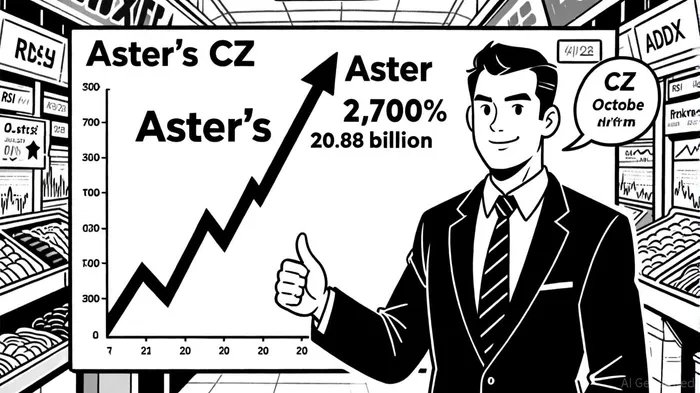
The 2025 price surge of Aster (ASTER), the governance token of the decentralized perpetuals exchange Aster DEX, has ignited a frenzy in both DeFi and traditional markets. Since its launch on September 17, 2025, ASTER has surged over 2,700%, peaking at $2.43 on September 24 before consolidating around $2.02 as of September 28, according to a BSC.News analysis. This meteoric rise, driven by endorsements from Binance's CZ as reported in a MarketMinute article, CoinRank analysis of yield-bearing collateral innovations, and strategic partnerships with platforms like Trust Wallet noted in Chainwire coverage, has notNOT-- only reshaped DeFi trading dynamics but also created cross-sector ripples in resource-driven equities.
Drivers of the ASTER Surge: A DeFi Revolution
Aster DEX's integration of tokenized stock perpetuals-allowing 24/7 leveraged trading on equities like AppleAAPL-- (AAPL) and TeslaTSLA-- (TSLA)-has attracted both retail and institutional capital, according to a TechStartups report. By leveraging Pyth NetworkPYTH-- for tamper-resistant pricing data and offering up to 50x leverage, as explained in a Phemex guide, Aster has captured $20.88 billion in 24-hour trading volume, rivaling centralized exchanges. CZ's endorsement of its "hidden orders" feature, highlighted in a Currency Analytics write-up, further amplified institutional interest, while airdrop programs and multi-chain support accelerated adoption, as outlined in a CoinPedia report.
Technical indicators reinforce bullish momentum: ASTER's price rebounded from $1.5 to $2.1, surpassing the 50-period moving average and forming a falling wedge pattern, per a Bankless Times analysis. The Relative Strength Index (RSI) remains in the 50–70 range, signaling sustained buying pressure in an InsideBitcoins snapshot, while the Average Directional Index (ADX) nears 25.0, indicating a strengthening trend in a BeInCrypto outlook.
Risks and Volatility: A Double-Edged Sword
Despite the optimism, ASTER's volatility poses risks. Upcoming token unlocks from October 17 could introduce sell pressure, warns a CoinUnited analysis, and concerns about wash trading-exacerbated by concentrated wallet ownership-have been raised in a OneSafe blog post. Regulatory scrutiny, particularly around tokenized stock perpetuals, remains a wildcard, according to a DiscoveryAlert note.
Sector Ripple Effects: DeFi Meets Resource-Driven Equities
Aster's innovations are indirectly reshaping resource-driven sectors. By enabling decentralized trading of tokenized assets, Aster DEX has spurred interest in blockchain-based commodity markets, where copper, lithium, and rare earth elements could be tokenized for 24/7 trading, a possibility explored in a Farmonaut piece. For instance, mining companies with stable operations (e.g., BHP Group, Rio Tinto) may benefit from increased liquidity in their tokenized assets, as noted in Global Mining Review, while energy firms could leverage DeFi platforms for hedging against price swings, per a Janus Henderson article.
However, the surge in DeFi activity has also intensified competition for capital. As investors allocate funds to high-yield DeFi protocols-Aster's 8.8% staking APY is noted in a Phemex blog-traditional mining and energy equities face margin pressures from reduced equity inflows, as discussed in a Nexseer piece. This dynamic is particularly acute in sectors already grappling with supply chain disruptions, such as copper mining, where LME prices hit $10,180/ton due to production halts, according to a Markets FinancialContent article.
Strategic Entry Points for Investors
For investors navigating this landscape, strategic entry points hinge on balancing DeFi opportunities with traditional sector fundamentals:
1. DeFi Exposure: Allocate to ASTER via dollar-cost averaging (DCA) strategies, targeting pullbacks below $1.80, a key support level highlighted in a BeInCrypto write-up. Prioritize platforms with yield-bearing collateral (e.g., asBNB) to offset volatility, following a CoinGecko guide.
2. Resource-Driven Equities: Focus on mining and energy firms with strong ESG profiles and low debt, such as Glencore or NextEra Energy, which are better positioned to weather capital flight to DeFi, per a Fidelity outlook.
3. Cross-Sector Arbitrage: Use Aster's tokenized stock perpetuals to hedge traditional equity positions. For example, short AAPLAAPL-- perpetuals on Aster DEX while holding the physical stock, capitalizing on price discrepancies identified in a Cointelegraph report.
Conclusion: A New Era of Convergence
Aster's price surge underscores the accelerating convergence of DeFi and traditional markets. While risks like token unlocks and regulatory uncertainty persist, the platform's innovations-tokenized assets, yield-bearing collateral, and 24/7 trading-offer novel tools for resource-driven sectors. Investors who strategically navigate this duality, leveraging DeFi's efficiency while anchoring in traditional sector fundamentals, may unlock alpha in an increasingly interconnected financial ecosystem.





Comentarios
Aún no hay comentarios