
Aster vs. Hyperliquid: The Battle for Perpetual DEX Supremacy in 2025
The on-chain perpetual decentralized exchange (DEX) market has become a battleground for innovation and user acquisition, with Aster and Hyperliquid leading the charge. As institutional and retail demand for decentralized trading infrastructure surges, investors are increasingly scrutinizing which platform can sustain long-term dominance. This analysis evaluates Aster's potential to outperform Hyperliquid, leveraging recent performance data, user growth, and strategic differentiation.
Hyperliquid's Dominance: A Proven Flywheel
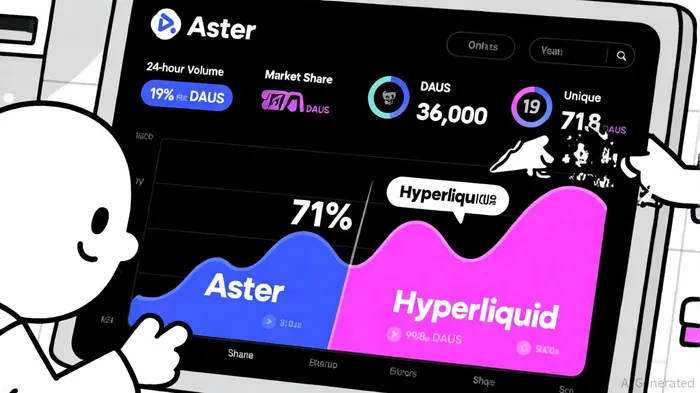
Hyperliquid has cemented its position as the leader in the perps DEX space, commanding 71–73% of the market as of early 2025 [3]. Its cumulative volume exceeds $5.2 trillion, with a 24-hour volume of $12.5 billion [4], driven by a custom HyperBFT consensus layer that enables 200,000 orders per second and zero gas fees for traders [2]. The platform's community-first approach and fair launch model have fostered a loyal user base of over 998,000 accounts [2].
However, Hyperliquid's dominance is under threat. Recent data from Coindesk reveals its market share has plummeted to 38% as of September 2025, with competitors like Aster and Lighter eroding its lead [3]. This decline signals a maturing market where user preferences are diversifying, and innovation is accelerating.
Aster's Meteoric Rise: A Disruptive Challenger
Aster, launched in September 2025, has rapidly emerged as a formidable rival. Despite its late entry, the platform has captured 19% of the perps DEX market share, up from 2% earlier in the year [4]. Its 24-hour volume of $1.5 billion and 36,000 daily active users (DAUs) are testament to its explosive growth [4]. Aster's success is fueled by strategic differentiators:
- High Leverage and Hidden Orders: Offering up to 1001x leverage and hidden order functionality, which appeals to aggressive traders seeking privacy [4].
- Multi-Chain Support: Deployment on BNBBNB-- Chain, EthereumETH--, ArbitrumARB--, and SolanaSOL-- broadens its accessibility, particularly as BNB Chain's perps volume surges [1].
- Influencer Endorsements: A rare endorsement from Binance co-founder Changpeng Zhao has amplified its visibility and credibility [4].
Aster's cumulative volume of $516 billion, while dwarfed by Hyperliquid's $5.2 trillion, reflects its rapid traction in a market where user acquisition is now a critical metric [4].
Strategic Divergence: Speed vs. Flexibility
Hyperliquid's focus on speed and efficiency—achieved through its HyperBFT consensus—positions it as the go-to platform for high-frequency traders. Its zero gas fees and order-processing capabilities (200,000 orders/second) create a sticky user experience [2]. However, this specialization may limit its appeal to traders seeking cross-chain liquidity or advanced order types.
Aster, conversely, prioritizes flexibility and innovation. Its multi-chain strategy taps into the growing demand for interoperability, while hidden orders and high leverage cater to niche but lucrative segments of the trading community [4]. This adaptability could prove advantageous as the market evolves beyond pure speed to value-added features.
Risks and Market Realities
While Aster's growth is impressive, several risks loom. Hyperliquid's entrenched user base and revenue flywheel—generated by its 0.05% trading fee—provide a financial buffer to fund further innovation [4]. Aster, with its 0.1% fee, must balance profitability with competitive pricing. Additionally, regulatory scrutiny of leveraged trading and cross-chain activity could impact both platforms, though Aster's multi-chain approach may expose it to more fragmented compliance challenges.
Investment Thesis: A Tipping Point in 2025
The perps DEX market is at a tipping point. Hyperliquid's dominance is undeniable, but Aster's rapid ascent demonstrates that market share is no longer a given. For Aster to outperform Hyperliquid, it must:
1. Sustain User Growth: Convert its 330,000 new wallets into active traders.
2. Expand Product Offerings: Introduce advanced tools (e.g., margin trading, derivatives) to retain high-net-worth users.
3. Optimize Liquidity: Address potential slippage issues on BNB Chain, where its volume has surged but depth remains a concern [1].
Conversely, Hyperliquid must innovate beyond speed—perhaps by integrating cross-chain capabilities or reducing fees—to retain its lead.
Conclusion
Aster's potential to outperform Hyperliquid hinges on its ability to leverage its agility and feature-rich model against Hyperliquid's entrenched infrastructure. While Hyperliquid's market share has declined, its technological foundation and user base remain formidable. Investors should monitor key metrics: Aster's ability to maintain its 19% market share and Hyperliquid's response to competitive pressures. In a market where innovation is the only constant, the winner may not be the largest but the most adaptable.







Comentarios
Aún no hay comentarios