
Aster Digital Asset Dynamics and Institutional Adoption Signals
The institutional adoption of digital assets in 2025 has reached a critical inflection point, with nearly 60% of surveyed institutional investors planning to increase their allocation to tokenized instruments within the year, according to State Street's 2025 outlook. This shift is notNOT-- merely speculative but reflects a strategic reorientation toward blockchain-based infrastructure, driven by benefits such as enhanced transparency, faster settlement, and reduced compliance costs, according to BTCC's analysis. Amid this backdrop, the ASTERASTER-- token-native to the privacy-focused decentralized perpetual exchange (perp DEX) Aster-has emerged as a focal point for institutional validation, combining utility-driven design with multi-chain liquidity aggregation.
Institutional Validation of ASTER's Utility
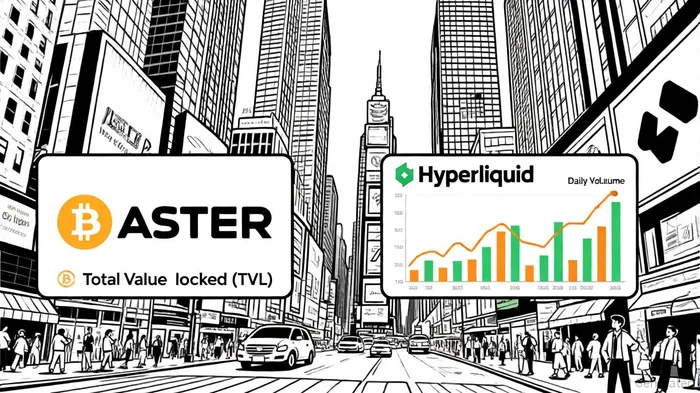
Aster's institutional credibility is anchored in its innovative features and strategic partnerships. The platform's ability to surpass Hyperliquid in daily trading volume-reaching $793 million in 24 hours compared to Hyperliquid's $462 million-demonstrates its capacity to attract liquidity, as noted in the State StreetSTT-- outlook. This success is underpinned by institutional-grade tools such as hidden orders to prevent front-running and yield-bearing collateral, which align with the demands of professional traders, per the BTCC analysis. Notably, Aster's total value locked (TVL) surged to $1.78 billion post-token launch, a figure that, while fluctuating post-token generation event (TGE) to $374 million, underscores its role as a liquidity magnet (the State Street outlook highlights these figures).
Institutional confidence is further reinforced by high-profile endorsements. Changpeng Zhao (CZ), the founder of Binance, has served as an advisor to Aster, lending credibility to its ecosystem, as noted in a Wedbush note. His venture firm, YZi Labs, holds a minority stake in the project, signaling alignment with Binance's broader strategy to dominate decentralized derivatives markets; Wedbush reported that this partnership has catalyzed a 2,000% surge in ASTER's value, with 330,000 new wallet addresses created in 24 hours during its growth phase, according to the BTCC analysis.
Custody and Compliance Frameworks
Institutional adoption of ASTER is also supported by robust custody solutions. Aster collaborates with Ceffu, an institutional-grade custody provider, to secure assets like USDF and USDTUSDT-- using multi-party computation (MPC) and multi-signature wallets, as detailed on Aster's custody page. These measures ensure compliance with ISO 27001 and SOC 2 standards, addressing institutional concerns about asset safety and regulatory alignment, as detailed on the same custody page. Additionally, Fasanara Capital's withdrawal of 6.036 million ASTER tokens from Gate.ioIO-- highlights a broader trend of institutional investors migrating assets to self-custody or DeFi platforms to mitigate exchange risks, a trend the State Street outlook discusses.
Liquidity and Market Dynamics
Aster's liquidity potential is validated by aggressive incentive programs and cross-chain integration. The platform's "Trade & Earn" model allows users to generate yields while trading, creating a flywheel effect that attracts both retail and institutional participants, according to the BTCC analysis. Furthermore, Aster's deployment across BNB Chain, ArbitrumARB--, EthereumETH--, and SolanaSOL-- reduces bridging friction, enabling access to existing liquidity pools, as also noted in the BTCC analysis. A notable example of institutional liquidity demand is the $3.16 million purchase of 1.69 million ASTER tokens by whale address 0xfE5A in October 2025, signaling confidence in the token's long-term trajectory, per the BTCC analysis.
Challenges and Risks
Despite these positives, ASTER faces challenges, including periodic supply unlocks-such as the 4% unlock on October 14, 2025-which could introduce short-term volatility, a point raised in the BTCC analysis. Regulatory scrutiny, exemplified by DeFiLlama's delisting of Aster DEX's perpetual futures data due to suspected wash trading, also raises transparency concerns (the BTCC piece discusses this development). However, these risks are mitigated by Aster's focus on compliance frameworks and its integration with institutional custody providers, which align with the 2025 EY Digital Assets Survey's emphasis on regulatory clarity as a growth enabler, according to a Kenson Investments article.
Conclusion
Aster's institutional adoption signals-ranging from CZ's advisory role to custody partnerships with Ceffu-position the ASTER token as a compelling utility-driven asset in the tokenized future. While challenges persist, the project's multi-chain liquidity, yield-bearing features, and institutional-grade infrastructure suggest a trajectory of sustained growth. For investors, ASTER represents not just a speculative play but a strategic bet on the convergence of DeFi and institutional finance.





Comentarios
Aún no hay comentarios