
Aster DEX's Recent Protocol Upgrade and Its Implications for DeFi Liquidity Providers
Technical Innovations: Precision and Leverage
The upgrade's cornerstone was the reduction of tick size for ARUSDTAR-- perpetual contracts from 0.01 to 0.001, effective November 10, 2025. This adjustment allows traders to execute orders at finer price increments, particularly beneficial in tight spreads where precision can amplify profitability. Coupled with the launch of Aster Harvest-Stage 4 of the Dawn program-the upgrade introduced 300x leverage options and a reward points system, broadening the platform's appeal to both retail and institutional participants.
On-Chain Utility and Capital Efficiency Gains
Aster's native token, $ASTER, now serves as 80% margin collateral for leveraged trading, enabling users to deploy $1,000 in ASTER for $800 in leveraged positions. This innovation reduces reliance on external assets like stablecoins, mitigating liquidation risks and fostering token utility. Additionally, a 5% fee discount for ASTER collateral holders incentivizes token retention, creating a flywheel effect that deepens liquidity.
The upgrade also integrated yield-generating assets such as asBNB and USDF as margin collateral, allowing LPs to earn passive rewards while maintaining leveraged positions. This dual-purpose model aligns with DeFi's core objective of minimizing transaction costs and maximizing asset utilization. Furthermore, the temporary removal of ASTER tokens from circulation during leveraged trades may stabilize the token's price, reducing volatility and enhancing its appeal as a collateral asset.
Implications for Liquidity Providers
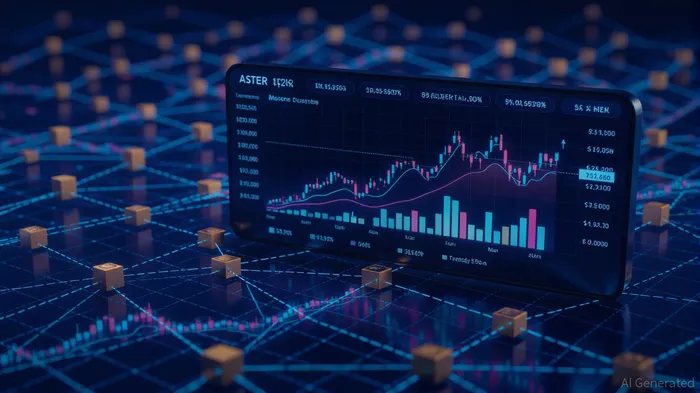
The upgrade catalyzed a 30% surge in ASTER's price and an 800% increase in 24-hour trading volume to $2 billion. While specific APR figures for LPs remain undisclosed, the platform's Total Value Locked reached $1.16 billion, reflecting robust capital inflows. However, on-chain data reveals a paradox: despite a $3 trillion trading volume milestone, protocol fees have stagnated below $20 million since mid-October, and open interest (OI) has halved to $2.669 billion. This suggests that while the upgrade boosted volume, user adoption and fee generation for LPs may be lagging.
The introduction of yield-generating collateral offers a partial offset. By enabling LPs to earn rewards on margin assets, Aster mitigates the opportunity cost of liquidity provision. Yet, the platform's reliance on leveraged trading exposes LPs to heightened volatility risks, particularly in a risk-off market environment.
Balancing Gains and Challenges
Aster's upgrade underscores a broader DeFi trend: the convergence of governance tokens and functional utility. By transforming ASTER into a core collateral asset, the platform reduces friction in leveraged trading and rewards long-term holders. However, the stagnation in protocol fees and declining OI highlight the need for sustained innovation to retain user engagement.
For LPs, the upgrade's success hinges on three factors:
1. Sustained Trading Volume: Maintaining the $2 billion daily volume requires continuous institutional onboarding and ecosystem growth.
2. Token Price Stability: The temporary token removal mechanism must effectively curb volatility to preserve ASTER's utility as collateral.
3. Fee Incentives: Expanding the 5% discount to additional use cases could further incentivize LP participation.
Conclusion
Aster DEX's November 2025 upgrade marks a significant step toward capital-efficient DeFi protocols. By enhancing ASTER's utility and reducing slippage through finer tick sizes, the platform has created a compelling value proposition for LPs. However, the challenge lies in translating high trading volumes into sustainable fee revenue and user retention. As the DeFi space matures, Aster's ability to balance innovation with stability will determine its long-term success.







Comentarios
Aún no hay comentarios