
Aster_DEX's Explosive Growth Post-Token Launch: Assessing the Sustainability of TVL and User Growth as Indicators of Long-Term DeFi Investment Potential
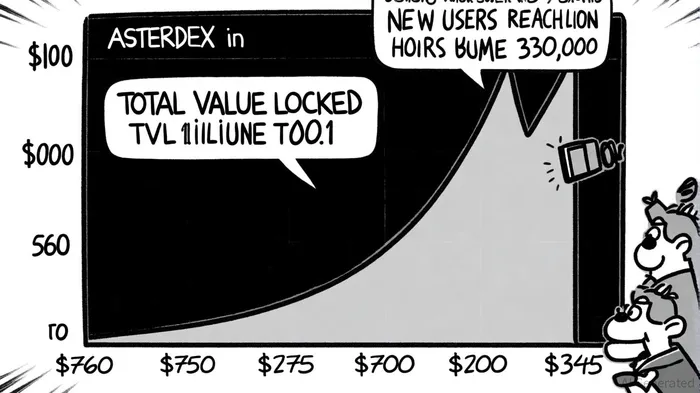
In the ever-evolving DeFi landscape, few events have captured market attention as dramatically as Aster_DEX's token launch in September 2025. The platform's native token, $ASTER, surged 1,650% in its first 24 hours, propelling the platform's Total Value Locked (TVL) from $660 million to $1.005 billion while attracting 330,000 new users and generating $345 million in trading volume [1]. This meteoric rise has positioned Aster_DEX as a formidable contender in the decentralized perpetual trading space, but the critical question remains: Can this explosive growth be sustained, and what does it signal for long-term investment potential?
The Mechanics of Growth: TVL and User Metrics
Aster_DEX's post-launch performance underscores the power of tokenomics and strategic design. The platform's TVL spike was driven by a combination of liquidity incentives, airdrop programs, and the allure of its privacy-focused features, such as ZK-powered hidden orders and MEV-free trading [2]. According to a report by Cryptonews, the platform's TVL briefly peaked at $2 billion before retracting to $655 million, a volatility pattern common in DeFi projects during hypergrowth phases [3]. However, the fact that TVL stabilized at $655 million—despite a 33% retracement—suggests a degree of resilience, particularly given the platform's multi-chain infrastructure (BNB Chain, EthereumETH--, SolanaSOL--, and Arbitrum) and institutional-grade tools [4].
User growth metrics further reinforce this narrative. Data from CoinJournal indicates that Aster_DEX added 617,379 new users within a seven-day period post-launch, with the total user base reaching 1.848 million [5]. This rapid adoption is a testament to the platform's user-friendly interface, competitive trading fees, and strategic partnerships, including backing from YZi Labs and endorsements from Binance's Changpeng Zhao (CZ) [6]. Yet, as with TVL, the sustainability of these user numbers hinges on retention. While the platform reported 2 million total users and 617,379 new additions in a week, the absence of long-term retention data raises questions about whether these users are active traders or liquidity providers incentivized by short-term rewards [7].
Competitive Positioning and Market Dynamics
Aster_DEX's growth must be contextualized within the broader DeFi perps market. In 2025, the sector is valued at $500 billion, with Hyperliquid dominating 35% of the market share. Aster_DEX, with a 20% share, faces an uphill battle to maintain its position [8]. However, its differentiation lies in privacy-centric innovations. The platform's use of zero-knowledge proofs to enable fully private trading—while still allowing regulators to verify transactions—aligns with evolving frameworks like the EU's MiCA regulation [9]. This dual approach to privacy and compliance could attract institutional investors wary of regulatory scrutiny, a critical advantage in markets like the EU and the U.S.
Technological advancements also bolster Aster_DEX's competitive edge. The launch of a ZK-powered Layer 1 blockchain in July 2025 optimized trading performance and privacy, while the introduction of stock perpetuals (e.g., TeslaTSLA-- and NVIDIA) expanded its appeal to a broader audience [10]. These innovations, coupled with a redesigned UI/UX and ultra-low trading fees, position Aster_DEX to capture market share from both centralized and decentralized rivals.
Risks and Challenges to Sustainability
Despite its strengths, Aster_DEX faces significant hurdles. First, TVL volatility remains a concern. While the platform's TVL stabilized at $655 million post-peak, it still lags behind Hyperliquid's $2.7 billion [11]. Sustaining TVL growth will require continuous innovation and liquidity incentives, which could strain the platform's token economics. Second, technical challenges persist. Reports of web version crashes and liquidity locks until October 1, 2025, highlight operational risks that could deter long-term users [12].
Regulatory uncertainty is another wildcard. While Aster_DEX's privacy features align with MiCA, the U.S. SEC's evolving stance on DeFi tokens could introduce compliance risks. The platform's token generation event (TGE) unlocked 70.4 million $ASTER tokens, driving a 150% volume surge, but regulatory scrutiny of token airdrops and liquidity mining programs could dampen future growth [13].
Conclusion: A High-Potential, High-Volatility Play
Aster_DEX's explosive growth post-token launch demonstrates the platform's ability to disrupt the DeFi perps market. Its TVL and user metrics, while impressive, must be evaluated through the lens of sustainability. The platform's privacy-focused innovations, multi-chain strategy, and institutional-grade tools provide a strong foundation for long-term growth. However, challenges such as TVL volatility, technical execution risks, and regulatory uncertainty cannot be overlooked.
For investors, Aster_DEX represents a high-potential, high-volatility opportunity. The platform's ability to retain users, maintain TVL, and navigate regulatory landscapes will determine whether it becomes a market leader or a short-lived flash in the pan. As the DeFi ecosystem matures, projects that balance innovation with operational resilience—like Aster_DEX—will likely emerge as key players.






Comentarios
Aún no hay comentarios