
Aster Coin's Evolving Value Proposition: A Deep Dive into Network Economics and Token Utility
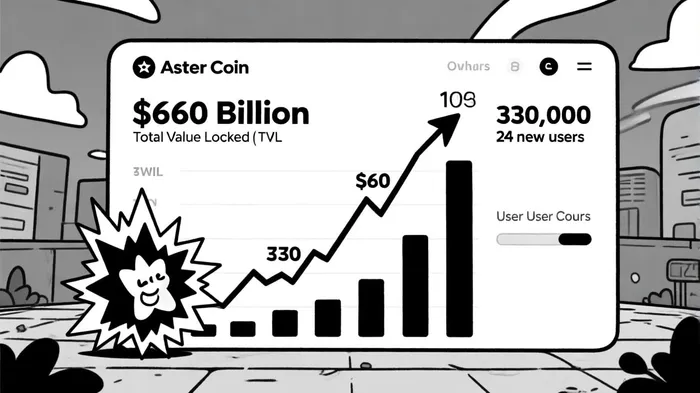
In the fast-evolving landscape of decentralized finance (DeFi), few projects have captured market attention as swiftly as Aster, a privacy-focused perpetual decentralized exchange (DEX). Since its token launch on September 18, 2025, Aster's native token, $ASTER, has surged 1,650% in just 24 hours, climbing from $0.03015 to a peak of $0.528 [2]. This meteoric rise coincided with a dramatic expansion of the platform's Total Value Locked (TVL), which jumped from $660 million to over $1.005 billion, while trading volume hit $345 million and user numbers swelled by 330,000 [1]. These metrics underscore a compelling narrative of rapid adoption and liquidity formation, positioning Aster as a disruptive force in the decentralized perpetual exchange space.
Network Economics: A Foundation for Scalability and Trust
Aster's success is rooted in its robust network economics, which combine multi-chain interoperability with privacy-centric features. The platform operates on BNBBNB-- Chain, EthereumETH--, SolanaSOL--, and ArbitrumARB--, enabling seamless cross-chain trading and broadening its accessibility to diverse user bases [3]. This multi-chain strategy not only mitigates congestion risks but also taps into the liquidity pools of high-throughput networks like Solana and BNB Chain.
The surge in TVL and user growth highlights Aster's ability to attract both retail and institutional capital. According to a report by Cryptonews, the platform's TVL growth was driven by its dual-mode interface, which caters to novice traders with simplified tools and professionals with advanced order types [2]. Additionally, Aster's “Hidden Orders” feature, designed to prevent front-running and Miner Extractable Value (MEV) attacks, has drawn institutional interest by enhancing trade execution privacy [3].
Data from Chainwire further reveals that Aster's 24-hour trading volume of $371 million reflects strong liquidity demand, particularly for USDⓈ-denominated perpetual contracts [3]. This liquidity depth, combined with a user base now exceeding 330,000, suggests a self-reinforcing cycle: higher TVL attracts more traders, who in turn generate fees that fund ecosystem growth.
Token Utility: Governance, Staking, and Ecosystem Incentives
The $ASTER token is central to Aster's value proposition, serving as both a governance and utility asset. Holders can vote on protocol upgrades, fee structures, and feature implementations, ensuring community-driven development [1]. This governance model aligns with DeFi's ethos of decentralization while fostering long-term stakeholder commitment.
Staking $ASTER further amplifies its utility. Platforms like CoinUnited.io offer stakers an Annual Percentage Yield (APY) of up to 55.0%, one of the highest in the DeFi space [2]. This high APY is underpinned by Aster's tokenomics, which allocate 53.5% of the total supply to airdrops and ecosystem development, incentivizing early adoption and liquidity provision [3]. Such a distribution model not only rewards active participants but also ensures the protocol's sustainability by funding future innovations.
Beyond staking, $ASTER facilitates fee payments and liquidity incentives. Traders can use the token to collateralize positions with yield-generating assets like asBNB and USDF, optimizing capital efficiency [3]. This dual functionality—serving as both a governance token and a medium for trading—creates a flywheel effect, where token demand is driven by both on-chain activity and off-chain incentives.
Competitive Advantages and Risks
Aster's privacy-focused architecture and multi-chain flexibility give it a distinct edge over competitors like Hyperliquid and dYdXDYDX--. By mitigating MEV risks and enabling cross-chain arbitrage, the platform appeals to a broader spectrum of traders. However, challenges remain. The high APY for staking could lead to token inflation if not carefully managed, and regulatory scrutiny of privacy-centric protocols may pose long-term risks.
Conclusion: A High-Potential Play in DeFi 2.0
Aster's explosive growth metrics and token design reflect a well-structured value proposition. The platform's ability to scale TVL, attract users, and offer high-yield staking positions it as a strong contender in the DeFi 2.0 era. While risks such as regulatory uncertainty and token inflation exist, the project's focus on privacy, interoperability, and community governance aligns with key trends in the crypto space. For investors seeking exposure to a rapidly evolving DEX ecosystem, Aster presents a compelling case—provided they conduct due diligence on its long-term tokenomics and compliance strategies.







Comentarios
Aún no hay comentarios