
Aster's Bullish Hammer at Key Support: A Strategic Entry Opportunity in the Short-Term Reversal Play
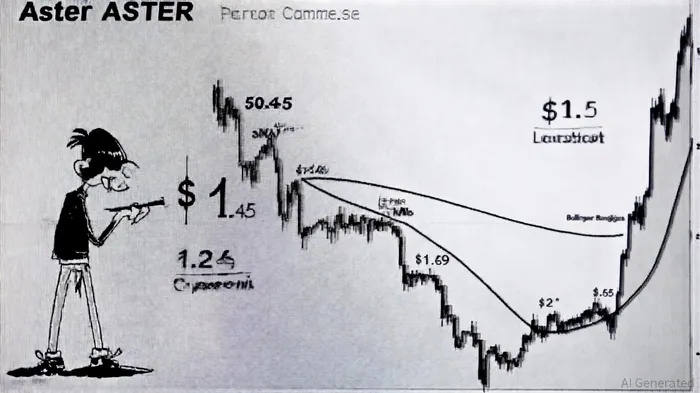
The cryptocurrency market is no stranger to volatility, but when technical signals align with institutional-grade fundamentals, opportunities emerge for disciplined traders. Aster (ASTER) has recently presented one such scenario, with a bullish hammer pattern forming at a critical support level near $1.45 on the 1-hour chart. This pattern, coupled with strong volume surges and a descending trendline breakout, suggests a high-probability reversal setup for short-term traders. Here's how to position for it.
Technical Confirmation: Hammer at $1.45 and Institutional Backing
A bullish hammer pattern forms when a security's price drops sharply during a session but rebounds to close near its high, creating a small real body and a long lower shadow. In Aster's case, this pattern emerged at $1.45—a level where the token had previously stabilized after a 33% decline from $1.94 to $1.33 [3]. According to Big Cheds, a respected technical analyst, this setup indicates “exhaustion of selling pressure and a potential reversal” [2].
The pattern's credibility is further reinforced by volume dynamics. The candlestick's formation coincided with a surge in buying activity at the lower Bollinger Band breach near the 50-period simple moving average (SMA) at $1.51 [3]. This suggests institutional participation, as large buyers often accumulate at key support levels. Additionally, Aster's institutional backing—endorsed by former Binance CEO Changpeng Zhao and Yzi Labs—provides a foundational floor for the token's price action [1].
Strategic Entry Points and Risk Management
For traders seeking to capitalize on this setup, the key is confirmation. As outlined in LuxAlgo's hammer pattern checklist, a long position should be initiated after a bullish candle closes above the high of the hammer pattern [2]. This confirms that buyers have taken control. Given Aster's current consolidation between $1.58 and $1.71, the ideal entry point would be around $1.63, where the price has recently stabilized [1].
Stop-loss placement should be below the hammer's lower shadow, ideally at $1.45 to $1.50, to limit risk if the reversal fails. A take-profit target can be set at $1.69 (mid-range target) or $1.80, aligning with the 50% rally projection from falling channel breakouts [1]. For aggressive traders, the $2 resistance level remains a critical psychological barrier. A successful breakout here could open the path to $2.50, but this requires sustained volume and a bullish MACD crossover [5].
Market Behavior and Indicator Divergences
While the hammer pattern is compelling, it's essential to cross-check with other indicators. The Relative Strength Index (RSI) and Moving Average Convergence Divergence (MACD) currently show mixed signals. The RSI has oscillated near overbought levels, while the MACD has yet to confirm a bullish crossover [4]. However, a bullish divergence is forming: Aster's price has made a lower low, but the RSI has formed a higher low, suggesting weakening bearish momentum [1].
Volume data also tells a story. The Chaikin Money Flow indicator has shown strong inflows as Aster rallied 16% to $1.62, indicating growing investor confidence despite broader market uncertainty [2]. This aligns with the hammer pattern's implication of a short-term bottoming process.
Broader Context: Liquidity and Volatility Considerations
Aster's ecosystem adds another layer of credibility. The platform's liquidity is bolstered by over 331,000 ETHETH-- locked in its smart contracts, providing a buffer against sharp corrections [1]. However, this also means the token remains volatile. Traders should monitor the 50-period SMA ($1.51) as a dynamic support level. A pullback below $1.58 could trigger a retest of the $1.45 hammer base, offering a second entry opportunity [4].
Conclusion: A High-Probability Setup with Clear Risk Parameters
Aster's bullish hammer at $1.45, combined with institutional fundamentals and volume surges, presents a compelling case for a short-term reversal. Traders who wait for confirmation above $1.63 and manage risk with a stop-loss below $1.50 can aim for a 1:2 risk-reward ratio. While the $2 resistance remains a key watchpoint, the immediate focus should be on $1.69 and $1.80. As always, patience and discipline are paramount—this is a setup that rewards those who wait for confirmation before committing capital.







Comentarios
Aún no hay comentarios