
Aster Airdrop Delay and Market Implications: Evaluating Long-Term Investment Potential Amid Uncertainty
The recent delay of Aster's Stage 2 airdrop and the subsequent delisting of its perpetual futures volume by DeFiLlama have sparked a crisis of confidence in the project. While the airdrop delay was officially attributed to "data inconsistencies" in token allocations, the broader implications-ranging from market sentiment to token valuation-reveal a complex interplay of transparency, trust, and speculative behavior. For investors, the question is no longer just about the mechanics of the airdrop but about whether AsterASTER-- can rebuild credibility in a market increasingly skeptical of unverified claims.
The Airdrop Delay: A Technical Fix or a Trust Crisis?
Aster announced the postponement of its Stage 2 airdrop from October 14 to October 20, citing miscalculated token allocations for some users. According to CoinCentral, the delay followed the launch of an "S2 airdrop checker," which revealed discrepancies in user allocations, including one case where a trader with $9 million in volume received only 336 ASTER tokens. The project assured users that most allocations would be adjusted to meet or exceed the original snapshot calculations, with a 48-hour window for those dissatisfied to opt for a USDTUSDT-- refund, as explained by Decrypt.
While Aster's response appears technically sound, the lack of third-party verification for these adjustments raises red flags. As noted by Yahoo Finance, the project has not engaged independent auditors to validate the revised allocations, leaving room for skepticism. In decentralized finance (DeFi), transparency is not just a virtue-it is a necessity. Without it, even well-intentioned fixes can erode trust.
Market Sentiment and the DeFiLlama Delisting
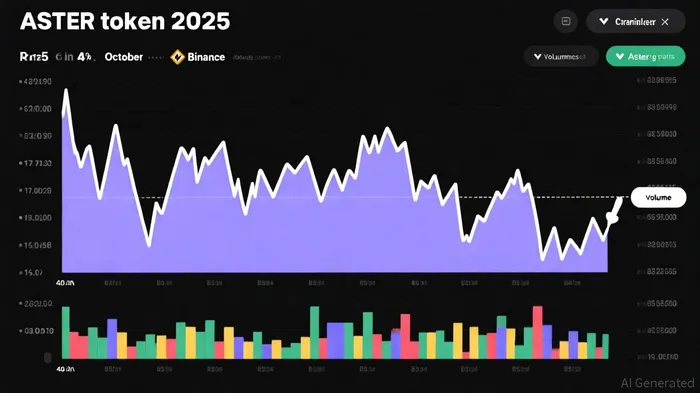
The airdrop delay coincided with a separate blow to Aster's credibility: the delisting of its perpetual futures volume by DeFiLlama. The analytics platform cited a "nearly 1:1 correlation" between Aster's and Binance's trading volumes for pairs like XRP/USDT and ETH/USDT, suggesting potential wash trading, as reported by Cointelegraph. Cointelegraph judged the correlation statistically improbable in natural trading conditions, and TheBitJournal linked those concerns to a 15–16% drop in the ASTER token price to $1.57.
The delisting amplified investor concerns, as it highlighted the fragility of Aster's reported metrics. CryptoRobotics observed that the price drop underscored the growing scrutiny of DeFi projects that rely on unverified volume data to attract speculative inflows. For long-term investors, this episode raises a critical question: Can Aster's ecosystem sustain itself without verifiable, independent validation of its activity?
Long-Term Investment Potential: Balancing Risks and Rewards
Aster's airdrop delay and the wash trading allegations are distinct issues, but both point to a larger challenge: the difficulty of maintaining trust in decentralized markets. For the project to regain credibility, it must demonstrate a commitment to transparency beyond public statements. This includes:
1. Third-party audits of both airdrop allocations and trading volume data.
2. Public disclosure of methodologies used to calculate token distributions and verify liquidity.
3. Community engagement to address concerns and rebuild trust.
However, even if Aster succeeds in resolving these issues, the damage to its reputation may linger. The DeFi space is increasingly competitive, and projects that fail to meet transparency standards risk being sidelined. As noted in a CoinCentral article, the delisting by DeFiLlama has already shifted investor sentiment, with many questioning the legitimacy of Aster's rapid growth.
For investors, the key consideration is whether Aster's technical fixes and future actions can outweigh the current erosion of trust. While the project's 153,932 eligible wallets for the airdrop suggest a broad user base, the lack of independent verification could deter institutional adoption. Moreover, the 48-hour refund option-while a gesture of goodwill-does little to address the systemic issues of data integrity.
Conclusion: A Project at a Crossroads
Aster's airdrop delay and the subsequent market turmoil present a cautionary tale for DeFi projects. The ability to adapt to scrutiny is a hallmark of resilient ecosystems, but Aster's response so far has been reactive rather than proactive. For long-term investors, the project's success will hinge on its capacity to rebuild trust through verifiable actions, not just promises.
In the short term, the ASTER token remains volatile, with its valuation heavily influenced by sentiment rather than fundamentals. However, if Aster can address the airdrop inconsistencies and refute the wash trading allegations with concrete evidence, it may yet recover. Until then, the investment thesis remains unproven-a gamble on a project at a crossroads.






Comentarios
Aún no hay comentarios