
ASTER's 14% Price Drop and the Lessons in DeFi Risk Management and Governance
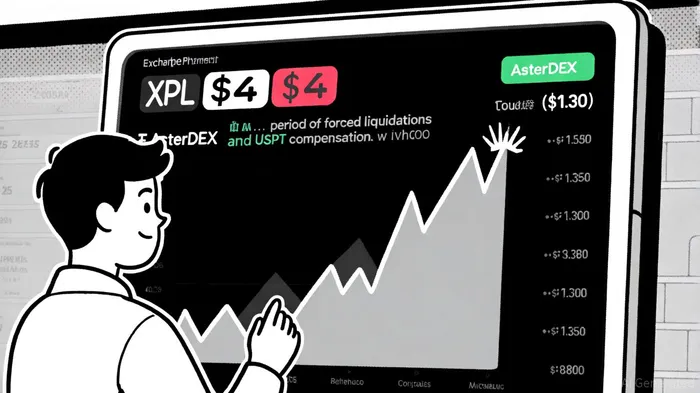
The recent 14% decline in ASTER's price following a technical error on the Aster decentralized exchange (DEX) underscores the fragility of risk management and governance in DeFi protocols. On September 25, 2025, a misconfigured index price for the XPLXPL-- perpetual trading pair caused a 200% artificial surge in its value on AsterDEX, while other platforms listed it at $1.30[1]. This discrepancy triggered widespread forced liquidations, particularly for short-position traders, who faced erroneous funding rate calculations[2]. The incident, rooted in a hardcoded index price of $1 and a mark price cap left unadjusted during the transition from pre-launch testing to live trading, exposed critical vulnerabilities in Aster's risk protocols[3].
Risk Management Failures and Compensation
Aster's response—pausing trading, reimbursing users in USDTUSDT--, and waiving liquidation fees—highlighted both its operational agility and systemic shortcomings. According to a report by The Block, the platform distributed over $16.6 million in USDT compensation within three hours, covering notNOT-- only losses but also trading fees[4]. While this swift action mitigated reputational damage, it also revealed a lack of real-time oracleADA-- synchronization, a cornerstone of robust DeFi risk management. The glitch occurred because Aster's index price was not dynamically linked to live market data, allowing a manual configuration from testing to persist[5].
This failure contrasts with best practices in the industry, such as multi-oracle models and circuit breakers. Aster now employs PythPYTH--, ChainlinkLINK--, and Binance Oracle to cross-verify prices, alongside a 1% price discrepancy threshold for halting trades[6]. However, these measures were absent during the XPL incident, leading to a 60% surge in XPL's value on AsterDEX in 24 hours while ASTER's price fell from $2.03 to $1.74[7].
Governance Reforms and Investor Implications
Post-incident, Aster has prioritized governance upgrades to restore user trust. ASTER token holders now wield voting rights on protocol upgrades and fee structures, a shift emphasized in an April 2025 AMA recap[8]. This decentralization of decision-making aligns with broader DeFi trends but raises questions about the speed of implementation. For instance, the platform's 300% ROI cap for 1001x leverage positions—a policy introduced after the XPL glitch—demonstrates a reactive rather than proactive approach to risk mitigation[9].
Investors must weigh these reforms against the broader context of DeFi's evolving landscape. While Aster's multi-sig wallets, regular audits, and planned Layer 1 blockchain aim to enhance security[10], the XPL incident serves as a cautionary tale. A decentralized protocol's governance structure must not only respond to crises but also anticipate them through rigorous testing and community oversight.
Conclusion
The ASTER price drop and XPL anomaly illustrate a broader challenge in DeFi: balancing innovation with institutional-grade risk management. While Aster's post-incident compensation and governance upgrades are commendable, they highlight the need for continuous adaptation. For investors, the key takeaway is that DeFi protocols must embed resilience into their core design, not as an afterthought. As Aster's case shows, even well-intentioned platforms can falter when technical debt and governance inertia collide.






Comentarios
Aún no hay comentarios