
AST SpaceMobile's $800M Equity Raise: A Strategic Inflection Point for Space-Based Broadband?
The space-to-cellular race is heating up, and AST SpaceMobileASTS-- (NASDAQ:ASTS) has just thrown another $800 million into the ring. But is this the bold move it needs to outmaneuver SpaceX's Starlink and Amazon's Project Kuiper-or a desperate gamble that could dilute shareholder value? Let's break it down.
The Equity Raise: Fuel for the Fire
AST SpaceMobile's latest at-the-market (ATM) offering-structured with underwriters like B. Riley and Barclays-grants the company flexibility to sell up to $800 million in Class A shares over three years. This follows a $500 million convertible bond raise and a $489 million ATM in 2025, swelling its cash reserves to over $1.5 billion, according to the company's Q2 2025 report. The funds are earmarked for deploying 45–60 satellites to enable U.S. coverage and developing Block 2 satellites, which promise higher data rates, as highlighted in a Spacenews report.
On the surface, this liquidity is a lifeline. The company's capital expenditures surged 600% in H1 2025 to $430.6 million, driven by satellite manufacturing and spectrum acquisitions like EllioSat's global S-band rights, per an Anand Capital thesis. Yet the stock plummeted 7% post-announcement, signaling investor unease over dilution. Class A shares outstanding ballooned from 208 million to 269 million in seven months, and long-term debt tripled to $482.5 million (company filings).
Competitive Positioning: Niche vs. Scale
AST's direct-to-cellular (D2C) technology-partnered with AT&T, Vodafone, and Bell Canada-offers a unique value proposition: connecting standard mobile devices to satellites without specialized hardware, as detailed in a 2025 satellite update. This could dominate niche markets like rural connectivity and emergency services. However, it lags behind Starlink's 349 D2C satellites and Amazon's 102, with only five Block 1 satellites in orbit, according to a TS2 analysis.
Starlink's head start is staggering. Elon Musk's team plans to launch 15,000 satellites for mobile services, leveraging phased-array antennas for low latency, as covered in an Ars Technica piece. Amazon's Kuiper, while resource-rich, remains years behind in deployment. AST's partnerships with 50+ mobile operators are a strategic edge, but execution risks loom large. As one analyst noted in MarketBeat financials, "AST's technology is a game-changer, but it's a race against time to scale."
Financial Health: A Double-Edged Sword
The equity raises have propped up AST's balance sheet, but at a cost. Its net loss widened to $145.1 million in H1 2025, with a net margin of -8,598.1%, per the MarketBeat forecast. While the debt-to-equity ratio of 0.58 is prudent, the average price target of $51.98 reflects skepticism about profitability, according to a Benzinga analysis. UBS downgraded ASTSASTS-- to Neutral, citing "mounting dilution risks," while Zacks upgraded it to Hold, acknowledging its technical progress, as noted in an Archyde article.
The CTO's recent sale of 16,000 shares ($768,640) has also raised eyebrows. Though insider sales often reflect personal needs, they can signal doubt. AST's path to revenue remains murky: it's pre-revenue for core services and relies on partnerships for monetization, per a Simply Wall St note.
Regulatory and Partnership Momentum
Recent wins, like FCC approval for launches and Bell Canada's 2026 commercial rollout, are bullish, according to a Business Wire update. AST's acquisition of EllioSat's spectrum rights and 45 MHz of U.S./Canadian mid-band access further solidify its infrastructure, as described in Investing.com coverage. These moves, combined with 50+ operator commitments, suggest the company is de-risking its commercialization timeline.
Is This a Buy or a Cautionary Tale?
AST's $800M raise is a strategic inflection point-but with caveats. The capital is critical for scaling its satellite constellation and partnerships, yet the stock's 7% drop underscores investor wariness. For the bullish case to hold, AST must:
1. Accelerate Block 2 deployments to match Starlink's scale.
2. Prove commercial viability with Bell Canada and AT&T.
3. Control dilution while maintaining liquidity.
If AST can execute, its D2C technology and telecom partnerships could carve out a profitable niche. But if Starlink's scale or Amazon's resources dominate, AST's premium valuation (19.8B market cap) may struggle to justify itself.
For now, the market is split. Analysts average a $51.98 price target, but with a wide range from $30 to $62. This volatility reflects the sector's high stakes. Investors with a high-risk tolerance and a 3–5 year horizon might find ASTS compelling-but only if they're prepared for turbulence.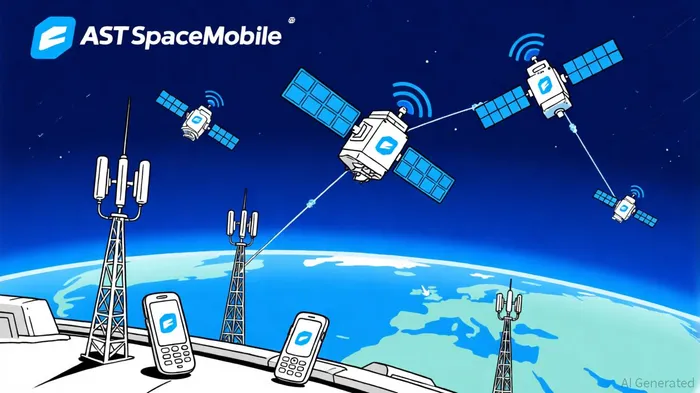





Comentarios
Aún no hay comentarios