
Asset Allocation in 2025: Gold, Bitcoin, or Equities? A Risk-Adjusted Return Analysis
The 2025 Investment Landscape: A Macro-Driven Dilemma
As October 2025 unfolds, global markets grapple with a fragmented macroeconomic backdrop. Inflation has eased to 5.43% globally, but regional disparities persist, with the Americas and Asia-Pacific edging higher while Europe and the Middle East see declines, according to the Global Macroeconomic Outlook Report, Q3 2025. Central banks, including the ECB and BoE, have slashed rates to offset tightening monetary conditions, yet the U.S. Federal Reserve remains cautious, projecting a federal funds rate of 3.6% by year-end, according to the FOMC Summary of Economic Projections. Meanwhile, GDP growth is uneven: China's 4.3% expansion contrasts sharply with the U.S.'s revised 1.6% forecast, dampened by tariffs and policy uncertainty, according to the Euromonitor forecast. This divergence creates a complex environment for asset allocators, particularly when evaluating Gold, BitcoinBTC--, and Equities through the lens of risk-adjusted returns.
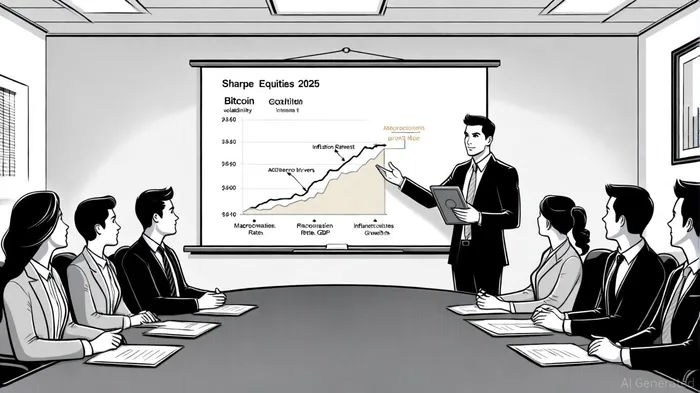
Gold: The Timeless Safe Haven
Gold's role as a hedge against inflation and geopolitical risk has solidified its appeal in 2025. With central bank demand surging and prices breaching $3,500 per ounce, its Sharpe ratio stands at 0.50, reflecting its low volatility (15% annualized) and uncorrelated performance, as shown by PortfoliosLab. J.P. Morgan Research predicts gold could hit $4,000 by mid-2026, driven by U.S.-China trade tensions and a flight to safety amid rate cuts. However, gold's lack of yield makes it sensitive to real interest rates; as the Fed signals gradual rate reductions, gold's Sharpe ratio may improve further, though its returns remain capped compared to riskier assets, according to FocusEconomics.
Bitcoin: The Evolving Risk Asset
Bitcoin's narrative in 2025 is one of normalization and institutional adoption. Despite its historical volatility (60% annualized), Bitcoin's volatility has normalized to 1.8% daily, thanks to $54.75 billion in U.S. spot ETF inflows, per Bitget. Its Sharpe ratio of 0.96 now rivals gold's, though it lags behind equities in bearish markets, according to a DayTrading analysis. The Bitcoin-gold ratio-a metric tracking their price relationship-has emerged as a key predictor of stock market returns, as highlighted in a HarbourfrontQuant analysis. However, Bitcoin's growing correlation with equities, particularly the Nasdaq, exposes it to broader market risks, complicating its role as a diversifier, as CryptoNews reports.
Equities: Sectoral Divergence and Volatility
Equities in 2025 are a mixed bag. U.S. markets, buoyed by AI-driven earnings and Fed rate cuts, have hit record highs, with the S&P 500 and Nasdaq outperforming. However, their Sharpe ratios remain modest (0.34–0.49), reflecting high volatility and sensitivity to interest rates, per the Luminth visualizer. Sectors like AI and energy lead, while healthcare and utilities lag. In contrast, emerging markets-led by India and Vietnam-offer higher growth potential but face trade policy headwinds. The key challenge for equities lies in balancing growth opportunities with macroeconomic fragility, particularly as tariffs and geopolitical risks persist, according to Schroders' Q3 2025 review.
Strategic Allocation: Balancing Risk and Return
The optimal 2025 portfolio hinges on macroeconomic positioning. For conservative investors, gold's stable Sharpe ratio and safe-haven status make it a cornerstone, particularly as inflation remains above 2.5%, according to the CBO outlook. Aggressive allocators may tilt toward Bitcoin, leveraging its improving risk-adjusted returns and institutional tailwinds, though a 4:1 gold-to-Bitcoin ratio is prudent to mitigate volatility, per a BlockNews analysis. Equities, while volatile, offer growth potential in AI and energy sectors, but sector rotation and geographic diversification are critical.
Conclusion: Navigating the 2025 Macro Maze
The 2025 asset allocation puzzle demands a nuanced approach. Gold and Bitcoin, with their diverging yet complementary risk profiles, provide a hedge against inflation and uncertainty, while equities offer growth in a selectively bullish environment. As central banks navigate rate cuts and trade tensions, investors must prioritize flexibility, leveraging macroeconomic signals to rebalance portfolios dynamically. In this fragmented landscape, the winners will be those who align their allocations with both risk tolerance and macroeconomic reality.







Comentarios
Aún no hay comentarios