
Assessing Zcash's (ZEC) Resilience Amid Governance Chaos and Price Volatility
The cryptocurrency market in late 2025 and early 2026 has been defined by a stark bifurcation: while BitcoinBTC-- faces regulatory headwinds and declining value, privacy-focused assets like ZcashZEC-- (ZEC) and MoneroXMR-- (XMR) have surged, driven by growing demand for financial privacy. However, Zcash's trajectory has been particularly volatile, marked by a governance crisis in early 2026 that saw the entire Electric Coin Company (ECC) development team resign en masse due to disputes with the Bootstrap board. This event triggered a nearly 10% price drop, raising critical questions about Zcash's long-term resilience. For investors, the challenge lies in balancing Zcash's technological innovation and institutional adoption against its governance instability and regulatory risks.
Governance Chaos and Developer Exodus
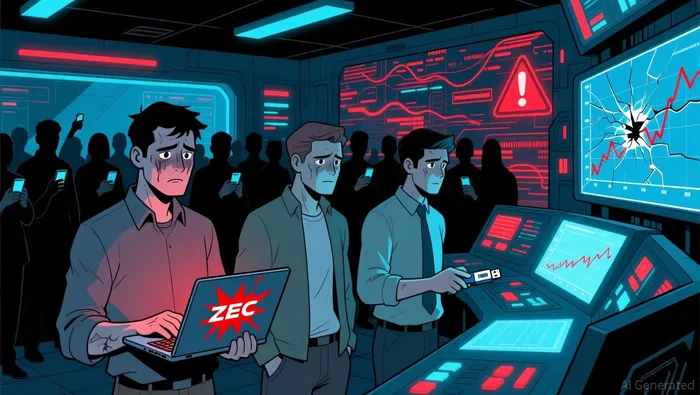
Zcash's governance model has long been a double-edged sword. While the project's transition to a coinholder funding model-where grants are allocated based on opt-in support from ZECZEC-- holders- aims to decentralize decision-making, it has also exposed structural vulnerabilities. The 2026 ECC resignation, described by CEO Josh Swihart as a "constructive discharge" due to board-imposed employment changes, underscores the fragility of centralized development teams in a decentralized ecosystem. This exodus not only disrupted ongoing protocol upgrades but also eroded investor confidence, as reflected in ZEC's sharp price correction.
 In contrast, Monero's community-driven governance, which enforces privacy by default and avoids centralized entities, has proven more resilient to internal disputes. DashDASH--, meanwhile, relies on a masternode-based governance system that allows decentralized voting on proposals, though it has shifted focus away from privacy in recent years. Zcash's hybrid model-combining corporate development with community funding-appears to lack the robustness of these alternatives, creating a governance risk that investors must weigh against its technological strengths.
Technological Innovation and Institutional Adoption
Despite governance turbulence, Zcash has made significant strides in protocol development. The Tachyon upgrade, introduced in late 2025, leverages stateless zero-knowledge proofs to enhance scalability, reducing sync times and improving network efficiency. These advancements align with growing institutional interest in Zcash, exemplified by the launch of the Grayscale Zcash Trust (ZCSH) and speculation about a potential ZEC ETF. By offering selective privacy through zk-SNARKs, Zcash caters to both privacy advocates and compliance-driven institutions, a duality that has fueled its 700% price surge in late 2025.
However, Zcash's reliance on user adoption of shielded transactions remains a hurdle. While the shielded pool expanded significantly in 2025, many users still default to transparent transactions, limiting the network's privacy utility. This contrasts with Monero's default privacy model, which ensures all transactions are untraceable. For Zcash to maintain its institutional appeal, it must incentivize broader adoption of shielded transactions without compromising usability-a challenge that could be exacerbated by governance instability.
Market Resilience and Regulatory Risks
Privacy coins have demonstrated remarkable market resilience in 2025, with Zcash outperforming broader trends despite its governance crisis. Analysts attribute this to a growing perception of privacy as a hedge against financial surveillance. Yet, regulatory pressures loom large. The EU's Markets in Crypto-Assets (MiCA) framework, for instance, has intensified scrutiny on asset traceability, potentially limiting Zcash's long-term viability. While Zcash's selective privacy model offers compliance-friendly options, its shielded transactions remain incompatible with traditional audit requirements, creating a regulatory gray area.
Monero, with its unwavering commitment to default privacy, faces even harsher regulatory headwinds, including delistings from major exchanges. Dash, by prioritizing usability over privacy, has avoided some of these pressures but risks losing relevance in a privacy-centric market. Zcash's position as a middle ground-balancing privacy with compliance-could prove advantageous, but only if it navigates governance and regulatory challenges effectively.
Strategic Risk-Rebalance for Investors
For long-term investors, Zcash's volatility and governance risks necessitate a strategic rebalance. While its technological advancements and institutional adoption signal strong fundamentals, the 2026 governance crisis highlights the need for caution. Diversification across privacy coins-such as pairing Zcash with Monero's default privacy model or Dash's governance stability-could mitigate risks while capitalizing on the sector's growth potential.
Moreover, investors should monitor Zcash's ability to stabilize its governance structure and incentivize shielded transaction adoption. A successful resolution of the ECC-Bootstrap dispute, coupled with continued protocol upgrades like Tachyon, could restore investor confidence. Conversely, prolonged instability or regulatory crackdowns may force Zcash to cede ground to competitors.
Conclusion
Zcash's journey in 2025-2026 exemplifies the dual-edged nature of privacy-focused crypto assets: innovation and adoption come with governance and regulatory risks. While its selective privacy model and institutional traction position it as a key player in the privacy sector, the 2026 governance crisis serves as a cautionary tale. For investors, the path forward lies in balancing Zcash's technological promise with strategic diversification and close monitoring of governance and regulatory developments. In a world increasingly defined by financial surveillance, privacy coins like Zcash may yet prove their resilience-but only if they can adapt to the evolving challenges of governance and compliance.






Comentarios
Aún no hay comentarios