
Assessing WTI's Resilience Amid U.S.-Venezuela Tensions and Oversupply Risks
The interplay between geopolitical volatility and fundamental supply dynamics has long defined oil market trajectories, but 2025–2026 has seen this tension sharpen into a critical inflection point for West Texas Intermediate (WTI) crude. U.S.-led sanctions and military actions against Venezuela, coupled with a global oversupply exacerbated by OPEC+ and U.S. shale output, have created a complex landscape for investors. This analysis dissects how these forces interact to shape WTI's price resilience, offering insights into the risks and opportunities for energy market participants.
Geopolitical Uncertainty: Venezuela's Role as a Double-Edged Sword
The U.S. escalation of sanctions and military intervention in Venezuela has directly curtailed the country's oil production and exports. By December 2025, Venezuela's crude output had plummeted to 963,000 barrels per day (bpd), down from 1.1 million bpd in November, while exports fell to 17.6 million barrels in December from 27.2 million in November as reported by SP Global. These declines stem from storage constraints, the shutdown of key joint ventures like Petrolera Sinovensa, and U.S. sanctions on tankers.
While this reduction initially buoyed WTI prices-pushing them to $57.50 per barrel in early 2026-market participants remain skeptical about Venezuela's long-term impact. Analysts note that even a full recovery of Venezuelan production would represent less than 1% of global supply, limiting its ability to disrupt markets. However, the potential for a gradual rebound, with output potentially rising to 2 million bpd within 18–24 months, introduces a bearish overhang as investors anticipate future oversupply pressures according to geopolitical analysts.
Fundamental Supply Dynamics: OPEC+ and U.S. Shale in a Tug-of-War
OPEC+ has adopted a cautious stance in 2025–2026, prioritizing price stability over aggressive market share gains. The coalition paused output hikes in early 2026, maintaining a 3.24 million bpd reduction from pre-2024 levels, and plans to reassess quotas for 2027. This strategy reflects a shift from growth to revenue optimization, as global oversupply continues to weigh on prices.
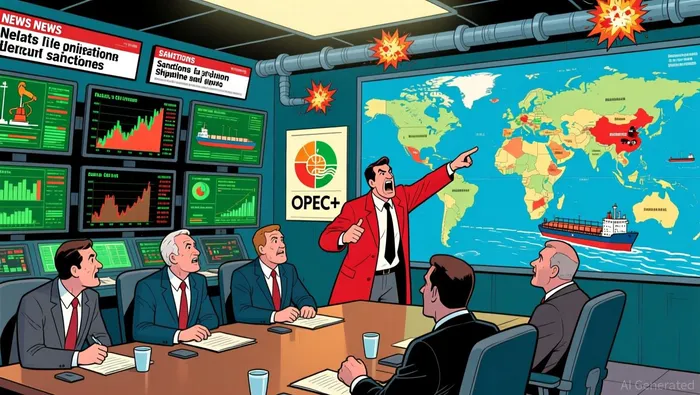
Meanwhile, U.S. shale production remains a wildcard. Despite high breakeven costs, the sector has demonstrated resilience, with production likely to stay near $60-per-barrel WTI levels according to energy analysts. However, the IEA projects a 2026 surplus of 3.84 million bpd, driven by non-OPEC supply growth and slowing demand. This surplus, combined with OPEC+'s strategic restraint, suggests a structural bearish bias for WTI unless geopolitical risks materialize to counterbalance fundamentals.
The Interplay: Geopolitical Risks vs. Oversupply Realities
The U.S.-Venezuela conflict exemplifies how geopolitical risks can temporarily offset oversupply concerns. Following Maduro's overthrow, WTI prices surged on fears of transitional chaos and potential sabotage of oil infrastructure. Yet, this upward momentum is fragile. Analysts caution that a return to normalcy in Venezuela-coupled with OPEC+'s gradual restoration of output and U.S. shale's cost discipline-could push WTI into a $50–55 range by late 2026 or early 2027.
Other geopolitical hotspots, such as Russia's energy sector instability and Middle East tensions, provide a partial counterweight to these bearish fundamentals according to financial analysts. These risks create a floor for prices, preventing a freefall even as oversupply pressures persist. However, the market's ability to price in these uncertainties remains uneven, leading to volatile, sideways price action.
Investment Implications: Navigating the Crosscurrents
For investors, the key lies in hedging against both geopolitical shocks and structural oversupply. Energy equities with exposure to U.S. shale may benefit from short-term price spikes but face long-term headwinds from a global surplus. Conversely, OPEC+ producers could see improved margins if geopolitical tensions delay the normalization of Venezuelan output.
WTI futures traders should monitor two critical thresholds: (1) the pace of Venezuela's production recovery, which could reintroduce bearish supply into the market, and (2) OPEC+'s willingness to adjust quotas in response to U.S. shale's resurgence. Meanwhile, macroeconomic factors-such as China and India's demand growth-will remain pivotal in determining whether the market transitions from oversupply to balance.
Conclusion
WTI's resilience in 2025–2026 hinges on a delicate equilibrium between geopolitical-driven uncertainty and fundamental supply dynamics. While U.S.-Venezuela tensions have provided a temporary boost to prices, the specter of global oversupply and OPEC+'s strategic recalibration suggest a cautious outlook. Investors must remain agile, balancing exposure to short-term volatility with long-term structural trends. As the energy landscape evolves, the ability to discern between transient geopolitical noise and enduring supply-demand imbalances will define successful investment strategies.







Comentarios
Aún no hay comentarios