
Assessing WTI's $55 Support Level Amid U.S.-Venezuela Tensions and Deloitte's 2026 Forecast
The interplay between geopolitical risk and supply-demand fundamentals has long defined crude oil market dynamics. As 2026 unfolds, West Texas Intermediate (WTI) faces a critical juncture at its $55 support level, with U.S.-Venezuela tensions and Deloitte's latest forecast offering contrasting narratives. This analysis dissects the forces at play, evaluating whether geopolitical volatility can offset the bearish pressures of a global oversupply.
Deloitte's 2026 Forecast: A Bearish Baseline
According to a report by Deloitte, the U.S. benchmark WTI is projected to average $58 per barrel in 2026, a decline from the 2025 average of $65.58. This forecast hinges on two core fundamentals: rising global production and subdued demand growth. The International Energy Agency (IEA) anticipates a 2026 surplus of 3.85 million barrels per day, driven by OPEC+ production discipline and record U.S. shale output. These structural factors suggest that WTI's $55 support level is under inherent pressure, even absent geopolitical shocks.
U.S.-Venezuela Tensions: A Temporary Buffer
Geopolitical risks, however, introduce a counterweight. U.S. sanctions against Venezuela's state-owned PDVSA have already forced the shutdown of wells producing extra-heavy crude, limiting supply in the short term. While Venezuela's current output of 800,000–900,000 barrels per day represents less than 1% of global demand, the symbolic significance of these sanctions-coupled with broader U.S. military interventions-has stoked market anxiety. As stated by analysts at EBC, such tensions have "priced in more supply" by raising concerns about long-term infrastructure investment in the region.
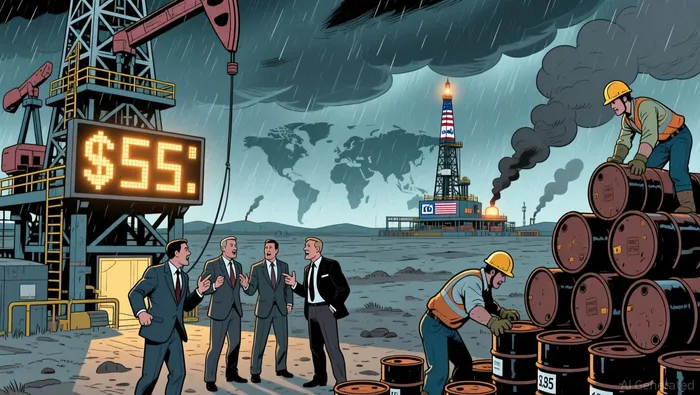
Yet, the immediate impact on WTI's $55 support level remains muted. A report by The Globe and Mail notes that Venezuela's limited scale means its disruptions are unlikely to offset the IEA's projected surplus. The market has largely discounted short-term volatility, instead focusing on the trajectory of U.S. shale and OPEC+ output.
The Long Game: Oversupply vs. Geopolitical Uncertainty
The critical question lies in the long term. If Venezuela's oil sector recovers to 2–3 million barrels per day-a scenario requiring political stability and significant capital investment-it could exacerbate the 2026 surplus. However, such a recovery hinges on factors beyond market control, including U.S. policy shifts and global investor confidence.
Conversely, Deloitte's forecast assumes a continuation of current trends, with U.S. production growth and OPEC+ compliance as dominant forces. This suggests that while geopolitical risks may temporarily buoy WTI above $55, the fundamental case for a breakdown remains intact.
Conclusion: A Fragile Support Level
For investors, the $55 support level represents a precarious battleground. Geopolitical risks-while headline-grabbing-lack the scale to counteract the structural bearishness of a 3.85 million barrel-per-day surplus. Deloitte's $58 forecast serves as a midpoint, but the path to it is likely to involve sharp volatility. Those betting on WTI's resilience should monitor Venezuela's political trajectory and U.S. sanctions policy, while acknowledging that supply-demand fundamentals will ultimately dictate the price floor.







Comentarios
Aún no hay comentarios