
Assessing the Viability of a Pi Network (PI) Bull Case Amid Technical Optimism and Fundamental Concerns
Technical Validation: A Breakout with Institutional Implications
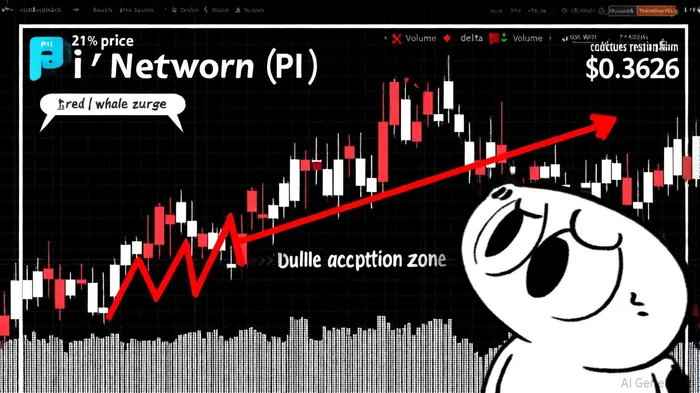
Pi's recent price action has been nothing short of explosive. After languishing in a $0.20–$0.23 range for months, the token's breakout above $0.27 coincided with a dramatic increase in average order sizes, a telltale sign of institutional or high-net-worth investor involvement noted in the Coinotag analysis. On-chain metrics further validate this bullish narrative: cumulative volume delta (CVD) has turned positive over 90 days, indicating sustained buyer dominance in derivatives markets without reliance on short liquidations, as the same Coinotag piece observed. Futures data also shows a surge in taker buy volume, reinforcing the thesis that Pi is transitioning from speculative hype to a more structured accumulation phase.
The $0.27 level is critical. If Pi sustains above this threshold, the next target is $0.3626, a historical supply zone aligned with prior resistance levels. This trajectory would require continued whale participation and a broader market narrative shift, but the current momentum suggests such a scenario is plausible.
Fundamental Developments: Utility and Integration, But Gaps Remain
While technicals paint a bullish picture, Pi's fundamentals are a mixed bag. The introduction of PiBridge, a DeFi platform enabling P2P lending and yield generation, marks a pivotal step in transitioning Pi from a mobile-mined token to a functional blockchain economy; PiBridge was detailed in a PiBridge announcement. This utility expansion is critical for long-term adoption, as it allows users to leverage their Pi holdings for real-world financial services.
Equally significant is Pi's SWIFT integration via OKX, which enables low-cost cross-border banking and positions Pi as a potential disruptor in international payments, as reported by Coinfomania. These developments align with the project's vision of global accessibility and have already triggered a 10.7% price surge in 24 hours, according to that Coinfomania report. However, these milestones remain in the pre-mainnet phase, with the Open Mainnet still under review by the Pi Core Team. Over 3.36 million users have completed KYC and migrated to the Mainnet, but full decentralization and scalability remain unproven, as noted in the earlier PiBridge announcement.
Fundamental Risks: Scalability, Sustainability, and Regulatory Hurdles
Despite these strides, Pi faces unresolved challenges. Critics argue that the project must evolve from a mobile mining experiment into a unified blockchain ecosystem capable of supporting real-world applications, according to a Coinpedia article. While PiBridge introduces DeFi utility, the token's price remains highly volatile, having dropped 93% from its February 2025 all-time high. Broader adoption in AI, real-world assets (RWA), and cross-chain interoperability could mitigate this, but such outcomes are conditional on sustained ecosystem activity and partnerships, as the Coinpedia article also discusses.
Regulatory risks also loom. Although no legal disputes have been reported in 2025, a Coinfomania update notes that Pi's SWIFT integration and KYC processes must align with evolving global standards. The network's AI-powered KYC system, which processed 4.76 million tentative cases, is a step toward compliance, but the ISO 20022 financial messaging standard implementation by November 22, 2025, will be a critical test of its readiness for institutional adoption, as the Coinfomania update explains.
Balancing the Bull Case: A High-Stakes Transition
Pi Network's bull case hinges on its ability to convert technical momentum into sustainable utility. The recent price surge and on-chain activity suggest strong short-term demand, but long-term success depends on overcoming scalability bottlenecks and regulatory scrutiny. If the Open Mainnet launch in 2025 is successful and Pi continues to expand its DeFi and cross-border payment integrations, the token could see exponential growth-some analysts predict $20–$30 by 2030, according to a 99Bitcoins projection. However, these projections assume widespread adoption and a competitive edge over established blockchains like SolanaSOL-- and EthereumETH--.
For investors, the key takeaway is clear: Pi's technicals are compelling, but its fundamentals remain a work in progress. The coming months will determine whether Pi can evolve from a grassroots experiment into a legitimate player in the global crypto ecosystem.






Comentarios
Aún no hay comentarios