
Assessing the Viability of AI Infrastructure Spending Amid Rising Costs, Competition, and Energy Constraints
The AI data center boom is reshaping the global economy, but investors must weigh staggering growth potential against mounting risks. With the market projected to balloon from $236.44 billion in 2025 to $933.76 billion by 2030-a 31.6% CAGR-this sector is no longer a speculative bet but a foundational pillar of modern tech according to Markets and Markets. Yet, as capital floods in, the question remains: Can the rewards justify the rising costs, competition, and energy demands?
The Allure of AI Infrastructure: Explosive Growth and Strategic Dominance
The numbers are staggering. Hyperscalers like GoogleGOOGL--, AmazonAMZN--, and MetaMETA-- are pouring billions into AI-ready infrastructure, with Google raising its 2025 capex to $91–93 billion. Microsoft's 74% spending increase to $34.9 billion and Amazon's $125 billion capex plan underscore a race to secure dominance in AI-driven cloud computing. These investments are not just about staying competitive-they're about capturing a market where AI's economic value could exceed $7 trillion by 2035.
For investors, the rewards are clear. AI infrastructure is already contributing 1.1–1.2% to U.S. GDP growth in 2025, and companies leveraging AI are outperforming peers. BCG reports that "future-built" AI leaders generate 1.7x higher revenue growth and 3.6x better total shareholder returns than laggards. Meanwhile, sustainability-driven cost savings-such as energy-efficient cooling systems and renewable energy integration-are creating long-term value.
The Risks: Energy Appetite, Grid Strain, and a Crowded Field
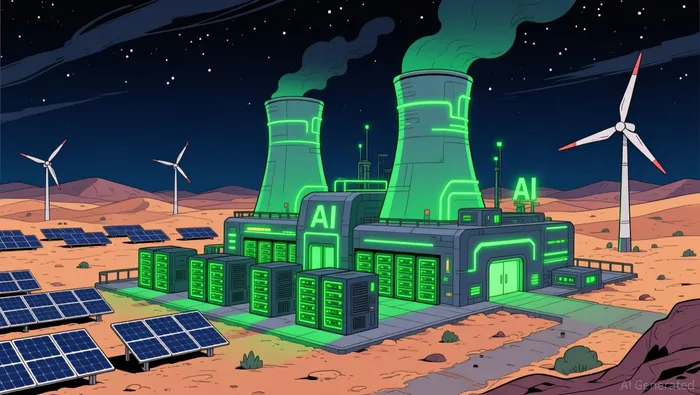 But the path to profit is fraught with challenges. AI data centers are voracious energy consumers, projected to use 945 terawatt-hours globally in 2025-double 2024 levels and equivalent to Japan's annual electricity demand. In the U.S., data centers already account for 4.4% of electricity use, a figure expected to hit 12% by 2028. Training a single large language model like ChatGPT requires hundreds of megawatt-hours, with inference operations consuming 90% of a model's lifecycle energy.
Sustainability efforts are critical but costly. While workload optimization and advanced cooling can reduce energy use by up to 40%, grid interconnection delays (4–8 years in many regions) and supply chain bottlenecks are slowing deployment. Meanwhile, the reliance on debt financing to fund infrastructure has raised red flags. Over $61 billion flowed into data centers in 2025, but investors are wary of overvaluation and a potential bubble.
Competition is another headwind. With 80% of U.S. private domestic demand growth tied to AI infrastructure in 2025, the market is becoming a battleground for scale. Smaller players like Digital Realty Trust and Iron Mountain are expanding, but they face stiff competition from hyperscalers with deeper pockets and vertical integration.
Balancing the Equation: Strategic Entry Points and Long-Term Vision
For investors, the key lies in balancing short-term risks with long-term rewards. While ROI on AI projects often takes 2–4 years to materialize, the sector's trajectory is undeniable. Companies that master energy efficiency-such as those adopting hybrid renewable power architectures-will gain a competitive edge. Similarly, firms with strong partnerships in grid resilience and supply chain innovation (e.g., through the Global AI Infrastructure Investment Partnership) are better positioned to navigate bottlenecks.
However, caution is warranted. Deloitte warns of seven critical gaps in AI infrastructure, including grid capacity and permitting delays, while McKinsey estimates $5.2 trillion will be needed globally by 2030 to meet compute demand. Investors must avoid overexposure to speculative plays and instead focus on companies with proven execution, transparent ROI metrics, and sustainability strategies.
Conclusion: A High-Stakes Gamble with High Rewards
The AI data center boom is a defining investment opportunity of the decade. For those who can stomach the energy costs, regulatory hurdles, and competitive pressures, the rewards are monumental. But success requires a disciplined approach: prioritizing companies with robust energy strategies, strategic partnerships, and a clear path to profitability. As the sector evolves, the winners will be those who build not just for today's AI demands, but for the energy-efficient, sustainable infrastructure of tomorrow.





Comentarios
Aún no hay comentarios