
Assessing Venezuela's Oil Re-entry: A Historical Lens on Risk and Reward
The core investment risk in Venezuela is not just political instability; it is a documented pattern of asset seizure that has scarred the industry. For U.S. oil companies, the memory of expropriation is deep and personal. In the 1970s, the Venezuelan government nationalized energy assets, including those owned by Exxon MobilXOM-- and ConocoPhillipsCOP--. The seizure was repeated in 2006 and 2007, with the companies left to pursue billions in compensation through international tribunals with little success. This history creates a wariness that no current political transition can easily erase.
The current situation-a radical break with Maduro in U.S. custody-is a clean slate in terms of leadership, but the legal and financial framework for foreign investment remains undefined. The U.S. government has offered a critical, untested incentive: President Trump has stated that oil companies will be reimbursed for the "very substantial amount of money" spent to repair and upgrade the nation's aging infrastructure. Whether this promise will be honored, and on what terms, is the central question for any potential investor. The promise is a direct attempt to overcome the historical precedent of uncompensated expropriation.
This setup echoes a recurring pattern in oil-rich nations. Initial enthusiasm for access to vast reserves is often tempered by the political risk of state intervention. The U.S. government's push to rebuild Venezuela's oil sector is a high-stakes bet that a new political order and a new financial promise can break this cycle. For companies like ExxonXOM--, which has been expropriated twice, the risk of a third such event looms large. The promise of reimbursement is meant to be the new anchor, but its credibility will be tested against a long shadow of past seizures.
The Scale of the Opportunity: From 750 kb/d to 1.3 mb/d
The potential upside is staggering, measured against a baseline of near-collapse. Venezuela holds an estimated 303 billion barrels of proven oil reserves, the largest on Earth. Yet its current output is a shadow of that potential, averaging roughly 750 thousand barrels per day. This is a production level that would rank it well outside the top 20 global producers, a far cry from its peak in the 1970s when it pumped over 3.5 million barrels daily.
J.P. Morgan's projection frames the scale of the recovery needed. The bank's research suggests that within two years of a political transition, Venezuela's oil production could realistically ramp up to 1.3 to 1.4 million barrels per day. That represents an immediate, dramatic increase of 80% to 90% from today's levels. For context, that new output would be comparable to the combined production of Norway and the United Arab Emirates. The bank notes this could be a major upside risk to the global oil supply outlook for 2026 and beyond.
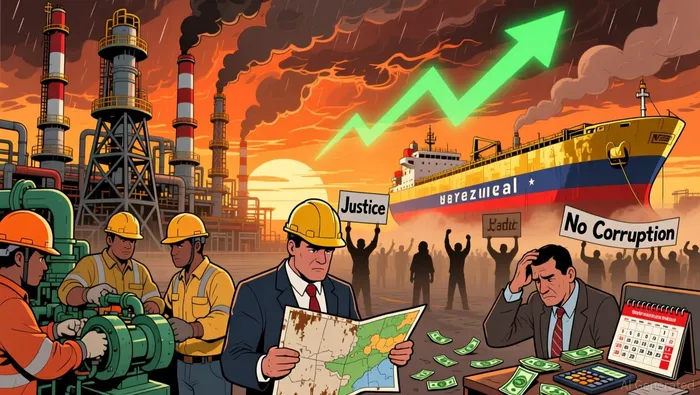
The first concrete step has already begun. In December, Chevron imported 120,000 b/d from Venezuela, marking the initial, conditional move as the U.S. starts lifting sanctions. This is the opening act, a small but symbolic volume that signals a return to the market. The broader plan, however, hinges on a much larger investment and institutional overhaul. As J.P. Morgan's head of commodities strategy points out, with new investments and major institutional reforms, output could potentially expand to 2.5 mbd over the next decade. The path from 750 kb/d to 1.3 mb/d is the critical first leap, testing whether the promise of U.S. reimbursement and a new political order can translate into the physical rebuilding of a shattered industry.
The Path to Production: Infrastructure, Sanctions, and Partners
Unlocking Venezuela's oil potential is a multi-stage process, beginning with the mechanics of moving crude and establishing a new financial system. The first step is already underway: the U.S. Treasury has issued private waivers to global trading firms, allowing them to purchase Venezuelan crude. This is a conditional, targeted move, not a broad license. The initial shipments must be sold to U.S. buyers, a clear sign of Washington's continued oversight. The goal is to immediately move the 30 million to 50 million barrels of oil held in floating and onshore storage, creating a new sales and financing mechanism for the first time in years.
This operational step is paired with a financial one. Treasury Secretary Scott Bessent has outlined a plan to meet with the IMF and World Bank next week to discuss mobilizing $5 billion in frozen Venezuelan Special Drawing Rights. These are international reserve assets that could be converted to dollars to help rebuild the shattered economy. The Treasury's aim is to facilitate the repatriation of oil sale proceeds back to Venezuela, a move that could help stabilize the government and security services. This is a critical piece of the puzzle, as it addresses the liquidity crisis that has paralyzed the state-owned oil company, PdVSA, for years.
For a major producer like ChevronCVX--, the path is more specific. Energy Secretary Chris Wright reported that the company sees a pathway to grow its Venezuela production by 50% within the next 18 to 24 months. This ambitious target is contingent on two things: additional U.S. approvals and significant investment in the damaged infrastructure. The company's initial import of 120,000 b/d in December was a small, conditional step. Scaling up by 50% would require not just permission, but a major capital commitment to revive wells and processing facilities.
The sequence is clear: first, move the stored oil to restart cash flows; second, unlock international reserves to fund recovery; third, secure private investment to rebuild production. Each step is a test of the new political and financial framework. The U.S. promise of reimbursement for infrastructure spending is meant to incentivize that final, costly phase. For now, the process is moving forward in stages, with each conditional waiver and planned meeting a building block toward the goal of 1.3 million barrels per day.
Catalysts, Scenarios, and What to Watch
The investment thesis now hinges on a series of forward-looking events that will validate or undermine the promise of a rapid, profitable re-entry. The first test is operational and immediate. Watch for the initial private sanctions waivers being granted and the flow of Venezuelan crude to U.S. buyers. The recent waiver to a global trading firm, with its condition that any initial shipment must be sold to U.S. buyers, sets a precedent. The success of this conditional, targeted approach in moving the 30 million to 50 million barrels of oil held in floating and onshore storage will demonstrate whether the new sales framework can function. A smooth start would signal Washington's control is working; any bottlenecks or disputes over terms would be an early red flag.
The primary risk, however, is financial. The entire plan rests on the credibility of President Trump's promise that companies will be reimbursed for the "very substantial amount of money" spent to repair Venezuela's infrastructure. Whether this reimbursement is honored, and whether the amount is sufficient to cover the actual costs, is the key factor that will determine if the economics are attractive. Oil companies appear skeptical, and their caution is understandable given the history of uncompensated expropriation. If the U.S. government ultimately demands that future revenue alone repay the investment, the required returns may be too high to justify the risk, derailing the expansion plans even if political conditions improve.
A secondary but significant risk is geopolitical pushback. The U.S. actions have been condemned as illegal by the U.N. human rights office and viewed as "unilateral, illegal and bullying acts" by some U.S. rivals and Latin American nations. This international criticism could complicate operations, potentially leading to diplomatic pressure or efforts to isolate companies involved. It adds a layer of friction that was absent in the initial, conditional waivers.
Historically, production ramp-ups in post-disruption scenarios often face severe delays and cost overruns. The parallels are instructive. Rebuilding oil infrastructure in Iraq after 2003 and in Libya after Gaddafi's fall were both marred by security challenges, corruption, and the sheer complexity of reviving a broken system. These episodes show that political transitions do not automatically translate into efficient capital deployment. For Venezuela, the risk is that the promised 50% growth in production for a company like Chevron within 18-24 months will be a best-case scenario, not a guaranteed outcome. The path from 750 kb/d to 1.3 mb/d is a marathon, not a sprint, and the first shipments to U.S. buyers are just the starting gun.





Comentarios
Aún no hay comentarios