
Assessing U.S. Treasury Bill Resilience and Yield Alternatives in a Post-Downgrade Era
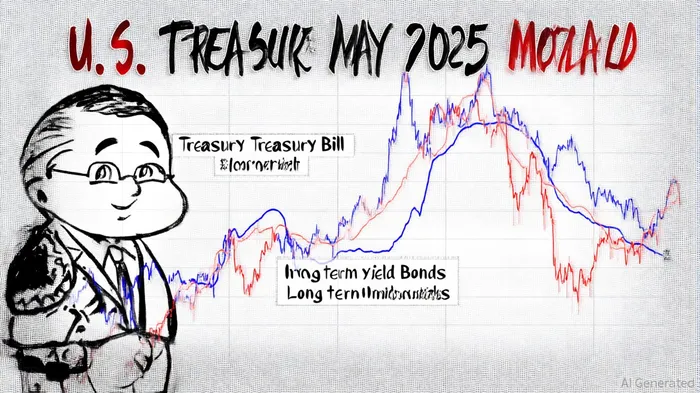
The U.S. Treasury Bill (TBIL) market has navigated a complex landscape in 2025, shaped by the Federal Reserve's rate-cutting cycle and the historic Moody'sMCO-- downgrade of U.S. sovereign debt. These developments have tested the resilience of TBILs as a cornerstone of global liquidity while forcing investors to reevaluate yield alternatives in a low-rate environment. This analysis examines the interplay between monetary policy, credit risk, and market dynamics to assess the outlook for TBILs and their substitutes.
Fed Rate Cuts and TBIL Yield Dynamics
The Federal Reserve's September 2025 rate cut—its first of the year—lowered the federal funds rate to a range of 4.00% to 4.25%, signaling a shift toward accommodative policy amid a softening labor market[1]. This move triggered immediate volatility in Treasury yields. The 10-year Treasury yield initially dipped below 4% but rebounded to 4.074% as markets digested the Fed's forward guidance of two additional cuts by year-end[2]. Short-term TBIL yields, however, remained anchored to the Fed's target range, reflecting their sensitivity to monetary policy and limited exposure to inflation expectations.
The Fed's decision, described by Chair Jerome Powell as a “risk management” measure, underscores the central bank's balancing act between supporting employment and managing inflation, which remains above 2% despite slowing wage growth[3]. While the rate cuts are expected to ease borrowing costs for mortgages and variable-rate loans, the broader impact on TBILs will depend on the pace of subsequent cuts and the trajectory of fiscal policy.
Moody's Downgrade and Fiscal Risks
The May 2025 downgrade of U.S. sovereign debt from Aaa to Aa1 by Moody's marked a pivotal moment for Treasury markets[4]. The agency cited escalating federal deficits, a $36 trillion national debt, and rising interest costs as key risks, projecting a debt-to-GDP ratio of 134% by 2035[5]. Despite the downgrade, the U.S. retained a stable outlook due to the dollar's reserve currency status and the Federal Reserve's independence. However, the downgrade reignited concerns about the sustainability of fiscal policies, particularly with House Republicans advancing tax and spending bills that could add trillions to the deficit[6].
The immediate market reaction was a surge in Treasury yields, with the 30-year rate peaking at 5.03% and the 10-year hitting 4.459%[7]. While yields later retreated, the downgrade intensified scrutiny over Treasurys' role as a safe-haven asset. Analysts warn that prolonged fiscal expansion and political gridlock could erode investor confidence, pushing yields higher and increasing borrowing costs for households and businesses[8].
TBIL Market Resilience: A Safe-Haven Asset
Despite the downgrade, U.S. Treasury Bills have demonstrated remarkable resilience. Short-term TBILs, with maturities of 30 days or less, have maintained stability due to their minimal duration risk and liquidity. For instance, the TBIL ETF (TBIL), which tracks 3-month Treasury Bills, reported a 3.04% year-to-date return as of September 2025, with total assets under management exceeding $5.9 billion[9]. This performance highlights the enduring appeal of TBILs during periods of economic uncertainty, as seen in April 2025 when the VIX index spiked to 50 amid tariff tensions[10].
The U.S. Treasury market's structural advantages—its unmatched depth, transparency, and role as a global collateral benchmark—have further insulated TBILs from the downgrade's fallout[11]. Institutional demand remains robust, supported by regulatory frameworks like Basel III, which prioritize Treasurys as high-quality liquid assets[12].
Yield Alternatives: Navigating a Low-Rate Environment
Investors seeking alternatives to TBILs have turned to high-quality municipal bonds, corporate bonds, and non-traditional yield strategies. Municipal bonds, for example, have shown lower default rates (0.9% for high-yield munis vs. 2.4% for corporates from 2020–2024) and tax-equivalent yields that outperform corporate bonds for high-tax-bracket investors[13]. The 30-year municipal bond yield of 4.25% in September 2025 lagged behind the 4.459% 10-year Treasury yield, reflecting their relative insulation from fiscal risks[14].
For higher-yield exposure, active bond funds like DoubleLineDLY-- Total Return Bond and American Funds Strategic Bond have diversified into mortgage-backed securities and corporate debt, offering resilience amid Treasury volatility[15]. Meanwhile, alternative yield strategies—such as reinsurance-linked securities (ILS) and transport leasing—have gained traction, with ILSILS-- currently yielding 6–8% annually[16]. These options appeal to investors seeking diversification beyond traditional fixed-income markets.
Outlook and Strategic Recommendations
The U.S. Treasury Bill market is likely to remain a critical pillar of global finance, even in a post-downgrade environment. However, investors should adopt a balanced approach, leveraging TBILs for liquidity while allocating to high-quality alternatives to enhance yield. Key considerations include:
1. Diversification: Blending TBILs with municipal and corporate bonds to mitigate interest rate and credit risks.
2. Active Management: Utilizing bond funds that adjust duration and sector exposure based on macroeconomic shifts.
3. Alternative Yield Strategies: Exploring ILS, private credit, and real assets to capitalize on higher returns in a low-rate world.





Comentarios
Aún no hay comentarios