
Assessing the U.S. Trade Deficit Plunge: Tariff Compression, Gold's Impact, and Structural Uncertainty
The sharp contraction in the U.S. trade deficit last month was not a sign of a fundamental rebalancing. It was a direct, policy-driven compression. The core driver is the sweeping tariff regime announced as "Liberation Day" in April 2025. A universal 10% baseline tariff on nearly all imports began on April 5, with country-specific rates following shortly after. This policy has already triggered a measurable economic cost, including manufacturing job layoffs at companies like Cleveland CliffsCLF-- and StellantisSTLA--.
The impact is visible in the latest numbers. U.S. imports fell 3.2 percent to $331.4 billion in October, a key factor in the deficit shrinking to $29.4 billion. Yet this monthly dip masks a more persistent reality. When measured year-to-date, the trade deficit remains up 7.7 percent from the previous year. This contrast is critical: the tariffs have compressed trade flows in the short term, but they have not reversed the structural deficit trend.
The mechanism is straightforward. Higher tariffs raise the price of imported goods, directly discouraging demand. This temporary suppression of imports is the primary reason for the October improvement. However, the economic costs of this policy are already being paid, and the long-term trajectory of the deficit remains uncertain as the policy faces legal challenges and market adjustments.
Gold's Role in the Trade Data: A Safe-Haven Surge
While tariffs compressed imports, a powerful counter-trend was inflating the trade deficit: the historic surge in gold prices. The metal has soared over 50% this year, breaking $4,000 per ounce for the first time in October. This isn't a typical commodity move. It's a safe-haven rally, directly fueled by the same tariff uncertainty that is compressing trade flows. As geopolitical risks and economic stress mount, investors are flocking to gold as a store of value, driving demand from both ETFs and central banks.
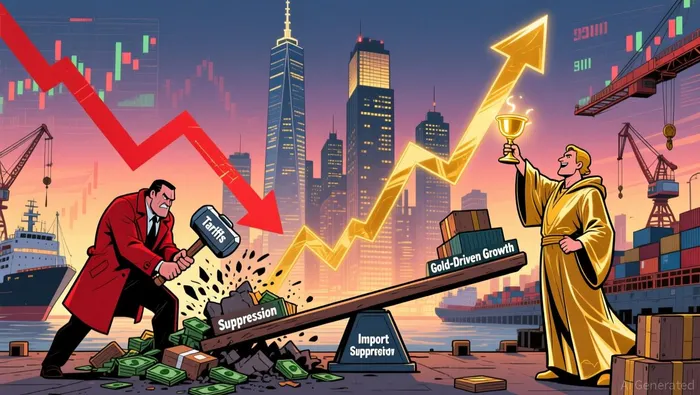
This surge has a direct and significant impact on the trade balance. Gold is a major component of the 'goods' trade deficit. When the U.S. imports more gold at record prices, it directly widens the deficit figure. In other words, the very policy meant to reduce the trade imbalance is also boosting a key category of imports. This creates a structural tension: tariffs suppress general imports, but the safe-haven demand for gold acts as a powerful offset.
The market's forward view underscores the durability of this pressure. J.P. Morgan's bull case projects prices could reach $5,000 per ounce by late 2026. That forecast is based on sustained demand from central banks and investors, which is expected to average 585 tonnes a quarter next year. For the trade data, this means the gold-driven deficit contribution is likely to persist, even as the tariff effect may wane. The October deficit figure, therefore, reflects a complex tug-of-war between policy-driven import suppression and a powerful, market-driven surge in a key import category.
Economic Impact Assessment: Tariff Revenue and GDP Effects
The fiscal calculus of the new tariff regime is now clear. The administration's own projections suggest the universal 10% baseline tariff will generate about $600 billion a year. This is the quiet, transactional story behind "Liberation Day"-a mechanism to help finance promised tax cuts without immediate new borrowing. While exact October revenue figures are not yet available, the scale of the expected inflow is a major shift in the federal budget outlook.
Yet this revenue comes at a tangible economic cost. The policy has already triggered manufacturing job layoffs at major U.S. companies, including Cleveland Cliffs and Stellantis. The mechanism is straightforward: higher input prices from tariffs squeeze margins and disrupt supply chains, leading to contraction and workforce reductions. This is the drag on domestic industry that the administration's reindustrialization narrative must overcome.
The broader impact on GDP is a net effect that remains uncertain. On one side, tariff revenue flows into government coffers, providing a direct fiscal boost. On the other, the compression of imports and the rise in input costs act as a drag on consumption and investment. The net outcome hinges on the scale of retaliatory measures from trading partners. If countries impose significant counter-tariffs on U.S. exports, the drag on export-driven sectors could easily outweigh the fiscal benefit of tariff receipts. For now, the data shows a compressed trade deficit, but the full macroeconomic footprint-whether this policy is a net stimulant or a net tax-will only become apparent as retaliatory actions unfold and their effects on growth materialize.
The Legal and Political Overhang: Threat to Policy Permanence
The most profound uncertainty now hanging over the tariff regime is not economic, but legal. The Supreme Court has already signaled deep skepticism about the administration's authority to impose these sweeping measures. Six weeks after oral arguments, the justices appeared doubtful that the President can rely on the 1977 law on which he relied to justify the universal 10% baseline tariff. This judicial doubt casts a long shadow over the policy's permanence.
The potential fallout from a ruling against the administration is not merely theoretical; it is a complex and costly financial risk. The central question is whether importers who have already paid the tariffs-amounting to more than $200 billion so far this year-would be entitled to refunds. Justice Amy Coney Barrett's pointed inquiry to the challengers' lawyer about the "reimbursement process" highlighted the logistical nightmare this could create. The precedent is mixed. The Court has previously limited remedies to prospective relief, as in a 2022 bankruptcy case, but that precedent may not apply here. The scale of the payments-far from being "short lived and small"-means any refund mechanism would be a monumental administrative and fiscal undertaking.
This legal overhang is compounded by political inconsistency. While the administration has framed the reciprocal tariffs as a targeted tool against a specific group of countries, the President has publicly dismissed the idea that only 10-15 nations are the intended recipients. This ambiguity weakens the policy's strategic coherence and could further complicate any legal defense. The combination of judicial skepticism, a potentially messy refund process, and shifting political messaging creates a volatile environment. For now, the tariffs remain in place, but their future is in legal limbo, introducing a major source of uncertainty that could abruptly reverse the trade compression seen in October.
Catalysts and Scenarios: What to Watch
The path forward for the U.S. trade deficit hinges on a handful of high-stakes catalysts. The paramount near-term event is the Supreme Court's final ruling on the tariff authority. The justices have already signaled deep skepticism, and a decision is expected in late 2026. This ruling will determine the policy's permanence. A favorable outcome could allow the administration to pursue further rate hikes, as hinted by the President's threatened reciprocal tariff rate increase to 15–20%. Conversely, a ruling against the administration would likely invalidate the universal 10% baseline, potentially triggering a costly refund process for the over $200 billion in tariffs already paid this year. This legal overhang is the single biggest source of uncertainty.
Beyond the courtroom, the trajectory of gold prices is a critical market reaction to watch. The metal's historic rally, driven by tariff uncertainty and strong demand, is a direct contributor to the trade deficit. J.P. Morgan's bull case projects prices could reach $5,000 per ounce by late 2026, with central bank and investor demand set to remain robust. A sustained gold surge would reinforce the "uncertainty premium" in the data, acting as a persistent offset to the tariff-driven compression of other imports. Monitoring quarterly demand figures will be key to gauging whether this pressure persists.
Finally, watch for signs of retaliatory tariffs from major trading partners. The administration's stated goal is balanced trade, but the policy's unilateral nature invites countermeasures. The Court of Appeals for the Federal Circuit has already ruled that some tariff measures exceed presidential authority, setting a precedent that could embolden other nations. Any significant retaliation would distort trade flows in the opposite direction, potentially undermining the deficit reduction achieved through import suppression. The interplay between legal risk, safe-haven demand, and geopolitical retaliation will define whether the recent deficit decline is a lasting shift or a temporary policy blip.





Comentarios
Aún no hay comentarios