
Assessing the Structural Threat to the Dollar's Reserve Status
This is not just a market event. It is a historic precedent of political interference in the central bank, and it poses a permanent risk to the dollar's credibility as a global reserve asset. The facts are clear: on Friday, the Department of Justice served the Federal Reserve with grand jury subpoenas, opening a criminal investigation into Chair Jerome Powell. The probe centers on the central bank's renovation of its Washington headquarters, a project that ballooned to $2.5 billion. The administration alleges Powell misled Congress about its scope, but his defiant video testimony last Sunday framed the move as a pretext for political control.
Chair Powell himself called the investigation "unprecedented" and directly linked it to the administration's pressure campaign. President Trump has repeatedly threatened to fire Powell, whom he nominated, and has publicly named a successor. This legal assault arrives as Powell's term as chair nears its end in May, creating a direct threat to the Fed's independence at a moment of maximum political tension. The immediate market impact underscores the severity of the shock. The U.S. dollar index has fallen to its lowest level in nearly a decade, while the yield on the 10-year Treasury note has spiked to 4.20%. This is the market pricing in a new, permanent political risk premium on American assets.
The bottom line is structural. When a sitting U.S. president can threaten to fire the Fed chair and then use the DOJ to serve criminal subpoenas against him, it fundamentally undermines the perceived insulation of monetary policy from political whim. For global investors, the dollar's reserve status rests on the expectation of stable, rule-based governance. This crisis challenges that expectation at its core.
Historical Precedent and the Erosion of Trust
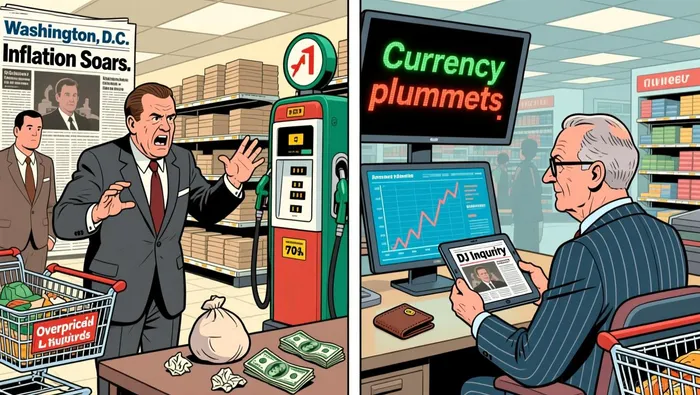
The current probe into Chair Powell is not an isolated incident. It echoes a darker chapter in American economic history, when political pressure directly corrupted monetary policy. In the early 1970s, President Richard Nixon pressured then-Fed Chair Arthur Burns to "goose" the economy ahead of re-election, a move that is widely seen as a key catalyst for the "Great Inflation" of the late 1970s. That episode demonstrated the catastrophic cost of blurring the line between political ambition and central bank independence. The current situation, with a sitting president threatening to fire the Fed chair and the DOJ launching a criminal investigation, revives that precedent. The market's immediate reaction-a dollar index drop to its lowest level in nearly a decade-is a direct repricing of that historical risk.
Yet the full threat is more insidious. The probe's impact appears concentrated in a sharp repricing of political risk, but the deeper danger is a self-reinforcing cycle. If the investigation leads to a perception that the Fed is vulnerable to political capture, it could undermine its credibility as an inflation fighter. A central bank seen as compromised would struggle to anchor long-term inflation expectations, which are the bedrock of any reserve currency's stability. This would further erode confidence in the dollar, accelerating capital flight and reinforcing the very political risk premium the probe is meant to punish.
The dollar's longer-term trend, however, remains anchored by fundamental forces. Its reserve status is still supported by the sheer scale of U.S. financial markets, the depth of its capital pools, and the lack of a near-term alternative. As one analysis notes, despite significant weakness, the dollar's reserve currency status remains intact due to its trustworthiness and the absence of a viable challenger. The primary risk is not an immediate collapse, but a gradual, structural erosion of trust. Each new political confrontation chips away at the perceived insulation of monetary policy, making the dollar more vulnerable to future shocks. The Nixon-Burns episode showed the cost of that erosion; the Powell probe risks making it a recurring feature of the dollar's story.
Financial Market Implications and Scenarios
The immediate market reaction to the DOJ probe is a textbook repricing of risk. The U.S. dollar index has fallen to its lowest level in nearly a decade, while the yield on the 10-year Treasury note has spiked to 4.20%. This dual move signals the emergence of a new, permanent "political risk premium" priced into all American assets. The cost of government borrowing is rising, as investors demand higher compensation for the perceived erosion of the Fed's insulation from political pressure. This premium is not a temporary sentiment shift; it is a structural recalibration of the risk-return calculus for U.S. debt.
The sell-off in the dollar has a direct and powerful beneficiary: dollar-denominated safe havens. Gold, in particular, has surged to a record $4,563.61 per ounce. This move is classic capital flight. As the dollar weakens, assets priced in it become more attractive to foreign buyers, and investors seek alternatives to U.S. government paper. The spike in gold prices reflects a flight to perceived store-of-value assets outside the dollar system, a dynamic that accelerates when trust in the currency's stability is challenged.
It is crucial to distinguish this new political shock from the dollar's longer-term trend. The currency's 10.7% decline in the first half of 2025 was driven by a confluence of fundamental forces: slower U.S. growth, rising fiscal deficits, and a gradual reallocation of global capital flows. The current probe does not negate those underlying pressures; it superimposes a severe new layer of volatility atop them. The market is now pricing in a higher probability of disruptive political interference, which compounds the existing vulnerabilities.
The scenario playing out is one of self-reinforcing pressure. A weaker dollar boosts the dollar cost of imports, potentially feeding inflation and complicating the Fed's mandate. At the same time, the spike in Treasury yields increases the burden of servicing the national debt, fueling further fiscal concerns. This creates a feedback loop where political risk undermines economic stability, which in turn can fuel more political instability. For now, the dollar's reserve status remains intact due to the lack of a near-term alternative, but its path is now far more turbulent. The market's new baseline includes a permanent political risk premium, making the dollar more vulnerable to any future crisis of confidence.
Catalysts and Watchpoints
The market has delivered its verdict on the probe's immediate shock. The U.S. dollar index has fallen to its lowest level in nearly a decade, and Treasury yields have spiked. This is the new baseline: a permanent political risk premium is now priced into American assets. The coming weeks will test whether this repricing is a lasting structural shift or a temporary overreaction. The key watchpoints are clear.
First, monitor the trajectory of the dollar index and Treasury yields. A sustained move back toward pre-probe levels would suggest the event was noise, a fleeting sentiment shock. But if the dollar remains weak and yields stay elevated, it confirms the erosion of trust in the Fed's insulation. The index's recent volatility, swinging from a one-month high to a multi-week low in just days, shows how fragile this equilibrium is. The market is now pricing in a higher probability of disruptive political interference, and that premium will persist unless the underlying threat dissipates.
Second, watch for any escalation in the investigation or political rhetoric. The probe's impact is not just about the facts of the renovation; it's about the precedent of a sitting president using the DOJ to pressure the Fed chair. Any new subpoenas, threats of indictment, or public statements from the administration that frame the Fed as an adversary would deepen the crisis of confidence. The recent backlash from Republican senators and former Fed chairs, who have condemned the DOJ's actions, is a positive sign of institutional pushback. But if the administration doubles down, it risks hardening the political risk premium into a permanent feature of the dollar's story.
Finally, the resolution of the probe itself will be a major catalyst. Whether it leads to a dismissal, a negotiated settlement, or an indictment will send a powerful signal about the rule of law and the Fed's independence. A dismissal could help stabilize sentiment, while an indictment would likely trigger a new wave of market turmoil. The Fed's own response matters too. Chair Powell's defiant video statement, framing the investigation as a pretext for political control, has emboldened defenders. The central bank's ability to maintain its credibility as an inflation fighter, even as it faces this legal assault, will be critical. If the investigation undermines its perceived neutrality, it could feed inflation expectations and further pressure the dollar.
The bottom line is that the dollar's reserve status is now subject to a new, unpredictable variable: the health of the Fed's independence. The market has priced in the risk, and the coming signals will determine if that risk becomes a reality.







Comentarios
Aún no hay comentarios