
Assessing the Structural Risk to Fed Independence from Political Pressure
The political pressure on the Federal Reserve has reached a new and dangerous threshold. The Justice Department has opened a criminal investigation into Chair Jerome Powell, specifically targeting his congressional testimony about the $2.5 billion renovation of the Fed's Washington headquarters. This move, approved by a Trump-appointed U.S. attorney, is a direct escalation in a long-running campaign. President Trump has repeatedly attacked Powell for resisting his demands to slash interest rates, even threatening to fire him and raising the prospect of a lawsuit over the building project.
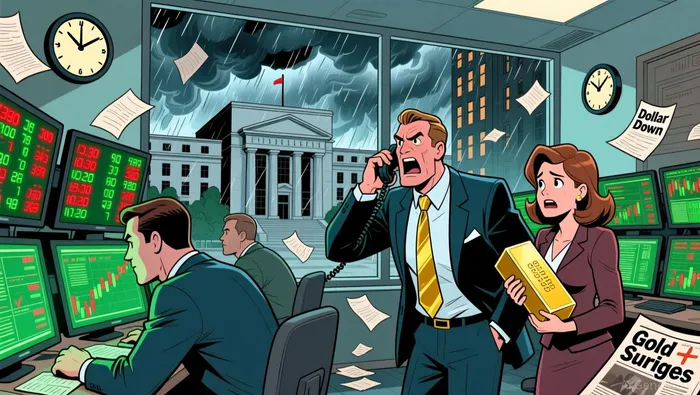
The framing is clear. Powell has called the investigation a "pretext" to gain influence over monetary policy, and the immediate market reaction underscores its disruptive potential. On Monday, the dollar fell and gold rose, a classic signal of heightened uncertainty about the Fed's future independence. This volatility highlights the core risk: when a sitting president uses the full machinery of his administration to threaten a central bank chair, it introduces a powerful political variable into the calculus of monetary policy.
Adding to the pressure, Trump has already named a front-runner for Powell's successor. Kevin A. Hassett, his top economic adviser, is positioned to take the helm. This sets up a stark choice for the Fed's future. The probe and the naming of a successor are not isolated events; they are components of a coordinated strategy to reshape the central bank in the administration's image. The conflict is no longer about a renovation cost. It is about the very structure of monetary authority.
Structural Risk: The Threat to Central Bank Independence
This probe represents a sharp escalation in a historical pattern where political pressure has influenced the Fed's actions, directly increasing the risk of inflation. The core tension is structural: politicians have a clear incentive to push for lower interest rates to stimulate growth before elections, but this can fuel inflation over the longer term. The Fed's design-its independent funding, long board terms, and insulated leadership-was precisely to insulate monetary policy from this political cycle. Yet, as analysis shows, this independence has not been absolute. Historical pressure from the White House in the 1960s and 1970s is linked to higher inflation than macroeconomic factors alone would predict.
The current investigation targets Powell's public statements, a tactic that could chill future Fed transparency and accountability. By threatening criminal indictment over testimony, the administration sets a dangerous precedent. It implies that a central bank chair could face legal consequences for defending the institution's actions or budget, even when those actions are within the Fed's mandate. This undermines the very principle of open communication that allows markets to understand policy decisions. The risk is not just for Powell; it is for the entire culture of independent, evidence-based policymaking.
The threat of a leadership vacuum compounds this structural risk. A key Republican senator, Thom Tillis, has stated he will oppose any future Fed chair nominee until the matter is resolved. This creates a gridlock that could leave the central bank without a clear leader at a critical juncture. The Fed's ability to control inflation depends on a stable, credible leadership that can act decisively. A prolonged vacancy or a nominee chosen under duress would severely weaken that credibility.
The bottom line is that this is not merely a dispute over a renovation cost. It is a direct assault on the Fed's institutional independence. When a president uses the Department of Justice to threaten a central bank chair, it introduces a powerful political variable into the policy calculus. This environment increases the likelihood that monetary policy will be directed by political pressure rather than economic conditions, directly undermining the Fed's primary mandate to maintain price stability.
Financial Market and Policy Scenarios
The immediate market reaction confirms the core risk: uncertainty is now a priced-in variable. On Monday, the dollar fell and gold rose, a classic flight to perceived safety and a bet on higher inflation. This volatility is not a one-off; it signals a fundamental reassessment of the Fed's operational environment. When the central bank's independence is in question, the market's anchor for long-term expectations weakens.
Looking ahead, two distinct scenarios emerge. The first is one of persistent policy pressure. With a key Republican senator pledging to oppose any nominee until the matter is resolved, the path to a new chair is blocked. This gridlock could force the current Fed leadership to navigate a prolonged period of political siege. In response, the central bank may feel compelled to accelerate rate cuts to demonstrate its resolve to act independently, even if economic data does not fully justify it. This would be a strategic accommodation to protect its institutional integrity, but it directly risks undermining its credibility.
The second, more severe scenario is a loss of the Fed's 2% inflation target. As economist Grant Slade notes, under a worst-case scenario, where Trump succeeds in forcing the Fed to lower rates, the 2% inflation target may lose credibility. This would de-anchor long-term inflation expectations, making future price stability harder and more costly to achieve. The market would price in this higher uncertainty, likely leading to greater volatility in US inflation and upward pressure on long-term Treasury yields as investors demand more compensation for a less predictable outlook.
The investigation's outcome will be a critical test of institutional independence. A politicized resolution would further erode trust in the Department of Justice and, by extension, the entire rule-of-law framework. This would compound the damage to the Fed's credibility. Conversely, a swift and impartial DOJ response could help contain the fallout, though it would not erase the precedent of using legal threats to influence monetary policy.
The bottom line is that the Fed's inflation target is now exposed to a new political variable. The central bank's ability to control price growth depends on its perceived credibility, which is directly tied to its independence. As long as the threat of legal action over testimony persists, that credibility faces a structural challenge. For investors, the path forward is one of heightened volatility and a re-pricing of the long-term inflation risk.
Catalysts and Watchpoints
The coming weeks will test whether this political pressure translates into a material threat to the Fed's operational independence. Several near-term events and metrics will serve as critical watchpoints.
First, monitor the DOJ's investigation timeline. The probe is now active, with grand jury subpoenas served. The key signal will be whether formal charges are filed against Powell. A criminal indictment would be the ultimate escalation, confirming the administration's use of legal machinery to intimidate a central bank chair. This would directly validate Powell's claim that the action is a pretext to gain influence over interest rates. Conversely, a swift and impartial resolution, or a decision not to pursue charges, could help contain the fallout, though it would not erase the precedent.
Second, watch for subtle shifts in Fed communications and FOMC meeting minutes. The central bank's credibility depends on its ability to speak with one voice. Any attempt by the Fed to soften its policy tone or delay rate decisions to avoid further political friction would be a red flag. The market's immediate reaction-the dollar falling and gold rising-shows how sensitive expectations are to perceived threats. Continued volatility in Treasury yields and inflation-linked derivatives would signal that the Fed's forward guidance is being undermined.
The most critical inflection point, however, is the political process for selecting a new chair. President Trump has already named Kevin A. Hassett as a front-runner. The nomination and confirmation process will be a major test. The key watchpoint is the stance of Senator Thom Tillis, who has pledged to oppose any nominee until the matter is resolved. His opposition, backed by a Republican senator, creates a clear gridlock. If the administration pushes forward with a nominee despite this, it would force a confrontation that could further politicize the Fed's leadership. If confirmation stalls, it could leave the central bank without a clear chair at a time of heightened uncertainty, severely weakening its ability to act.
The bottom line is that the threat to Fed independence is now a live political process. The investigation's outcome, the Fed's internal communications, and the nomination fight are the catalysts that will determine whether this pressure becomes a permanent feature of monetary policy or is contained. For now, the clock is ticking.







Comentarios
Aún no hay comentarios