
Assessing the Structural Impact of Elevated Tariffs on the U.S. Economy
The United States has entered a new era of trade policy, one defined by a permanent and elevated tariff regime. The current setup is not a temporary policy adjustment but a structural shift in the economy's foundation. The most immediate signal is the consumer price tag. Americans now face an overall average effective tariff rate of 17.9%, the highest level since 1934. This isn't just a headline figure; it represents a direct tax on households. In 2025 alone, the imposed tariffs amounted to an average tax increase per US household of $1,100. The fiscal impact is clear and significant, with the price level rising by 1.3% in the short run-a loss of purchasing power that falls hardest on lower-income families.
This regime is also unprecedented in its complexity. The system has become a labyrinth of overlapping rules. As of September 2025, more than half of all US imports (by value) were subject to one or more special tariff measures. The legal architecture has expanded dramatically, with the number of distinct US tariff regimes increasing from 18 to 20 in just a few weeks. This proliferation of rules, codified in over 100 new pages to the tariff schedule, creates a massive administrative burden and a hidden cost for businesses navigating compliance.
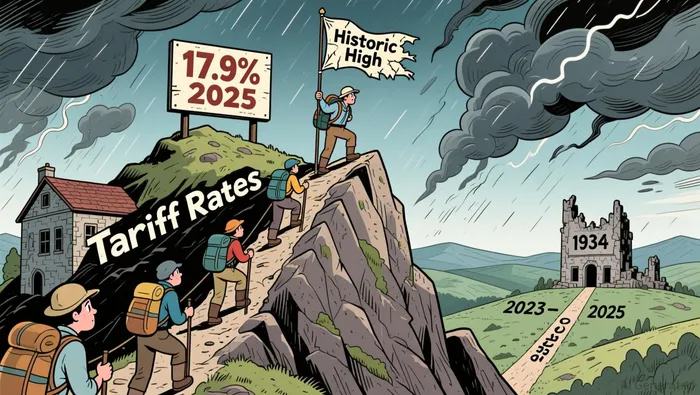
The central question now is whether this new normal is here to stay. The regime's permanence hinges on a looming Supreme Court decision on the president's emergency powers. Yet, even if that decision invalidates the most controversial tariffs, the structural changes to the trade landscape would remain. The regime has already demonstrably slowed economic growth, reduced employment, and reshaped sectoral output. The shift is not merely about higher prices; it is about a fundamental reallocation of economic activity and a new, more complex operating environment for American commerce. The distributional consequences-of who pays, who profits, and which industries expand or contract-are now baked into the long-term economic trajectory.
The Path of Least Resistance: Behavioral and Revenue Effects
The fiscal impact of the new tariff regime is being shaped less by the stated rates and more by the economic actors' response. The system has created a clear "path of least resistance": importers and consumers are adapting through behavioral shifts that directly determine the actual revenue collected and the broader economic cost. The numbers show a complex interplay between policy intent and market reality.
The most critical adaptation is the change in import behavior. Between January and September 2025, these shifts contributed $124.5 billion in tariff revenue. But this figure is a net outcome. The data reveals a crucial decomposition: without these behavioral changes, revenue would have been even higher. In other words, importers' strategic moves-accelerating purchases before rate hikes or altering sourcing patterns-acted as a brake, preventing an estimated $31.5 billion increase in collections. This is the mechanism of the path of least resistance: the market finds ways to minimize the direct tax burden, and the government collects less than the mechanical application of the new rates would suggest.
The heaviest pressure is concentrated on specific sectors. The regime's design is evident in the effective rates applied. Steel and aluminum products face the highest effective tariff rate at 40 percent, a direct result of recent, significant hikes. Automotive vehicles follow as a major target with a 18.2 percent effective rate. These are not marginal adjustments but deliberate, high-impact interventions aimed at reshoring production and protecting domestic industries. The fiscal mechanism itself is now a key feature. The U.S. Treasury has become a net importer of tariff revenue, using the collections to offset other federal liabilities. This practice, where tariff receipts are applied against income and payroll tax obligations, effectively turns the tariff into a form of fiscal stimulus, reducing the direct budgetary cost of the policy while still transferring wealth from importers and consumers.
The bottom line is that the actual economic impact is a product of this adaptation. The stated rates create a shock, but the market's response-through sourcing shifts, inventory management, and aggressive use of exemptions like the surge in USMCA claims from Canada and Mexico-determines the final outcome. This behavioral feedback loop means the fiscal revenue is lower than it would be under a static model, and the cost to consumers and businesses is partially mitigated by these market-driven workarounds. The path of least resistance, therefore, is not just about avoiding tariffs but about reshaping the very flow of trade to minimize the policy's bite.
Sectoral and Geographic Impacts Beyond the Core
The new tariff regime is not a uniform tax. Its true impact is revealed in the stark geographic and sectoral divides it has created, turning trade policy into a powerful tool for reshaping economic activity. The numbers show a deliberate targeting: the system has engineered a clear winner and a clear loser among major partners. In September, the effective tariff rate on imports from China reached 37.1 percent, a punitive level designed to pressure and reshape supply chains. By contrast, the rate for goods from Canada and Mexico hovered around 10 percent. This isn't just a difference in numbers; it's a strategic choice that incentivizes a near-total reallocation of North American trade, funneling business away from one partner and toward the other.
This geographic split is mirrored in the sectoral concentration of the heaviest blows. The policy has been laser-focused on specific industries deemed critical to national security and industrial policy. The data is unequivocal: Steel and aluminum products face the highest effective tariff rate at 40 percent, a direct result of recent, significant hikes. Automotive vehicles follow as a major target with a 18.2 percent effective rate. These are not incidental tariffs but core components of a strategy to protect and revive domestic manufacturing in these capital-intensive, politically sensitive sectors.
The regime's complexity, however, creates a hidden layer of cost that extends beyond the headline rates. The system has evolved into a form of "tariff stacking", where imports from certain countries face multiple overlapping measures. As of September, more than half of all US imports (by value) were subject to one or more special tariff measures. This proliferation of rules, codified in over 100 new pages to the tariff schedule, transforms compliance into a major operational burden. The result is a hidden cost that disproportionately affects businesses, especially smaller ones, that lack the resources to navigate this labyrinth. This complexity itself becomes a barrier to trade, creating winners among large, well-resourced importers who can exploit loopholes and losers among smaller, more agile firms.
The bottom line is a distributional shock. The regime has created a new economic geography where trade flows are dictated by political design rather than pure market efficiency. It has protected specific domestic industries while imposing a heavy cost on their import-dependent suppliers and consumers. It has reshaped North American integration, accelerating the use of USMCA rules to avoid tariffs. And it has added a layer of administrative friction that acts as a tax on doing business. The winners are clear: domestic producers of steel, aluminum, and autos, and the large importers who can manage the complexity. The losers are broader: consumers facing higher prices, businesses navigating a more convoluted system, and the overall efficiency of the trade network. This is the structural impact in practice-a deliberate, uneven reallocation of economic activity.
The Supreme Court Catalyst and Its Implications
The immediate future of the elevated tariff regime hinges on a single, pending decision. The Supreme Court is expected to rule on the legality of the president's use of the International Emergency Economic Powers Act (IEEPA) to impose sweeping tariffs. This ruling is the catalyst that will determine whether the current high levels are a temporary policy or a permanent structural feature. The stakes are staggering. If the Court strikes down the tariffs, it could trigger a potential $150 billion in refunds to importers for duties already paid. This would be an unprecedented financial flow, effectively returning a massive sum of capital to the private sector.
Yet the path to those refunds is fraught with legal uncertainty. Even if the Court invalidates the tariffs, importers are not guaranteed a payout without further judicial action. The legal landscape is complex, and the government's position is clear: it will not make the process easy. As one CEO noted, "It's not in the government's DNA to give back money". The practical mechanics of a refund are also in flux. The U.S. Customs and Border Protection has announced a technical change to shift all tariff refunds to electronic distribution, a move that "signals that Customs is fully prepared to move forward with refunds" if the Court rules in their favor. But the process will still require importers to navigate protective actions and potential court-ordered reliquidation, creating a prolonged period of administrative and legal complexity.
This uncertainty is the regime's Achilles' heel. The Court's decision will resolve the fundamental question of the policy's legal foundation. A ruling against the tariffs would dismantle the core authority for the current regime, forcing a rapid recalibration of trade flows and fiscal policy. The Treasury has already signaled it could replicate lost revenues with new tariffs under other legal authorities. A ruling in favor would cement the regime's permanence, validating the president's unprecedented use of IEEPA and likely leading to further legislative or executive actions to solidify the elevated rates.
The catalyst, therefore, is not just about refunds. It is about the regime's survival. The outcome will determine whether the economic reallocation, sectoral protection, and administrative burden created by the tariffs become a lasting feature of American commerce or are abruptly reversed. For now, the market operates under a cloud of legal ambiguity, with companies preparing for a potential financial reset that could reshape the trade landscape overnight.
Forward-Looking Scenarios and Investment Implications
The structural shift initiated by the elevated tariff regime now faces a critical fork in the road. The path forward will be determined by the Supreme Court's pending decision, but the broader economic setup suggests a new normal of protectionism, regardless of the ruling's specifics. For investors and corporate strategists, the key is to map the distinct scenarios and their implications.
The baseline scenario is one of permanence. Even if the Court invalidates the IEEPA authority, the administration is expected to seek to maintain high tariffs under other legal frameworks. As JPMorgan noted, the president could invoke Section 122 to maintain 15% tariffs for 150 days while crafting alternatives. The market's expectation is that the average tariff rate will settle near 15% in the year ahead. In this case, the economy locks in the new reality: a persistent 17.9% effective tariff rate for consumers, which the Budget Lab estimates will keep the price level elevated by 1.3% in the short run. This creates a lasting headwind for real GDP growth, which would be slowed by 0.5 percentage points annually, and a drag on employment, with the unemployment rate rising by 0.7 percentage points by the end of 2026. For corporate strategy, this means a permanent recalibration. Supply chains must be further reshored or diversified, and pricing power becomes a critical asset to pass through costs. The long-term trade-off is clear: domestic manufacturing output expands, but construction and agriculture contract, reshaping the industrial landscape.
The Supreme Court invalidation scenario presents a more complex, but potentially less severe, shock. If the Court strikes down the IEEPA tariffs, the effective rate would drop to 9.1%, halving the immediate price pressure. However, the economic reset would be massive. The Treasury would face a potential $150 billion in refunds to importers, a logistical and political minefield. As one CEO noted, the government is "not in the government's DNA to give back money", suggesting a prolonged battle over eligibility and distribution. This scenario would mitigate the long-run GDP loss, reducing it from 0.35% to 0.1%, and ease the employment drag. Yet, the administration is unlikely to abandon its protectionist goals entirely. The focus would shift to replacing the invalidated tariffs under other statutes, meaning the fundamental pressure on trade and prices may not abate significantly.
For investors, the watchpoints are now threefold. First, the Supreme Court's ruling itself is the immediate catalyst. The decision will resolve the legal foundation and set the tone for the next phase. Second, the administration's response is critical. Will it seek to replace the tariffs, and under what authority? This will determine the trajectory of the effective rate and the associated fiscal and trade flows. Third, the pace and scale of retaliatory tariffs from trading partners remain a major risk. The regime has already triggered a complex web of foreign measures, and any escalation would compound the economic damage, particularly for export-dependent sectors.
The bottom line is one of managed volatility. The regime's core structural impact-the reallocation of trade, the reshoring of manufacturing, and the administrative burden-is likely to persist. The Supreme Court ruling is a legal event, not a policy reset. Investors should prepare for a period of uncertainty around refunds and replacement tariffs, but the forward view points to a sustained period of elevated trade barriers. The winners will be those companies with the most resilient, diversified supply chains and the strongest pricing power to navigate this new, more complex economic terrain.







Comentarios
Aún no hay comentarios