
Assessing the Strategic Value and Investment Potential of Herald Trust Plc and Barclays Plc
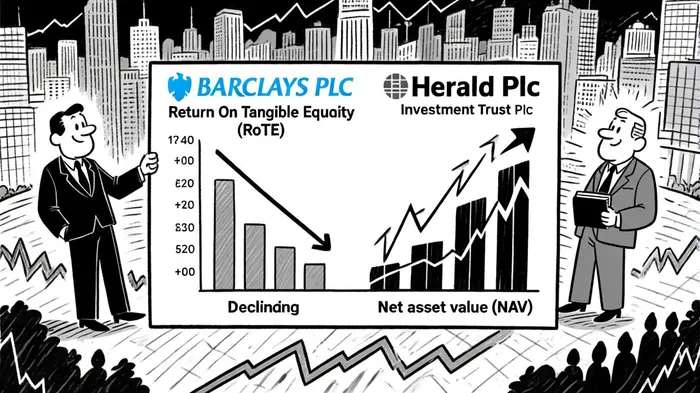
In the evolving landscape of financial services, the interplay between regulatory pressures and market dynamics has become a defining factor for investment decisions. Two entities-Barclays Plc and Herald Investment Trust Plc-offer contrasting yet instructive case studies. BarclaysBCS--, a global banking giant, navigates macroeconomic volatility and regulatory fragmentation, while Herald Trust, a focused investment vehicle, grapples with governance challenges and sector-specific risks. This analysis evaluates their strategic value and investment potential through the lens of portfolio composition, regulatory compliance, and alignment with market shifts.
Barclays Plc: Balancing Growth and Regulatory Headwinds
Barclays' first-half 2025 results underscore its resilience in a challenging environment. The bank reported a Return on Tangible Equity (RoTE) of 13.2%, up from 11.1% in H1 2024, driven by a 23% increase in pre-tax profit and a £1 billion share buyback, according to its half‑year report. Its core UK business, bolstered by the acquisition of Tesco Bank, saw Net Interest Income (NII) rise 17% year‑over‑year to £3.7 billion as detailed in the same half‑year report. However, credit impairment charges climbed 24% to £1.1 billion, reflecting heightened macroeconomic uncertainty, particularly in US retail credit (also noted in the half‑year report).
Strategically, Barclays is recalibrating its capital allocation. The bank aims to grow UK NII to over £7.6 billion in 2025 and achieve a group RoTE of 12% by 2026, according to its interim results. CEO C.S. Venkatakrishnan emphasized confidence in meeting these targets despite trade tensions and labor market disruptions in the same interim results. Yet, regulatory challenges loom large. The global fragmentation of financial rules-exemplified by divergent approaches to third‑party risk and cybersecurity-threatens to inflate compliance costs, as outlined in EY's four regulatory priorities. Barclays is responding by investing in compliance technologies and blockchain‑driven operational resilience noted in that EY analysis.
Herald Investment Trust Plc: Navigating Governance and Sector Volatility
Herald Trust, a mid‑cap technology and communications‑focused trust, has delivered a 20.87% annual return since 2024, according to S&P Global Market Intelligence. Its portfolio, diversified across 34.1% US stocks and 30.8% UK holdings, outperformed benchmarks like the Russell 2000® Technology Index as reported by S&P Global Market Intelligence. However, its share price of 2,490p trades at a 9.30% discount to NAV, a fact recorded in a subsequent Reuters filing carried on TradingView's news feed and other outlets (see the Reuters filing).
A significant challenge emerged in January 2025, when Saba Capital Management attempted to oust the board and restructure the trust; shareholders rejected the proposal, with 65.10% voting against it, according to S&P Global Market Intelligence. The board argued that Saba's lack of experience in managing smaller tech firms posed risks to NAV stability, a position also covered by S&P Global Market Intelligence. Meanwhile, institutional investors like Jefferies Financial Group increased their stakes to 5.23%, signaling cautious optimism (reported in the half‑year report).
Herald's strategic alignment with market shifts is evident in its active management approach. The trust avoids overexposure to any single company (capped at 10%) and targets firms with market caps below $5 billion at purchase, as noted in the half‑year report. This strategy, while potentially volatile, aligns with the growth trajectory of disruptive tech firms. However, its reliance on US dollar‑denominated assets exposes it to currency fluctuations, as seen in H1 2025 when sterling appreciation dampened headline returns reported alongside Barclays' quarterly commentary on performance in the Barclays Q3 earnings release.
Strategic Alignment and Investment Implications
Both entities face distinct yet interconnected challenges. Barclays' strength lies in its capital returns and cost discipline, with a CET1 ratio of 14.0% providing a buffer against economic shocks, as detailed in the half‑year report. Its strategic focus on UK retail and corporate lending aligns with structural trends in interest rate normalization. However, regulatory headwinds-particularly in cross‑border compliance-could constrain margins.
Herald Trust, conversely, thrives on niche market opportunities but is vulnerable to governance risks and sector‑specific volatility. Its active management model offers upside potential in high‑growth tech sectors but requires robust risk controls. The recent Saba Capital episode highlights the importance of board stability in maintaining long‑term value. Notably, historical data suggests that the trust has underperformed in the month following shareholder meetings, with an average 30‑day event return of approximately ‑15% since 2022, a pattern documented by S&P Global Market Intelligence. This pattern underscores the market's sensitivity to governance‑related events and the need for investors to monitor board dynamics closely.
For investors, the key differentiator lies in risk tolerance. Barclays offers defensive appeal with its capital returns and diversified portfolio, albeit with regulatory overhangs. Herald Trust, while riskier, presents growth opportunities in innovation‑driven sectors, provided governance challenges are managed effectively.
Conclusion
The strategic value of Barclays and Herald Trust hinges on their ability to adapt to regulatory and market shifts. Barclays' disciplined capital allocation and cost efficiency position it as a resilient player in a fragmented regulatory environment. Herald Trust's focus on high‑growth tech firms offers compelling upside but demands careful monitoring of governance and currency risks. In a world where financial services are increasingly shaped by both macroeconomic forces and regulatory innovation, these two entities exemplify the dual imperatives of stability and agility.





Comentarios
Aún no hay comentarios