
Assessing the Strategic and Financial Risks of Paramount's Hostile Takeover Bid for Warner Bros. Discovery
Warner Bros. Discovery's board has officially rejected Paramount Skydance's $30-per-share hostile takeover bid, deeming it an "illusory" offer with insufficient financial assurances. This decision underscores the board's preference for a binding merger with NetflixNFLX--, which it argues offers greater certainty and long-term value for shareholders. The rejection of Paramount's bid highlights critical flaws in its financing structure, regulatory risks, and strategic weaknesses compared to the Netflix deal. For investors, the choice between these two paths is not merely a matter of price but a stark contrast in risk profiles and execution potential.
The Illusory Nature of Paramount's Offer
Paramount's bid, backed by Oracle founder Larry Ellison's family trust and RedBird Capital, hinges on a financing structure that Warner Bros.WBD-- Discovery (WBD) has described as "opaque" and "unbackstopped" according to a report. According to Reuters, the offer relies on the Lawrence J. Ellison Revocable Trust, which lacks the legal enforceability of a binding commitment. This arrangement leaves WBDWBD-- shareholders exposed to the risk of a last-minute withdrawal, a vulnerability the board explicitly criticized as "illusory". In contrast, Netflix's $27.75-per-share offer is fully financed with committed debt and does not require equity financing, providing a level of certainty absent in Paramount's proposal according to the board's analysis.
The lack of a robust backstop is compounded by regulatory and geopolitical uncertainties. Paramount's bid has drawn scrutiny over its ties to Middle Eastern sovereign wealth funds and the withdrawal of key financing partners like Jared Kushner's Affinity Partners according to Reuters. These developments raise questions about the bid's viability, particularly as regulatory bodies may view its complex funding structure as a potential risk to market stability.
Strategic Weaknesses of the Ellison-Driven Bid
Beyond financial risks, Paramount's offer lacks the strategic coherence of the Netflix merger. A report by Variety notes that Paramount's bid fails to address WBD's core challenges, such as declining advertising revenue and the need for a sustainable content pipeline. 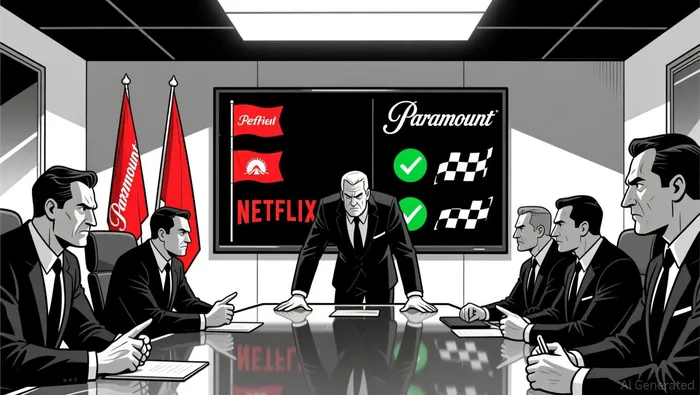 By contrast, the Netflix deal integrates WBD's film and television studios-home to franchises like Game of Thrones and Harry Potter-into a platform with 250 million global subscribers. This acquisition not only expands Netflix's content library but also preserves a theatrical window for WBD's films, a critical factor in maintaining relationships with cinema operators according to market analysis.
Financial analysts have also highlighted the Netflix merger's superior debt structure. While the deal will saddle Netflix with $75 billion in debt-nearly three times its EBITDA over the past four quarters-the company's investment-grade balance sheet and strong cash flow position it to manage this burden according to financial reports. Paramount, on the other hand, has a credit rating "a notch above 'junk'" and would face a debt-to-operating-income ratio exceeding 10x if the deal closes according to Reuters. Such leverage levels could strain Paramount's financial flexibility and increase the risk of downgrades or liquidity crises.
The Netflix Merger: A Path to Long-Term Value
WBD's board has repeatedly emphasized that the Netflix merger offers a "clear path to close" with definitive regulatory and financing timelines. This contrasts sharply with Paramount's protracted and uncertain process, which includes a $2.8 billion termination fee if WBD accepts a competing offer according to market analysis. For investors, the Netflix deal represents a lower-risk, higher-conviction path to unlocking value. By acquiring WBD's studios, Netflix gains access to high-value intellectual property and a diversified content pipeline, reinforcing its dominance in the streaming wars according to industry analysts.
Critics may argue that the Netflix offer undervalues WBD's assets, but the board has countered that Paramount's $30-per-share bid is inflated and unsustainable. As stated by WBD in a press release, the Netflix deal "provides immediate and certain value" without exposing shareholders to the "additional risks" of a volatile, unbackstopped offer according to the board's statement.
Conclusion
For investors weighing the merits of these competing bids, the choice is clear. Paramount's Ellison-driven offer is fraught with financial and regulatory uncertainties, while the Netflix merger provides a well-capitalized, strategically coherent path to long-term value. The rejection of the Paramount bid by WBD's board reflects a pragmatic assessment of risk and reward-a decision that investors would be wise to follow.





Comentarios
Aún no hay comentarios