
Assessing the Strategic and Economic Implications of South Korea's Balancing Act Between China and Japan
South Korea's economic and geopolitical strategy in 2025 is defined by a delicate balancing act between its largest trading partner, China, and its growing security alliances with the United States and Japan. This dual focus has created a unique landscape where trade dynamics and regional security concerns intersect, driving investment flows into high-potential sectors such as semiconductors, artificial intelligence (AI), and defense technology. For investors, understanding these overlapping priorities is critical to identifying opportunities in a market poised for transformation.
Semiconductors: A Pillar of Trade and Strategic Resilience
South Korea's semiconductor industry remains a cornerstone of its trade relationship with China. In 2025, the country exported $4.56 billion worth of integrated circuits to China alone, a figure expected to grow as global demand for AI-related products surges. However, China's rapid advancement in manufacturing and its overproduction of intermediate goods have begun to erode South Korea's competitive edge in this sector. To counter this, South Korea is doubling down on domestic innovation. A notable example is the proposed $3.1 billion foundry investment to bolster local chip development for automotive and industrial applications.
Simultaneously, regional security dynamics are reshaping the semiconductor landscape. The U.S.-South Korea trade and security agreement announced in late 2025 underscores this shift. Under the deal, South Korea pledged $150 billion in U.S. shipbuilding investments and $200 billion in industrial sectors, with specific provisions to avoid market disruptions. The U.S. also agreed to reduce tariffs on South Korean semiconductors to levels comparable to those for Taiwan, addressing long-standing concerns about trade competitiveness. These moves highlight how geopolitical alignment is reinforcing South Korea's semiconductor strategy, ensuring both economic resilience and technological leadership.
AI: Bridging Trade and Defense Innovation
The AI sector exemplifies the convergence of South Korea's trade and security priorities. China's demand for AI-driven technologies has fueled South Korean exports of information and communication devices, which are projected to grow in 2025 due to improved consumer sentiment and global demand. Yet, the same AI advancements that drive trade are also redefining defense capabilities. South Korea's military is increasingly adopting AI-powered systems, including drones and smart battlefield technologies, to transition from platform-centric to network-centric warfare.
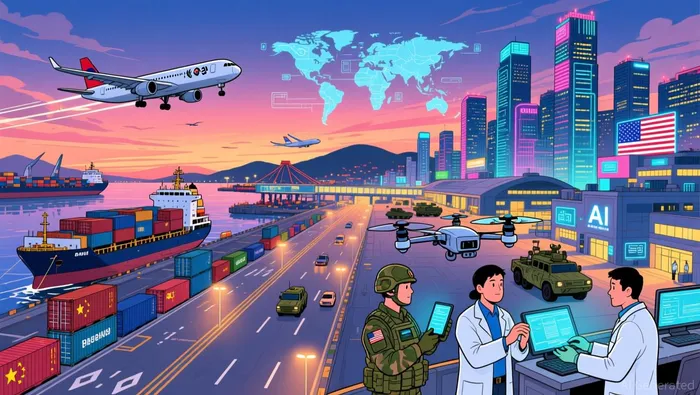 This dual-use potential is attracting significant investment. For instance, the Yoon administration's Indo-Pacific strategy emphasizes the development of New Generation Technologies (NGTs) such as AI and robotics, positioning South Korea as a "global pivotal state" in the U.S.-led democratic alliance. The integration of AI into defense systems is not just a strategic imperative but also a commercial opportunity, as South Korean firms like Hanwha Group and LIG Nex1 expand their international arms exports.
Defense Technology: A Response to Regional Tensions
South Korea's defense sector has emerged as a high-growth area driven by both trade competition with China and security threats from North Korea and Russia. The country's arms exports have more than doubled between 2010–14 and 2020–24, with a significant portion directed to European markets seeking to modernize their arsenals in response to the Ukraine conflict. This growth is underpinned by a state-led industrial policy that prioritizes self-reliance and technological advancement.
Regional security alliances are further accelerating investment in defense tech. The U.S.-South Korea agreement includes provisions for South Korea to develop nuclear-powered submarines and nuclear fuel capabilities, enhancing its energy and defense infrastructure. Meanwhile, trilateral cooperation with Japan and the U.S. is expanding into joint research on advanced technologies like joint domain command-and-control (JDC2), which integrates GPS, ISTAR, and PNT systems to optimize battlefield operations. These developments reflect a strategic pivot toward integrating economic and security interests, particularly as South Korea seeks to reduce its reliance on China.
Navigating Challenges and Opportunities
While South Korea's strategic investments are promising, challenges persist. China's economic slowdown and geopolitical risks, such as the Russia-Ukraine war and Middle East tensions, could constrain trade growth. Additionally, the country's traditional "economy with China, security with the U.S." approach is being redefined under the Yoon administration's de-risking strategy, which prioritizes diversification and resilience. For investors, this means opportunities lie in sectors where South Korea can leverage its technological expertise while mitigating over-reliance on any single market.
Conclusion
South Korea's balancing act between China and Japan is creating a fertile ground for high-potential sectors that align with both economic and strategic imperatives. Semiconductors, AI, and defense technology stand out as areas where trade dynamics and security needs converge, offering investors a unique opportunity to capitalize on a nation's dual focus on innovation and resilience. As South Korea continues to navigate this complex landscape, its ability to harmonize these priorities will shape not only its own economic trajectory but also the broader geopolitical order in the Indo-Pacific.







Comentarios
Aún no hay comentarios