
Assessing South Africa's Political-Economic Reckoning: Investment Opportunities Amid ANC's Governance Challenges
South Africa stands at a crossroads in 2025, balancing ambitious economic reforms with persistent governance challenges that complicate its path to sustainable growth. The African National Congress (ANC), now navigating a fragile coalition government, faces mounting pressure to deliver on promises of infrastructure modernization and service delivery while contending with systemic corruption, political fragmentation, and external trade tensions. For investors, the country's essential services sectors-energy, water, and healthcare-present both compelling opportunities and significant risks. This analysis examines how structural reforms and sector-specific initiatives intersect with ANC governance dynamics to shape investment prospects.
Energy: A Transition-Driven Sector with Mixed Signals
South Africa's Just Energy Transition Partnership (JETP) remains a cornerstone of its economic strategy, having secured over $9.3 billion in funding to decarbonize its energy grid and develop green hydrogen capabilities. The establishment of the South African Wholesale Electricity Market (SAWEM) and the unbundling of Eskom signal a shift toward a competitive energy landscape, potentially unlocking private investment in renewable projects. However, progress is tempered by weak investor confidence, driven by delayed budget processes, U.S. reciprocal tariffs, and the government's reliance on state-centric industrial policies that sometimes clash with international trade norms.
While the energy sector's long-term potential is undeniable, short-term volatility persists. The ANC's coalition government must navigate ideological divides to ensure consistent policy execution, a challenge exacerbated by public skepticism about service delivery failures. Investors should prioritize projects aligned with JETP's decarbonization goals but remain cautious about regulatory overreach and fiscal constraints.
Water Infrastructure: A $30 Billion Gap and Governance Gaps
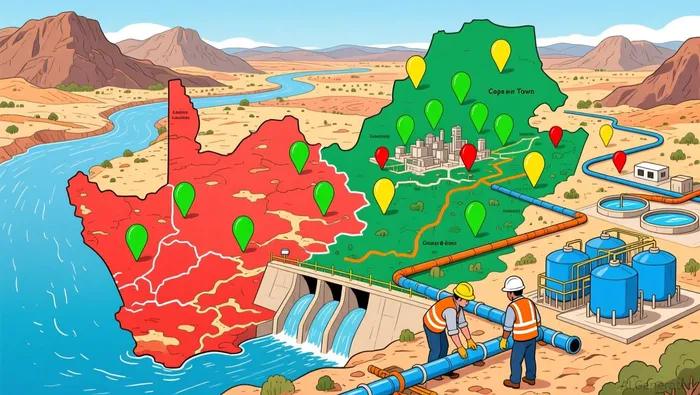 Water security is a critical frontier for South Africa, with the government allocating R940 billion over three years to address infrastructure deficits, including dam construction and climate-resilient systems. The African Union-AIP Water Investment Summit 2025, hosted in Cape Town, underscores the continent's recognition of South Africa's role in mobilizing $30 billion annually by 2030 to close the water infrastructure gap. Projects like the Algoa Water Supply System ($40 million) and the Crocodile East Water Project (ZAR 5 billion) highlight the scale of required investments.
Yet, governance challenges loom large. The ANC's dominance in water agencies has led to mismanagement, irregular expenditures, and deteriorating infrastructure. For instance, the Department of Water and Sanitation reported over R2.995 billion in delayed projects in 2023/24, while municipalities owe R22 billion to service providers. Politically connected cadres have prioritized patronage over capacity-building, undermining public trust and operational efficiency. Despite these hurdles, partnerships between the public and private sectors-such as Mediclinic Southern Africa's wastewater recycling initiatives- demonstrate the viability of innovative solutions. Investors with a long-term horizon may find value in water purification and distribution ventures, provided they can navigate political interference and secure lifecycle support.
Healthcare: Underfunding, NHI Ambitions, and Systemic Strain
South Africa's healthcare sector remains a patchwork of underfunded public services and a robust private sector. The National Health Insurance (NHI) Act, aimed at universal coverage, has been delayed by fiscal constraints and governance inefficiencies. While the 2025/26 budget allocates R9.9 billion for NHI implementation and workforce retention, chronic staff shortages, overcrowded facilities, and mismanagement continue to erode service quality.
The ANC's governance challenges are acutely felt here. Stagnant health spending over the past decade has failed to meet rising demand, while shrinking donor inflows and rising debt obligations further strain budgets. Corruption and weak oversight have also hampered infrastructure development, leaving many communities without reliable access to care. However, the sector's alignment with global health financing trends-such as impact investing-offers a glimmer of hope. For example, decentralized water purification systems in healthcare facilities, as seen in Mediclinic's initiatives, highlight the potential for cross-sectoral innovation. Investors may find opportunities in private healthcare expansion or public-private partnerships, though success hinges on navigating ANC-led bureaucratic inertia.
Strategic Positioning: Navigating Risks and Opportunities
For investors, South Africa's essential services sectors demand a nuanced approach. The energy transition and water infrastructure reforms present high-impact opportunities, particularly in renewable energy and climate-resilient projects. However, these must be weighed against the ANC's governance risks, including corruption, political fragmentation, and inconsistent policy execution.
Key strategies include:
1. Sector-Specific Focus: Prioritize sectors with clear reform momentum, such as energy and water, where international partnerships (e.g., JETP) provide partial risk mitigation.
2. Public-Private Collaboration: Engage with local stakeholders to navigate regulatory complexities and leverage government incentives, as seen in the Vaalkop Water Treatment Works project.
3. Long-Term Patience: Given the ANC's governance challenges, short-term volatility is inevitable. Investors should adopt a phased approach, aligning with multi-year infrastructure plans and capacity-building initiatives.
Conclusion
South Africa's political-economic reckoning is far from resolved, but its strategic position in essential services offers a compelling case for selective investment. While the ANC's governance challenges remain a drag on progress, the country's reform agenda-anchored in decarbonization, water security, and health equity-creates a framework for long-term value creation. Investors who can navigate the political landscape and align with sector-specific opportunities may find themselves well-positioned to contribute to-and benefit from-South Africa's next chapter.







Comentarios
Aún no hay comentarios