
Assessing J.M. Smucker's Resilience Amid Declining Profits and Strategic Divestitures
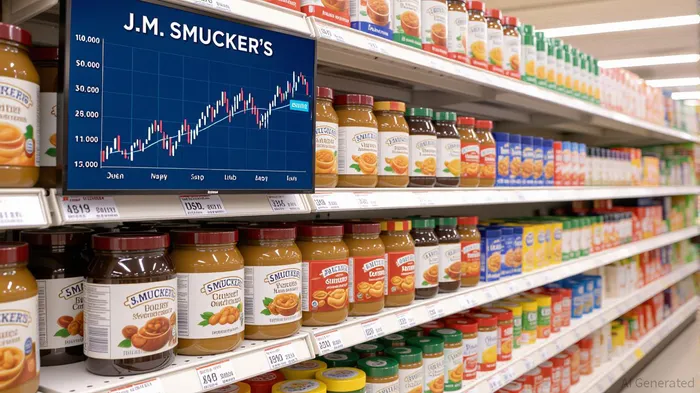
The J.M. Smucker Co. (SJM) has navigated a turbulent fiscal 2025 marked by strategic divestitures, a high-profile acquisition, and inflationary pressures. While its financial results reflect a mix of challenges and opportunities, the company's operational efficiency and capital allocation strategy remain critical to its long-term resilience in the high-margin consumer packaged goods (CPG) sector. This article evaluates Smucker's ability to restore profitability and deliver shareholder value amid a shifting landscape.
Operational Efficiency: A Mixed Bag
Smucker's fiscal 2025 results highlight both strengths and vulnerabilities. Net sales rose 7% to $8.7 billion, driven by the Hostess Brands acquisition, but adjusted earnings per share (EPS) grew modestly by 2% to $10.12. The company's gross margin dipped to 38.4% from 38.1% in 2024, pressured by rising commodity costs and unfavorable volume/mix dynamics. However, cost-cutting initiatives reduced SG&A expenses by 6% year-over-year, and special project costs fell 73%, signaling disciplined cost management.
Despite these efforts, Smucker's Q4 2025 operating loss of $599.1 million—a stark contrast to a $406 million profit in the prior year—was largely due to $980 million in noncash impairment charges. These charges, tied to the Sweet Baked Snacks unit and Hostess brand, masked underlying operational performance. Adjusted operating income of $422.4 million in Q4, however, suggests the core business remains viable.
In the CPG sector, EBITDA margins typically range between 15% and 25%. Smucker's adjusted EBITDA margin for Q4 2025, calculated as approximately 19.7% (adjusted operating income of $422.4 million plus depreciation/amortization of $53.6 million divided by $2.1 billion in net sales), aligns with the lower end of this range. This reflects the drag from impairment charges and cost inflation, but also highlights the company's focus on high-margin segments like U.S. Retail Coffee (28.6% segment margin) and International & Away From Home (22.4% margin).
Capital Allocation: Balancing Divestitures and Shareholder Returns
Smucker's strategic divestitures of non-core businesses—such as Voortman, Sweet Baked Snacks value brands, and Sahale Snacks—were designed to sharpen focus on core growth platforms. While these moves reduced segment profits (e.g., a 72% decline in Sweet Baked Snacks' segment profit), they also freed up capital for reinvestment. The company returned $455.4 million to shareholders via dividends in FY2025 and plans to maintain this momentum in 2026, with guidance for $875 million in free cash flow.
Smucker's capital allocation strategy mirrors industry best practices: deleveraging (net debt repayments of $177.6 million in Q4 2025), reinvesting in high-margin brands (Hostess, Uncrustables), and prioritizing shareholder returns. However, its return on invested capital (ROIC) remains a concern. While ROIC data is not explicitly disclosed, the company's net losses (before adjustments) and high leverage (noncurrent liabilities of $8.8 billion) suggest a ROIC below industry benchmarks. For context, CPG peers like Procter & Gamble (PG) and UnileverUL-- (UL) typically report ROICs of 10–15%, driven by robust cash flow generation and disciplined reinvestment.
Long-Term Growth: Navigating Inflation and Portfolio Rationalization
Smucker's 2026 outlook—projecting 2–4% sales growth and adjusted EPS of $8.50–$9.50—hinges on its ability to offset inflationary pressures and sustain cost discipline. The company's focus on price realization (e.g., 3% sales growth in the International & Away From Home segment) and operational efficiency (e.g., reduced pre-production costs for Uncrustables) positions it to weather macroeconomic headwinds.
Yet risks persist. The Sweet Baked Snacks segment's 8.0% margin and U.S. Retail Pet Foods' 26.8% margin (down from 25.2% in 2024) underscore the fragility of lower-margin businesses. Additionally, Smucker's reliance on one-time cost savings (e.g., 73% decline in special project costs) may not be sustainable.
Investment Implications
For investors, Smucker's resilience lies in its strategic agility. The company's focus on high-margin segments, disciplined cost management, and shareholder returns align with CPG sector norms. However, its exposure to noncash impairments and inflationary pressures necessitates caution.
Key Takeaways for Investors:
1. Monitor Core Segment Performance: The U.S. Retail Coffee and International & Away From Home segments are critical to long-term growth. A 11% sales increase in Coffee and 3% in International & Away From Home in FY2025 bodes well.
2. Assess Debt Management: Smucker's deleveraging efforts (net debt repayments of $177.6 million in Q4 2025) are positive, but its $8.8 billion in noncurrent liabilities remains a risk.
3. Evaluate Hostess Integration: The Hostess acquisition, which drove 7% of FY2025 sales growth, must deliver sustained synergies to justify its $1.3 billion price tag.
In conclusion, J.M. Smucker's strategic reallocation of capital and operational efficiency measures position it to navigate a challenging environment. While its ROIC and EBITDA margins lag behind peers due to recent impairments, its focus on high-margin growth platforms and disciplined cost management offer a path to restoring profitability. Investors should weigh these factors against macroeconomic risks and the company's ability to execute its 2026 guidance. For those with a medium-term horizon, Smucker's stock may present an opportunity to capitalize on its resilience in a high-margin sector.





Comentarios
Aún no hay comentarios