
Assessing the Short-Term Volatility in Solana Amid Network Upgrades and Market Sentiment Shifts
Technical Infrastructure: A Foundation of Resilience
Solana's 2025 upgrades have cemented its position as a high-performance Layer-1 blockchain. The Firedancer validator client, developed by Jump Crypto, has significantly enhanced throughput and reduced single points of failure, enabling 16 months of uninterrupted uptime and a Nakamoto Coefficient of 20-a-measure of decentralization that suggests robust validator diversity according to Cryptorank. Complementing this, the Alpenglow consensus upgrade has slashed block finality to 100–150 milliseconds, rivaling traditional financial systems in speed according to Cryptorank. These advancements, alongside a doubling of block space and compute units, position Solana to handle mainstream financial operations at scale.
Performance metrics further underscore this resilience. Solana processes 870.6 transactions per second with replay times under 400 milliseconds according to Bitget, while real-world throughput exceeds 1,000 transactions per second according to MEXC. The network's sub-cent transaction fees and near 99.9% uptime over multi-month periods according to MEXC make it an attractive platform for applications ranging from international remittances to high-frequency trading. Developer activity, too, has surged, with 17,708 active developers as of mid-2025, driven by improved tooling and institutional grants. This technical and human capital suggests a durable infrastructure capable of withstanding short-term turbulence.
Investor Psychology: A Tale of Two Forces
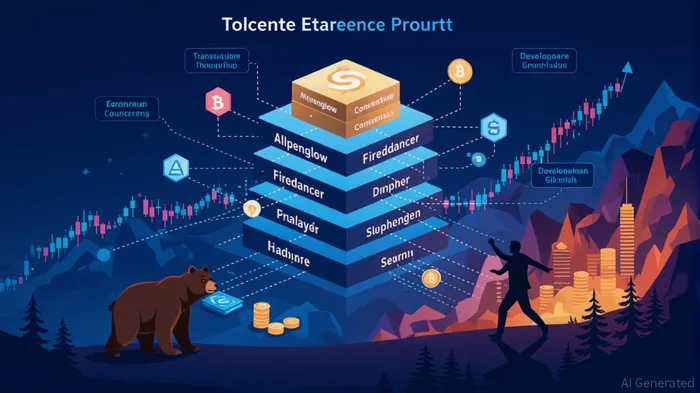 Yet, technical strength alone cannot insulate Solana from the vagaries of investor psychology. In early December 2025, the network experienced a sharp 19% price drop, with SOLSOL-- falling to $132 amid broader crypto market weakness according to Bitget. This decline was exacerbated by fading on-chain momentum, shrinking decentralized exchange (DEX) volumes, and a bearish Fear and Greed Index, which entered the "extreme fear" zone as BitcoinBTC-- fell below $100,000.
However, institutional confidence has remained a counterweight. The launch of Franklin Templeton's Solana Spot ETF (SOEZ) according to Crypto.com and partnerships with firms like Western Union according to Bitget have injected bullish sentiment. Meanwhile, large token holders have exhibited accumulation behavior: in July 2025, whale wallets withdrew $23 million worth of SOL from exchanges, staking it for long-term gains. Such actions suggest that strategic buyers view the price drop as an opportunity rather than a crisis.
The market's mixed signals are further complicated by technical indicators. While the Relative Strength Index (RSI) entered oversold territory near the $130 support level, futures markets reflected caution, with negative funding rates and imbalanced long-to-short ratios hinting at potential corrections. Polymarket's 1% probability of SOL reaching $300 by November 2025 underscores this skepticism, even as ETF inflows hit $351 million in assets under management according to Yahoo Finance.
Broader Market Trends: A Crucial Context
Solana's trajectory cannot be divorced from the broader crypto ecosystem. The $1 billion+ RWA (Real-World Asset) consortium on Solana according to Crypto.com and Base Network's ChainlinkLINK-- CCIP integration according to Crypto.com signal growing institutional adoption. Yet, macroeconomic headwinds-such as high interest rates and regulatory scrutiny-continue to dampen speculative demand according to Bitget.
On-chain metrics reveal a nuanced picture. While DEX trading volume hit $35.9 billion in Q4 2025 according to Bitget, daily active addresses fell from 7–9 million to 3–4 million by midyear according to Bitget, reflecting reduced retail participation. The Network Value to Transaction (NVT) ratio, which compares market value to on-chain usage, has also risen, indicating a disconnect between price and utility. This divergence raises questions about whether Solana's valuation is driven by fundamentals or speculative fervor.
### Conclusion: A Cautious Case for Resilience
For investors, the key lies in balancing Solana's technical strengths with the realities of market psychology. The network's infrastructure-bolstered by upgrades like Firedancer and Alpenglow-remains a formidable asset, capable of supporting mainstream adoption. Developer growth and institutional partnerships further reinforce its long-term potential.
However, short-term volatility is likely to persist. The $80 billion market cap thresholdT-- is a critical support level according to Yahoo Finance, and a breakdown could trigger a retest of the $100 level according to Phemex. Conversely, if Solana holds this line and sees a rebound in daily active addresses, the $150–$170 resistance range could become a focal point for bullish momentum according to InvestingHaven.
In this context, Solana presents a cautious buying opportunity for investors with a medium-term horizon. The network's fundamentals are robust, but its price remains vulnerable to macroeconomic shifts and sentiment swings. Those willing to navigate this volatility may find value in Solana's ecosystem, provided they remain vigilant to both technical and psychological signals.






Comentarios
Aún no hay comentarios