
Assessing the Short-Term Bull Case for Soybeans Amid Rising Chinese Demand and Supply Constraints
The global soybean market in 2025–2026 is poised for a pivotal inflection point, driven by a confluence of surging Chinese demand and emerging supply constraints in key exporting regions. For near-term commodity traders, this dynamic presents both opportunities and risks. China's role as the world's largest soybean importer- accounting for 60% of global trade in 2025/26-positions it as a central driver of price volatility and market direction. Meanwhile, logistical bottlenecks in Brazil, Argentina, and the U.S., coupled with geopolitical trade dynamics, create a complex but potentially lucrative environment for strategic positioning.
China's Appetite: A Structural Tailwind
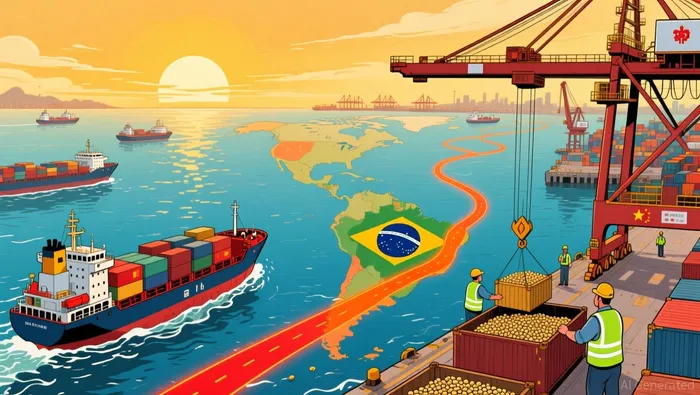
China's soybean imports in 2025 have surged to 103.79 million metric tons for the first 11 months, a 6.9% year-over-year increase. This growth is underpinned by two key factors: a partial resumption of U.S. soybean purchases following the October 2025 trade truce and sustained commercial buying from Brazil, which now supplies 71% of China's imports. Analysts project full-year 2025 imports to reach 112 MMT, with 2026 likely to see record levels as well.
The U.S.-China trade agreement, which mandates 12 MMT of U.S. soybean purchases by year-end 2025 and 25 MMT annually through 2028, has provided temporary stability. However, these volumes remain below pre-trade war levels (26.8 MMT in 2024) and face headwinds from lingering 13% tariffs, which make U.S. soybeans less competitive than Brazil's low-cost offerings. Brazil's dominance is further reinforced by its extended export window and robust port infrastructure, enabling record shipments of 79 MMT to China in January–October 2025. Argentina, meanwhile, has capitalized on the U.S. trade hiatus, with soybean exports to China surging 65% year-to-date.
China's demand is structurally anchored by its need for animal feed and vegetable oil, driven by a growing middle class and a shift toward higher-protein diets. Despite efforts to reduce soybean meal in feed formulas and promote alternative protein sources, domestic production remains insufficient to meet demand. Infrastructure investments in Latin American ports, such as those in Brazil and Argentina, further underscore China's commitment to securing a stable supply chain.
Supply Constraints: A Double-Edged Sword
While demand is robust, supply-side challenges in major exporting regions could amplify price volatility. Brazil, the world's largest soybean exporter, is projected to produce a record 177.6 MMT in 2025–26. However, this surge in output is accompanied by logistical bottlenecks, including rising freight rates and competition for transport capacity in key export corridors like Mato Grosso. The National Supply Company (Conab) has warned of potential delays in harvesting and shipping, which could disrupt China's procurement timelines.
Argentina's recovery from the 2024 drought has boosted production to near 50 MMT in 2025–26. Yet, high export taxes and inadequate infrastructure continue to undermine its competitiveness. Paraguay, another key player, is also rebounding with output projected at 10.9 MMT, but its smaller scale limits its ability to offset Brazil's logistical challenges.
 The U.S. faces a more pronounced headwind. Production is expected to decline by 2.8% to 115.75 MMT in 2025–26 as farmers shift to corn amid trade uncertainties. While the U.S. soybean crush industry is expanding- driven by renewable diesel and biofuel investments-this growth is unlikely to fully offset the loss of Chinese demand. The EU's Deforestation Regulation (EUDR), set to take effect in late 2025, adds another layer of complexity by requiring deforestation-free supply chains, potentially favoring countries with established certification systems.
Strategic Positioning for Traders
For near-term traders, the interplay of these factors suggests a bull case for soybeans, albeit with caveats. First, the U.S.-China trade agreement, while modest in scale, reduces uncertainty and provides a floor for U.S. exports. Traders should monitor the pace of Chinese purchases in December 2025 and early 2026, as delays could exacerbate price swings. Second, Brazil's logistical challenges and Argentina's tax policies create opportunities for short-term volatility, particularly if weather or policy shifts disrupt supply.
A third angle lies in the U.S. biofuel sector. The expansion of soybean crush capacity to meet renewable diesel demand could absorb domestic supply and reduce reliance on Chinese exports. Traders might hedge against this by diversifying exposure across soybean meal and oil markets. Finally, the EU's EUDR could create a secondary market for certified soybeans, offering long-term upside for traders with access to compliant supply chains.
Conclusion
The soybean market in 2025–26 is a study in contrasts: China's insatiable demand collides with fragmented and constrained global supply. For commodity traders, the bull case rests on China's structural need for imports, Brazil's logistical bottlenecks, and the U.S.'s uncertain trade recovery. While risks remain-such as overstocking at Chinese crushers and policy shifts-strategic positioning in soybean futures, biofuel-linked derivatives, and regional arbitrage opportunities could yield significant returns. As always, agility and a nuanced understanding of geopolitical and logistical dynamics will be paramount.







Comentarios
Aún no hay comentarios