
Assessing Shareholder Influence and Corporate Governance at 74Software in 2025
In the evolving landscape of corporate governance, the alignment—or misalignment—between share ownership and voting rights remains a critical factor for investors. At 74Software, a French software company listed on Euronext Paris, the 2025 shareholder structure reveals a nuanced interplay of concentrated control and dispersed ownership, raising questions about governance efficacy and shareholder influence.
Share Capital and Voting Rights: A Tale of Two Metrics
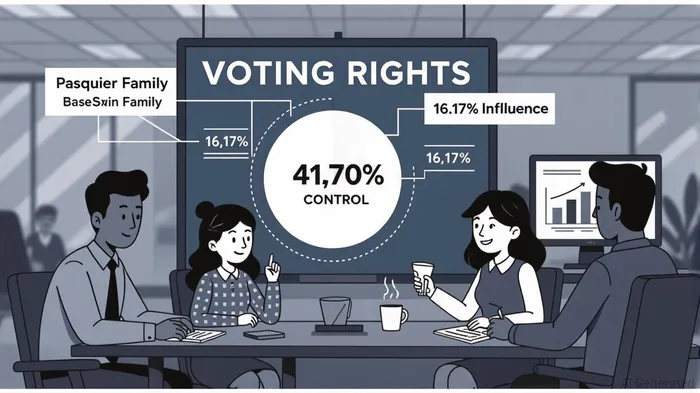
As of August 31, 2025, 74Software’s share capital comprises 29.75 million shares, with 41.29 million theoretical voting rights and 40.81 million exercisable voting rights [1]. This discrepancy between shares and voting rights suggests a non-proportional voting structure, a common feature in companies with dual-class share systems. According to a report by MoneyController, the Pasquier Family holds 41.50% of shares but 41.70% of voting rights, while the Odin Family owns just 0.26% of shares yet commands 16.17% of voting rights [3]. This inversion underscores a deliberate design to amplify the influence of specific stakeholders, particularly family shareholders.
Concentration of Power: The Pasquier and Odin Families
The Pasquier Family’s dominance is striking. With nearly 42% of voting rights, they wield disproportionate control over board appointments and strategic decisions, despite owning slightly fewer shares (41.50%) [3]. This dynamic mirrors structures seen in family-controlled firms like Alphabet or Samsung, where voting rights are engineered to preserve long-term ownership stability. Meanwhile, the Odin Family’s 16.17% voting stake—despite minimal share ownership—further complicates the governance landscape, potentially enabling minority shareholders to sway outcomes in critical votes.
Institutional investors, including Sopra Steria Group (11.07% shares) and treasury shares (2.15%), hold relatively smaller voting blocks compared to family stakeholders [2]. The public, which owns 54.95% of shares, controls 59.45% of voting rights [3], suggesting a majority that could theoretically counterbalance family influence. However, the fragmented nature of public ownership—spread across retail and institutional investors—often dilutes collective action, leaving concentrated shareholders with outsized leverage.
Implications for Corporate Governance
The 2024 Universal Registration Document, filed with the Autorité des Marchés Financiers (AMF), outlines 74Software’s governance framework, emphasizing transparency in share capital disclosures [4]. Yet, the absence of detailed proxy voting data or shareholder register specifics in the document [2] limits visibility into how these voting rights are exercised in practice. For instance, while the Pasquier Family’s voting power could ensure strategic continuity, it also raises risks of entrenchment, where minority shareholders may lack recourse against decisions that prioritize family interests over broader stakeholder value.
Conversely, the Odin Family’s voting rights—disproportionate to their shareholding—could serve as a check on Pasquier dominance, fostering a more pluralistic governance environment. This duality reflects a delicate balance between control and accountability, a hallmark of 74Software’s corporate architecture.
Investor Considerations
For investors, the key takeaway lies in understanding the mechanics of voting rights distribution. The Pasquier Family’s control ensures that long-term strategic goals, such as R&D investments or M&A activity, may align with family interests rather than short-term market pressures. However, this structure could also deter activist interventions or hostile takeovers, potentially stifling innovation or efficiency.
Data from Euronext’s company information portal highlights that managers hold 1.28% of voting rights [3], a modest but non-trivial stake that could influence executive compensation or operational decisions. Investors should monitor proxy voting trends and board composition to assess whether these dynamics align with their governance preferences.
Conclusion
74Software’s 2025 corporate governance model exemplifies the complexities of modern shareholder influence. While the Pasquier Family’s voting dominance ensures stability, it also necessitates scrutiny of decision-making processes to prevent governance capture. For investors, the challenge lies in evaluating whether this structure enhances long-term value or introduces risks of misalignment. As the company navigates a competitive software landscape, transparency in voting rights execution and shareholder engagement will be pivotal in maintaining trust.
**Source:[1] Information on the total number of voting rights and shares of 74Software share capital as of August 31, 2025 [https://www.globenewswire.com/news-release/2025/09/08/3145859/0/en/Information-on-the-total-number-of-voting-rights-and-shares-of-74Software-share-capital-as-of-August-31-2025.html][2] 74SOFTWARE | FR0011040500 | Company information [https://live.euronext.com/en/product/equities/FR0011040500-XPAR/company-information][3] 74Software SA: Investor Deck - May 2025 [https://www.moneycontroller.co.uk/finance-news/74software-sa/investor-deck-may-2025-2952712][4] 74Software:2024 Universal Registration Document Is Now [https://live.euronext.com/en/products/equities/company-news/2025-03-24-74software2024-universal-registration-document-now]







Comentarios
Aún no hay comentarios