
Assessing the Risks and Rewards of Politicized Meme Coins: The Case of Eric Adams' NYC Token
The intersection of politics and cryptocurrency has become a fertile ground for innovation-and controversy. In 2026, former New York City Mayor Eric Adams' "NYC Token" emerged as a high-profile example of a politically backed crypto project, blending social impact rhetoric with the volatile allure of meme coins. This article evaluates the viability and ethical concerns of such initiatives, using the NYC Token as a case study to dissect the broader risks and rewards of politicized crypto ventures.
The NYC Token: A Politicized Meme Coin?
The NYC Token, launched in early 2026, was marketed as a "commemorative digital asset" with a social mission: funding initiatives against antisemitism, anti-Americanism, and blockchain education for underserved communities. Adams, a vocal proponent of blockchain, framed the project as part of his broader vision to make New York the "crypto capital of the world." However, the token's classification as a meme coin-or at least its proximity to the genre-has sparked debate.
Meme coins, typically characterized by their reliance on viral culture and speculative hype, often lack clear utility or governance. The NYC Token's website, for instance, described it as a "movement" representing New York's "resilience," while its technical details remained opaque. This ambiguity mirrors the traits of meme coins like DogecoinDOGE-- or Shiba InuSHIB--, which derive value from community sentiment rather than tangible use cases. Adams himself criticized meme coins for prioritizing "frivolous" trends over long-term value, yet his project's execution-replete with vague whitepapers and nonfunctional website features-raised questions about its legitimacy.
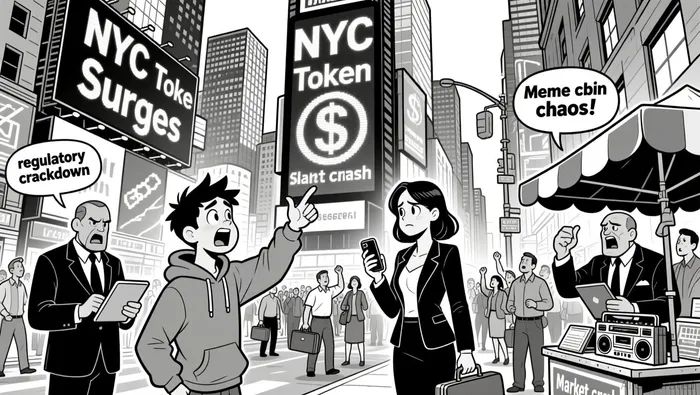
Ethical Controversies and Regulatory Scrutiny
The NYC Token's ethical challenges are multifaceted. First, there is the issue of conflict of interest. Adams, who faced prior DOJ allegations of bribery and illegal campaign donations (later dismissed), has been accused of leveraging his political influence to promote a personal crypto venture. While he claimed not to receive financial compensation for his involvement, critics argue that his endorsement inherently benefits the token's marketability.
Second, the project's transparency and accountability remain questionable. As of its launch, the token's website lacked functional links to purchase or read its whitepaper, and details about fund allocation or technical infrastructure were absent. This opacity is particularly problematic given the token's stated goal of funding social causes. Government ethics groups have highlighted the risks of politically backed crypto projects, where public trust can be exploited for private gain.
Regulatory hurdles further complicate the NYC Token's viability. Incoming Mayor Zohran Mamdani invalidated all prior Adams-era crypto initiatives, including the NYC Token, citing concerns over ethics and governance. This abrupt halt underscores the fragility of politically driven projects, which often depend on the tenure of their champions.
Adoption Rates and Market Realities
Adoption metrics for the NYC Token are sparse, but available data paints a mixed picture. The token reportedly had a market cap of $2.5 million with one billion tokens in supply and 10,000 holders. However, these figures pale in comparison to broader crypto trends: 30% of Americans owned cryptocurrencies in 2026, up from 27% in 2024. Institutional adoption has also grown, with 80% of financial institutions in key jurisdictions announcing digital asset initiatives.
The NYC Token's adoption, however, faces unique barriers. Acquiring the token requires users to navigate a complex process involving EthereumETH-- purchases, crypto wallets, and the UniswapUNI-- exchange. This complexity limits accessibility for non-technical users, a critical demographic for social impact projects. Moreover, the token's association with Adams' controversial legacy may deter institutional investors wary of reputational risk.
Case Studies: Blockchain's Proven Viability vs. Politicized Projects
While the NYC Token struggles with credibility, other blockchain initiatives in 2026 demonstrate the technology's potential. For example, OMOMO's decentralized money market protocol and Blockchain Australia's bullion-linked NFTs highlight blockchain's utility in financial services and asset tokenization. These projects succeeded by prioritizing regulatory compliance, clear use cases, and institutional partnerships-elements conspicuously absent in the NYC Token.
The contrast is stark. Projects like MiamiCoin, which generated $21.3 million for Miami, show how community-led crypto initiatives can align with public interests. Yet the NYC Token's lack of partnerships, technical blueprints, or measurable outcomes undermines its social impact claims.
Risks and Rewards: A Balanced Perspective
The risks of politicized meme coins like the NYC Token are manifold. Ethically, they risk exploiting public trust for speculative gains. Practically, they face regulatory headwinds and adoption barriers. Yet, the rewards of blockchain in governance- such as transparent fund allocation and decentralized identity systems-remain compelling.
For investors, the key lies in distinguishing between projects with genuine utility and those driven by hype. The NYC Token's failure to deliver on its promises-coupled with Adams' legal history-suggests a high-risk proposition. Conversely, blockchain's institutional adoption in 2026, supported by regulatory clarity and case studies like Pragmatic Coders, indicates a maturing industry capable of delivering long-term value.
Conclusion
Eric Adams' NYC Token exemplifies the double-edged sword of politicized crypto projects. While it taps into the growing enthusiasm for blockchain, its ethical ambiguities, regulatory vulnerabilities, and lack of transparency highlight the dangers of conflating political influence with technological innovation. For investors, the lesson is clear: the viability of politically backed crypto ventures hinges not on the charisma of their champions, but on their ability to deliver measurable value, adhere to ethical standards, and navigate regulatory landscapes. As the crypto space evolves, projects like the NYC Token serve as cautionary tales-reminders that not all digital assets are created equal.






Comentarios
Aún no hay comentarios