
Assessing the Risks and Rewards of Investing in Russian Banking Sector Amid High Profits and Underestimated Credit Risks
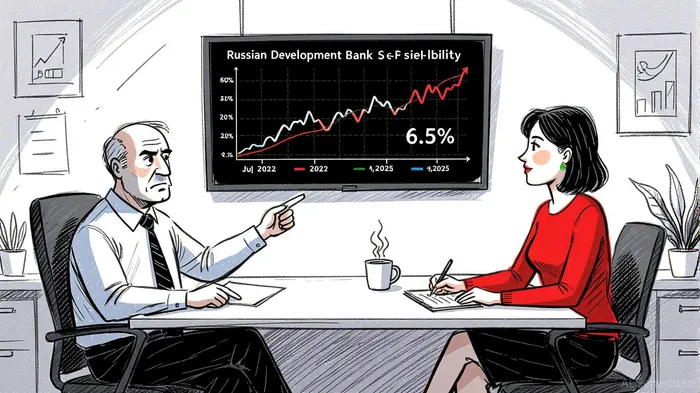
The Russian banking sector in 2024-2025 presents a paradox: record profits coexist with underestimated credit risks, shaped by geopolitical turbulence and regulatory adaptation. While banks like the Russian Development Bank have demonstrated resilience—reducing default probabilities from 1.254 in July 2022 to 0.495 by mid-2025 and upgrading their credit rating from B2 to A2 [1]—the broader economic environment remains fraught. Russia’s “D4” country risk rating, labeled as “HIGH RISK for enterprise,” underscores systemic challenges, including inflationary pressures (6.5% in 2024, 4.5% in 2025) and a shrinking current account surplus [2]. For investors, this duality demands a strategic due diligence framework that balances short-term gains with long-term geopolitical exposure.
Geopolitical Volatility and Sectoral Resilience
The Russian banking sector’s recent profitability—driven by Q3 2025 profits exceeding prior-year levels and a 11% capital increase over six months [2]—has masked deeper vulnerabilities. Despite returns on assets hovering near 1.9% [3], the sector faces corporate loan portfolio risks, particularly among small and micro businesses struggling with debt servicing [3]. These challenges are compounded by international sanctions, including SWIFT exclusions and hi-tech export restrictions, which have fragmented access to global capital markets [2].
Geopolitical risks have further intensified with the Trump administration’s Q3 2025 global tariff policies, which could indirectly strain Russian trade and banking liquidity [3]. Yet, the Bank of Russia’s digital prudential supervision regime and macroprudential buffers have mitigated some shocks, enabling the sector to avoid systemic collapse [2]. This resilience, however, should not be conflated with stability. As one report notes, “the banking system’s adaptability is a double-edged sword—enabling short-term survival but masking long-term fragility” [1].
Strategic Due Diligence: Mitigating Risks in a High-Risk Environment
For investors, due diligence must prioritize three pillars: compliance mechanisms, scenario planning, and regulatory adaptation.
Compliance and Sanctions Risk Mitigation
The U.S. Department of State explicitly warns that businesses in Russia face “significant exposure to sanctions and repressive laws” [3]. Investors must conduct rigorous audits of counterparty ties to sanctioned entities and ensure alignment with evolving export controls. For example, the 2014 sanctions crisis forced Russian banks to overhaul compliance frameworks, a lesson still relevant today [1].Scenario-Based Risk Modeling
Academic research emphasizes the need for stress-testing portfolios against geopolitical shocks, such as prolonged conflicts or abrupt sanctions. A 2025 study highlights that “scenario planning is not optional but a necessity for Russian banking investments, given the cascading impacts of geopolitical volatility on borrower repayment capacity” [2].Regulatory Adaptation and Digital Resilience
The Bank of Russia’s digital supervision regime offers a blueprint for investors to monitor real-time credit quality and liquidity metrics [2]. However, reliance on domestic regulatory buffers—while stabilizing—may create blind spots to external shocks, such as capital flight or currency depreciation.
The Path Forward: Balancing Rewards and Risks
While Russian banks’ Q3 2025 profits suggest short-term opportunities, investors must remain cautious. The sector’s profitability is partly propped up by government support and inflation-linked lending, which may erode as global trade shifts and sanctions persist [3]. A could further contextualize these dynamics.
In conclusion, the Russian banking sector offers high returns but demands a due diligence approach that transcends traditional financial metrics. By integrating geopolitical risk assessments, compliance rigor, and adaptive strategies, investors can navigate this volatile landscape—capitalizing on opportunities while safeguarding against underestimated credit risks.
Source:
[1] Russian Development Bank, [https://martini.ai/pages/research/Russian%20Development%20Bank-0f09abd1edfbf74007b75565185ac6f1]
[2] Russia Country Risk Report & Analysis, [https://www.allianz-trade.com/en_US/resources/country-reports/russia.html]
[3] Financial Stability Review | Bank of Russia, [https://www.cbr.ru/eng/analytics/finstab/ofs/4q_2024_1q_2025/]







Comentarios
Aún no hay comentarios