
Assessing the Risks and Opportunities for United Airlines Amid Potential Disruption in the Low-Cost Carrier Sector
The airline industry is at a crossroads. Legacy carriers like United AirlinesUAL--, long defined by their global networks and premium services, now face a dual challenge: inflation-weary travelers and the relentless innovation of low-cost carriers (LCCs). These LCCs are not merely undercutting prices—they are redefining the economics of air travel through strategic pricing models, technological agility, and customer-centric segmentation. For United, the question is no longer whether it can compete with LCCs but how it can adapt its sprawling business model to thrive in a market where cost efficiency and digital transformation are paramount.
The LCC Threat: Pricing Power and Technological Edge
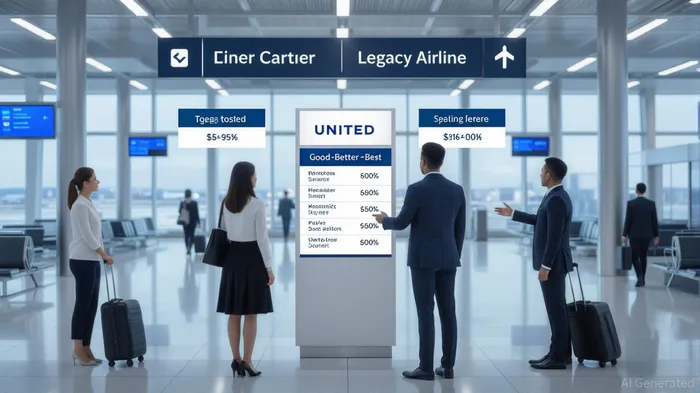
Low-cost carriers have weaponized pricing strategies that cater to shifting consumer priorities. The "Good-Better-Best" model, popularized by Harvard Business Review, allows LCCs to offer bare-bones options (e.g., "Basic Economy") while upselling ancillary services like seat selection, baggage allowances, and priority boarding [1]. This tiered approach not only captures price-sensitive travelers but also creates a revenue stream that rivals traditional fare-based models. Meanwhile, bundled pricing—grouping services into value packages—has proven effective in an inflationary environment, where travelers seek predictability over discounts [2].
Technological innovation further amplifies LCCs' competitive edge. AI-driven dynamic pricing and demand forecasting systems enable real-time fare adjustments, optimizing profitability while maintaining aggressive pricing [3]. For example, LCCs like SouthwestLUV-- and Spirit have leveraged these tools to dominate routes where United operates, particularly in domestic U.S. markets. The result? A shrinking margin of safety for legacy carriers, which must now contend with LCCs that are not only cheaper but also more agile in responding to market fluctuations.
United's Response: A Mixed Bag of Promotions and Promises
United Airlines has not been idle. The carrier has advertised competitive fares to secondary destinations like Scranton and State College, offering prices as low as $149 for economy class in the latter half of 2025 [4]. These promotions suggest a willingness to engage in price competition, but they lack the structural coherence of LCC strategies. United's broader route network—spanning 300+ international and domestic destinations—remains a strength, but it also represents a vulnerability: maintaining profitability across such a vast network requires balancing high-cost hubs with low-cost, high-frequency routes [5].
The airline has not disclosed specific technological investments or pricing model overhauls aimed at countering LCCs in 2025 [6]. This opacity raises questions about its preparedness for a sector increasingly defined by digital transformation. While United's recent promotions hint at a recognition of competitive pressures, they do not signal a systemic rethinking of its cost structure or customer segmentation.
Broader Economic Shifts: A Double-Edged Sword
Global economic trends complicate the landscape further. Rising U.S. tariffs and economic nationalism are reshaping supply chains, indirectly affecting airline operations through labor and fuel costs [7]. Meanwhile, the Future of Jobs Report 2025 underscores the transformative role of AI in industries ranging from logistics to customer service [8]. For United, this means both an opportunity to adopt AI-driven efficiencies (e.g., predictive maintenance, automated check-ins) and a risk of falling behind LCCs that prioritize technology as a core differentiator.
Strategic Vulnerabilities and Opportunities
United's primary vulnerability lies in its legacy cost structure. Unlike LCCs, which are designed for lean operations, United's reliance on hub-and-spoke networks and premium service offerings creates inherent inefficiencies. These are magnified in an inflationary environment, where travelers increasingly prioritize affordability over ancillary spending.
However, United's scale and brand equity remain significant assets. The airline could leverage its global footprint to differentiate itself by emphasizing premium experiences—business class lounges, loyalty programs, and seamless international connectivity—that LCCs cannot replicate. A strategic pivot toward hybrid pricing models, blending the flexibility of LCC tiers with United's existing premium offerings, could also attract a broader customer base.
Conclusion: A Race Against Time
The low-cost carrier sector is no longer a niche disruptor but a dominant force reshaping air travel. For United, the path forward requires a delicate balance: embracing cost-cutting and technological innovation without sacrificing the brand's identity as a premium carrier. The airline's recent promotions and route expansions are steps in the right direction, but they must be part of a larger, more transparent strategy to address LCC competition. Investors should watch closely for signs of structural change—whether in pricing models, technology adoption, or route optimization—as these will determine United's ability to navigate the turbulence ahead.





Comentarios
Aún no hay comentarios