
Assessing the Risks and Opportunities in DeFi Governance: The WLFI Controversy and Justin Sun’s Stake
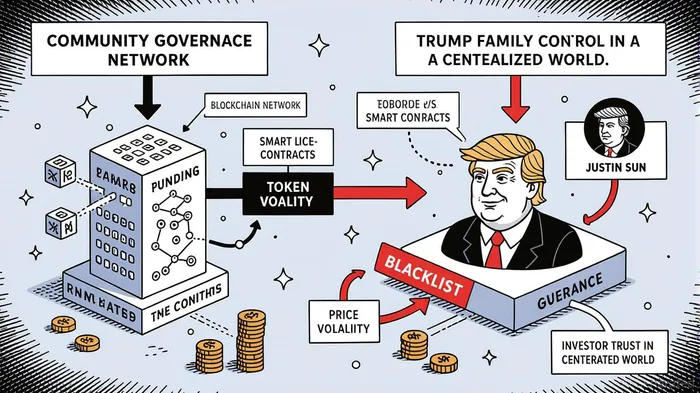
The decentralized finance (DeFi) space has long prided itself on its promise of trustless systems and democratic governance. Yet, the recent controversy surrounding World Liberty Financial (WLFI)—a crypto project tied to former U.S. President Donald TrumpTRUMP-- and blockchain entrepreneur Justin Sun—has exposed the fragility of these ideals. As WLFI’s token price plummeted 20% in 24 hours following a unilateral governance decision to blacklist Sun’s wallet, the incident has reignited debates about centralization, transparency, and investor trust in DeFi. This analysis unpacks the risks and opportunities embedded in WLFI’s governance structure, using the project as a case study for broader DeFi challenges.
The WLFI Launch: Ambition and Centralization
WLFI’s September 1, 2025, debut was met with both hype and skepticism. Listed on major exchanges like Binance and CoinbaseCOIN--, the token briefly hit a $7.9 billion market cap before dropping 34% within hours, raising accusations of insider dumping [1]. Critics pointed to the Trump family’s staggering 22.5 billion token stake—equivalent to $5 billion at current prices—and their 60% ownership of the parent company as evidence of centralized control [3]. This concentration of power contradicts DeFi’s foundational ethos of distributed governance, creating a paradox: a project marketed as decentralized yet governed by a politically influential family.
The Trump family’s influence extends beyond ownership. They reportedly receive 75% of token sale revenues, further entangling their financial interests with WLFI’s governance decisions [3]. Such arrangements risk conflicts of interest, particularly as Trump’s political role (e.g., potential 2024 presidential campaign) could clash with his private enterprise ambitions. This duality has left investors questioning whether WLFI’s governance is truly community-driven or a vehicle for centralized profit extraction.
Justin Sun’s Blacklist: A Governance Crisis
The controversy escalated on September 2, 2025, when WLFI’s leadership used the token contract’s guardianSetBlacklistStatus function to freeze Sun’s wallet after he transferred $9 million worth of tokens to exchanges like HTX [1]. This action immobilized 540 million unlocked tokens ($100 million) and 2.4 billion locked tokens, triggering a 20% price drop. Sun defended the transfers as “exchange deposit tests” but faced accusations of market manipulation due to the timing and scale of the transactions [2].
The unilateral nature of the blacklist decision—executed without community voting—highlighted a critical flaw in WLFI’s governance model. While DeFi projects often tout on-chain governance as a safeguard against centralization, WLFI’s leadership retained the power to override community input. This incident eroded trust, with critics arguing that the project’s “decentralized” branding is a misnomer [5].
Investor Trust and Market Reactions
WLFI’s price has since partially recovered to $0.18, but it remains 15% below its $0.46 launch price [4]. The volatility underscores the fragility of investor confidence in projects with opaque governance. A recent token burn of 47 million WLFI (0.19% of the circulating supply) aimed to stabilize prices, but the move was overshadowed by ongoing centralization concerns [3].
The controversy has also cast a shadow over WLFI’s USD1 stablecoin, which grew to a $2.5 billion market cap in five months [1]. While USD1’s success demonstrates demand for alternative stablecoins, its association with WLFI’s governance risks could deter institutional adoption. Regulators and investors are increasingly scrutinizing projects where political ties and centralized control coexist.
Opportunities Amid Risks
Despite the setbacks, WLFI’s ecosystem presents opportunities for those willing to navigate its risks. The Trump family’s massive token holdings could act as a stabilizing force if managed transparently, while USD1’s growth suggests a viable use case for the project’s infrastructure. Additionally, Sun’s public appeal for wallet unfreezing—framed as a call for “fairness and trust”—could catalyze governance reforms [5].
However, these opportunities hinge on WLFI’s ability to address centralization. A transition to community-driven governance, coupled with clearer tokenomics and regulatory compliance, could restore investor confidence. For now, the project remains a cautionary tale: decentralization is not a binary state but a spectrum, and WLFI’s governance model sits perilously close to the centralized end.
Conclusion: The Future of DeFi Governance
The WLFI controversy underscores a broader challenge in DeFi: balancing innovation with accountability. While projects like WLFI aim to disrupt traditional finance, their reliance on centralized control undermines their credibility. Investors must weigh the potential rewards of high-growth tokens against the risks of governance failures, regulatory scrutiny, and reputational damage.
For WLFI to survive, its leadership must prioritize transparency and decentralization. Until then, the project serves as a stark reminder that in DeFi, trust is not inherent—it is earned, one governance decision at a time.
**Source:[1] Justin Sun's WLFI Address Blacklisted After $9M Transfer [https://www.ccn.com/education/crypto/justin-sun-9m-wlfi-blacklist-explained/][2] The full story behind WLFI, Trump, and Justin Sun's frozen ... [https://crypto.news/wlfi-trump-justin-sun-frozen-wallet-bromance/][3] WLFI World Liberty Financial [https://cryptoslate.com/coins/world-liberty-financial/][4] Top 5 Things You Should Know About WLFI: Key Insights ... [https://www.okx.com/en-us/learn/top-5-things-about-wlfi][5] Justin Sun publicly asks for the unfreezing of his WLFI tokens [https://coinjournal.net/news/justin-sun-publicly-asks-for-the-unfreezing-of-his-wlfi-tokens/]






Comentarios
Aún no hay comentarios