
Assessing the Risks and Opportunities in Colombia's Coca-Driven Conflict Zones
The 2016 peace agreement between the Colombian government and the Revolutionary Armed Forces of Colombia (FARC) was hailed as a historic breakthrough, yet its legacy remains deeply fractured. While the accord initially reduced violence, it created a power vacuum that has since been exploited by dissident FARC factions, the National Liberation Army (ELN), and transnational criminal groups like the Gulf Clan. These actors now dominate coca-growing regions, perpetuating instability and undermining efforts to transition to legal economies. For investors, the implications are stark: narcotics-linked instability and failed peace agreements have transformed Colombia's coca zones into high-risk corridors where agricultural, infrastructure, and foreign direct investment (FDI) projects face systemic threats.
The Fractured Peace and Escalating Violence
The 2016 agreement's implementation has been glacial. As of May 2024, only 33% of its stipulations had been fully realized, with 37% showing minimal progress and 20% at an intermediate stage[2]. Key components—rural development, crop substitution, and reintegration of former combatants—remain unmet, leaving communities economically dependent on coca cultivation. The government's “total peace” strategy, aimed at demobilizing armed groups, has yielded limited results. Instead, violence has intensified, with over 121,000 people displaced between January and July 2024 due to territorial clashes[1].
The collapse of a bilateral ceasefire with the ELN in August 2024 further exacerbated tensions, triggering a surge in attacks on security forces and civilians. According to Human Rights Watch, armed groups continue to commit abuses such as child recruitment and forced displacement, particularly in Chocó, Cauca, and Nariño[1]. This instability deters investment, as companies and governments prioritize security over long-term commitments in regions where state presence is weak.
Sector-Specific Risks: Agriculture and Infrastructure
Coca cultivation remains a critical—if illicit—economic activity in rural Colombia. It contributes approximately 0.4% to the national economy during growth periods and accounts for 10.5% of income in small coca-growing municipalities[3]. However, this economic role is a double-edged sword. Farmers cite coca's profitability compared to legal alternatives, while forced eradication campaigns—often conducted manually—have proven ineffective. Replanting rates exceed 40–50%, and such efforts frequently alienate communities, pushing them into the orbit of armed groups[3].
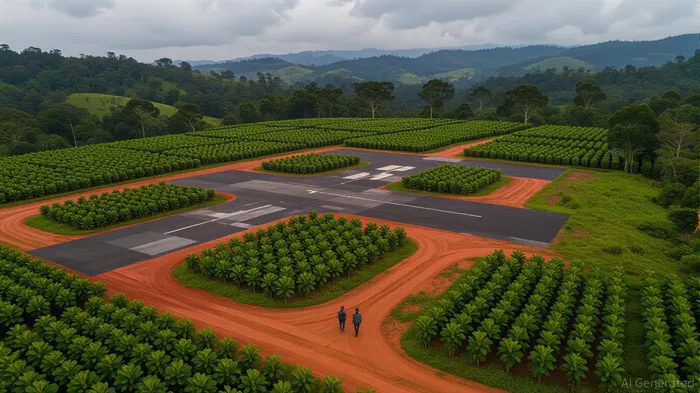
Infrastructure development in coca zones is equally fraught. Clandestine landing strips and docking bays discovered in Nariño and Cauca underscore the integration of coca with illicit transportation networks[3]. Projects requiring access to these regions face delays, cost overruns, and security risks. For example, the Canon del Micay region, a focal point of the 2016 peace accord, remains under the control of armed groups, stalling promised infrastructure and social projects[1].
Investment Climate and Geopolitical Tensions
Colombia's investment climate has deteriorated in recent years. MorningstarMORN-- DBRS downgraded the country's credit rating in 2024, citing a negative economic outlook and a 5-percentage-point decline in investment rates since 2020[4]. While Latin America as a whole attracted 15% of global FDI in 2023—double its share of the global economy[5]—Colombia's coca zones lag behind. The World Economic Forum's Global Risks 2025 report highlights state-based conflicts and geoeconomic confrontation as material risks, further clouding investor sentiment[4].
U.S. anti-narcotics funding and security cooperation with Colombia have also been strained by the government's focus on “total peace.” Critics argue that diplomatic overtures to Venezuela and the ELN have diluted efforts to combat drug trafficking, creating uncertainty for investors reliant on stable security frameworks[6].
Pathways to Stability and Investment
Despite these challenges, opportunities exist for investors willing to navigate Colombia's complex landscape. The Crisis Group emphasizes that coercive eradication alone cannot resolve the crisis; instead, a shift toward comprehensive rural development and crop substitution is essential[3]. Successful agroforestry initiatives, such as cacao cultivation in post-conflict areas, offer a blueprint for sustainable alternatives[7].
For infrastructure, partnerships with local communities and private-sector actors could mitigate risks. Projects that integrate security with economic development—such as road-building tied to crop substitution programs—might attract FDI by addressing both instability and market needs. However, such efforts require political will and long-term commitment, which remain elusive under current governance.
Conclusion
Colombia's coca-driven conflict zones exemplify the interplay of failed peace agreements, narcotics-linked instability, and investment risk. While the 2016 accord offered hope, its incomplete implementation has entrenched cycles of violence and economic dependency. For investors, the path forward lies in balancing short-term security concerns with long-term development strategies. Until Colombia addresses the root causes of instability—through rural development, effective governance, and sustainable alternatives to coca—its coca zones will remain a high-risk, low-reward frontier.







Comentarios
Aún no hay comentarios