
Assessing the Risk-Reward Profile of NRG Energy's Debt Capital Raise Strategy: A Deep Dive into Senior Secured and Unsecured Notes
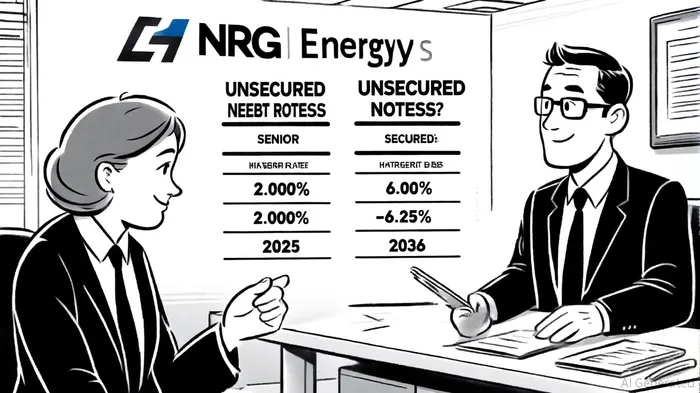
NRG Energy, Inc. has embarked on an aggressive debt capital raise strategy in 2025, issuing both senior secured and unsecured notes to fund its acquisition of Lightning Power and refinance existing obligations. This move underscores the company's balancing act between leveraging low-cost secured debt and issuing higher-yielding unsecured debt to meet its financial objectives. For investors, understanding the risk-reward dynamics of these instruments is critical to evaluating their alignment with portfolio goals.
Senior Secured Notes: Collateral as a Safety Net
NRG's recent offerings include $500 million in aggregate principal amount of 2.000% senior secured first lien notes due 2025, alongside longer-dated secured notes maturing in 2030 and 2035 [1]. These instruments are backed by a first-priority security interest in NRG's core assets, including property and those pledged under its credit agreement [2]. This collateralization significantly reduces default risk for holders, as secured creditors would have priority claims on assets in liquidation scenarios.
However, the low interest rate of 2.00% on the 2025 notes reflects the current low-rate environment and the security provided by collateral. While this offers stability, the short maturity (less than a year as of September 2025) introduces refinancing risk for NRGNRG--. The company plans to use proceeds from the new secured offerings to repay these notes in full at maturity [3], avoiding potential liquidity strain.
Senior Unsecured Notes: Higher Yields, Higher Risks
In contrast, NRG's unsecured notes—priced at 6.00% for 2033 and 6.25% for 2034—offer substantially higher yields, reflecting their subordination to secured debt [4]. These instruments lack direct collateral but are guaranteed by NRG's wholly-owned U.S. subsidiaries [5]. Their risk-reward profile hinges on the company's creditworthiness and operational performance.
Fitch Ratings has assigned 'BBB-' to senior secured debt and 'BB+' to unsecured debt, with a stable outlook for the latter [6]. S&P Global Ratings similarly affirmed a 'BB+' issuer credit rating, indicating a speculative-grade profile but with positive momentum due to NRG's raised 2025 earnings guidance . While these ratings suggest manageable default risk, unsecured holders face greater exposure to credit downgrades or operational setbacks.
Historical analysis of NRG's earnings releases from 2022 to 2025 reveals that post-earnings performance has been mixed. For example, the average 30-day excess return following earnings announcements was approximately 2.5% versus the S&P 500's 5.5%, with a win rate of 50-65% across most holding windows. These results suggest that earnings events have not provided a strong predictive signal for stock performance, underscoring the importance of broader market and operational factors for unsecured note holders.
Covenants and Structural Protections: A Mixed Bag
The secured notes benefit from robust structural protections, including first-lien status on NRG's collateral. However, covenant details remain sparse in public filings, leaving gaps in understanding liquidity constraints or financial ratios that could trigger defaults. Unsecured notes, meanwhile, rely entirely on NRG's credit profile, making them more sensitive to market volatility or sector-specific risks, such as regulatory shifts in the energy industry.
Risk-Reward Trade-Off: Which Notes Fit Your Portfolio?
For risk-averse investors, the senior secured notes present an attractive option. Their low yields compensate for minimal default risk, particularly given NRG's stable credit outlook and asset-backed guarantees. However, the short maturity of the 2025 notes limits long-term income potential.
Conversely, the senior unsecured notes appeal to income-seeking investors willing to accept higher volatility. The 6.00%–6.25% yields are competitive in today's market, especially considering NRG's recent financial improvements. Yet, these instruments require confidence in NRG's ability to sustain profitability amid challenges like rising interest rates or acquisition integration risks.
Conclusion: Strategic Debt for Growth, But Caution Remains
NRG's debt strategy reflects a calculated approach to funding growth while managing liquidity. The secured notes provide a stable foundation, while the unsecured offerings tap into investor appetite for higher yields. However, the absence of detailed covenant terms and reliance on speculative-grade ratings for unsecured debt warrant careful scrutiny. Investors should weigh NRG's strong collateral position against its credit trajectory and macroeconomic headwinds before committing capital.





Comentarios
Aún no hay comentarios