
Assessing the Risk-Reward Profile of Long-Term Crypto Whales' Positions in a Volatile Market: Strategic Positioning and Implications for Retail Investors in the Solana Ecosystem
In the volatile landscape of 2025, SolanaSOL-- (SOL) has emerged as a focal point for both institutional and retail investors, with long-term crypto whale positions playing a pivotal role in shaping market dynamics. As the network navigates critical price thresholds and on-chain activity intensifies, understanding the strategic behavior of whales-large holders of SOL-offers actionable insights for smaller investors. This analysis examines the risk-reward profiles of whale positioning, highlights contrasting outcomes from recent market cycles, and explores how retail participants can leverage these patterns to navigate Solana's ecosystem effectively.
Whale Accumulation and Distribution: A Barometer of Market Confidence
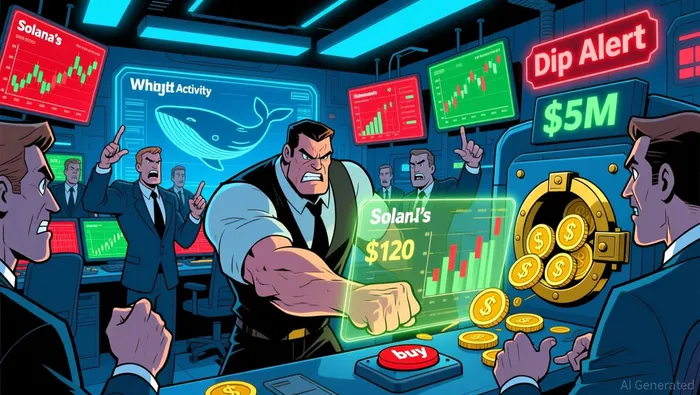
Solana's whale activity in late 2025 has underscored the interplay between strategic accumulation and market volatility. During the December 18 dip, when SOLSOL-- fell below $120, whale wallets collectively purchased over 41,000 SOL, amounting to $5 million in inflows. This surge in buying pressure, as noted by blockchain analytics platforms, reflects institutional confidence in Solana's long-term recovery and serves as a bullish signal for the broader market. Such accumulation patterns mirror historical cycles, where whales use market downturns to build positions, countering short-term retail selling pressure.
 Conversely, distribution phases reveal the risks of overexposure. For instance, the whale at address "0x3cd" incurred an $8.5 million loss through high-leverage positions on wrapped BitcoinWBTC--, illustrating the perils of excessive risk-taking in volatile markets. These contrasting outcomes highlight the dual nature of whale activity: while disciplined accumulation can stabilize prices, reckless trading amplifies downside risks.
Strategic Position Sizing and Risk Management: Lessons for Retail Investors
The disparity in whale outcomes offers critical lessons for retail investors. The whale at address "0x0e4," for example, demonstrated advanced risk management by selling half of its 50,000 SOL position-accumulated at $169.6 each-to secure a $313,000 profit while retaining a large unrealized gain. This approach emphasizes position sizing and profit realization, principles that retail investors can adopt to mitigate exposure to sudden market swings.
In contrast, the collapse of "0x3cd's" 20x leveraged position underscores the dangers of over-leveraging, particularly in synthetic and wrapped asset markets. As stated by blockchain analysts, such strategies amplify losses during rapid price corrections, a risk that small investors must avoid. For retail participants, this reinforces the importance of maintaining conservative leverage ratios and prioritizing capital preservation over aggressive speculation.
Institutional Inflows and On-Chain Metrics: A Tailwind for Solana
Beyond individual whale behavior, broader institutional trends have bolstered Solana's ecosystem. In December 2025, Solana ETFs recorded $11 million in net inflows, signaling sustained demand and providing a stabilizing force amid volatility. These inflows, combined with robust on-chain metrics-such as high daily active addresses and growing total value locked (TVL) in DeFi protocols-suggest that Solana's fundamentals remain resilient despite price fluctuations.
For retail investors, this institutional tailwind presents an opportunity to align with long-term trends. By monitoring whale activity and on-chain data, smaller participants can identify entry points during dips, as seen in the December 18 accumulation event. Additionally, tools like AI-driven financial models (e.g., Tickeron's FLMs) offer real-time insights into bullish and bearish signals, enabling data-backed decision-making.
Navigating Volatility: A Framework for Retail Investors
To capitalize on Solana's whale-driven dynamics, retail investors should adopt a structured approach:
1. Monitor Key Support Levels: Solana's $130 support level in November 2025 acted as a psychological threshold for both whales and retail traders. Breakouts or retests of such levels can signal accumulation or distribution phases.
2. Leverage Whale Activity as a Contrarian Indicator: Whale accumulation during dips often precedes price recoveries, while large sell-offs may indicate short-term bearish sentiment.
3. Prioritize Position Sizing and Diversification: Retail investors should avoid overconcentrating capital in high-leverage positions and instead adopt a diversified portfolio to hedge against volatility.
Conclusion: Balancing Opportunity and Caution
The Solana ecosystem in 2025 exemplifies the duality of crypto markets: whales can act as both stabilizers and destabilizers, depending on their strategies. For retail investors, the key lies in balancing opportunistic participation with disciplined risk management. By analyzing whale behavior, leveraging institutional trends, and adopting conservative trading practices, smaller participants can navigate Solana's volatility while aligning with its long-term growth trajectory.
As the market evolves, the lessons from whale positioning-whether in accumulation, profit-taking, or risk mitigation-will remain a critical compass for investors seeking to thrive in a high-stakes, decentralized economy.






Comentarios
Aún no hay comentarios