
Assessing Regional Stability Risks in Southeast Asia: Implications for Investors Amid Thai-Cambodia Tensions
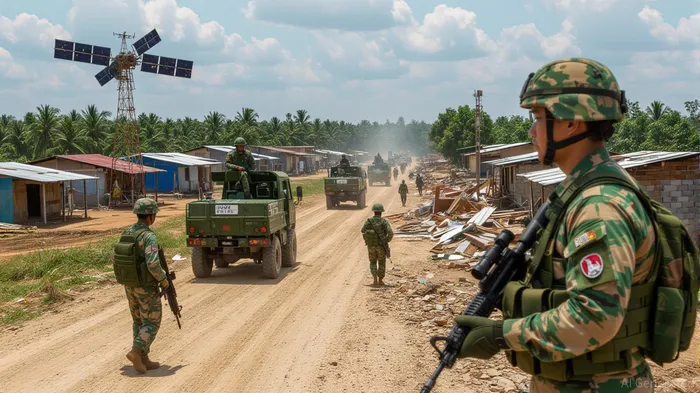
The Thai-Cambodia border conflict, now in its third week of open hostilities, has evolved into one of the most destabilizing crises in Southeast Asia in over a decade. What began as a territorial dispute rooted in colonial-era border demarcations has escalated into a full-scale military confrontation, with artillery exchanges, airstrikes, and the use of banned cluster munitions. For investors, the fallout extends far beyond the battlefield. The conflict has disrupted a $1.2 billion annual trade corridor, triggered a 12% plunge in Cambodia's stock market, and exposed the fragility of ASEAN's economic integration agenda. As regional tensions ripple outward, the interplay between geopolitical volatility and asset valuations demands a nuanced, sector-specific approach to risk management.
The Economic Fallout: Trade Disruption and FDI Retreat
The closure of all seven Thai-Cambodia border crossings since July 24 has crippled cross-border trade, which accounted for 109.16 billion baht of Thailand's trade surplus in 2024. Key sectors such as agriculture, energy, and consumer goods are particularly vulnerable. Thailand's $3 billion surplus with Cambodia—driven by exports of auto parts, beverages, and agricultural machinery—is now under threat as companies like Carabao Group and President Foods scramble to stockpile supplies and reroute logistics. Meanwhile, Cambodia's reliance on Thai imports of cassava and scrap metal has forced a pivot toward Vietnamese and Singaporean suppliers, benefiting firms like Petronas and Petrovietnam.
Foreign direct investment (FDI) has also suffered. Thai businesses, which accounted for 62,733 jobs in Cambodia in 2024, are reassessing their exposure to a region where 200,000 civilians have been displaced and tourism—a 9% GDP contributor for Cambodia—has collapsed by 70%. The Thai baht's 0.3% depreciation against the U.S. dollar since the conflict began further signals investor anxiety.
Stock Market Volatility: Defense vs. Tourism
The conflict has created stark divergences in sector performance. Thai Aerospace Industries (TAA) and Siam Defense Systems (SDS) have surged 15% above the SET Index since May 2025, capitalizing on a 20% year-over-year increase in defense spending. Cambodia's military modernization—backed by Chinese-supplied QW-3 Vanguard missiles—has further fueled regional arms competition. Conversely, tourism and retail stocks have underperformed, with companies like Bangkok Airways and Asean Leisure experiencing double-digit declines.
Logistics firms rerouting shipments through Laos and Vietnam have gained traction, with Singapore-based Pan-Asia Freight and Malaysia's Maylong Logistics charging a 30% premium for alternative corridors. Cybersecurity and surveillance firms, such as Thai ICT Solutions (TICS), have also seen demand spike amid fears of hybrid warfare.
ASEAN's Fragile Economic Architecture
The crisis has exposed ASEAN's inability to enforce cross-border stability. Designed to insulate member states from external shocks, the bloc now faces a stark reality: bilateral conflicts can unravel regional trade frameworks. Companies are increasingly adopting contingency plans, including digital customs platforms and emergency coordination centers, but the lack of a unified response mechanism remains a critical weakness.
The rerouting of shipments through the CLV (Cambodia-Laos-Vietnam) economic triangle has created new opportunities for Vietnamese and Indonesian firms. Vietnam's 0% tariff agreement with the U.S., secured in exchange for a 20% tariff on Vietnamese goods, has already widened its trade surplus with the U.S. to three times Thailand's. Meanwhile, Indonesia's $15 billion energy pact with the U.S. and purchase of 50 BoeingBA-- aircraft highlight a strategic realignment in Southeast Asia's economic hierarchy.
Strategic Opportunities Amid Chaos
For investors, the crisis presents asymmetrical opportunities:
- Defense and Infrastructure: The surge in demand for drones, surveillance tech, and logistics solutions offers long-term growth potential. Thai Aerospace Industries (TAA) and Siam Defense Systems (SDS) are well-positioned to benefit from regional arms competition.
- Humanitarian Aid: Companies supplying emergency shelters, medical supplies, and water purification systems are likely to see increased demand. Thai-based humanitarian firms like Red Cross Thailand and international NGOs operating in the region could attract ESG-focused capital.
- Conflict-Adjacent Infrastructure: Alternative trade corridors, such as the India–Myanmar–Thailand highway, are gaining traction. Investors in regional infrastructure projects—particularly those involving digital customs platforms—could capitalize on ASEAN's push for contingency planning.
Hedging Strategies for Investors
Given the fluidity of the situation, strategic hedging is essential:
- Avoid Overexposure to Cambodia's Tourism Sector: With international arrivals down 70% in July 2025, investors should prioritize Thai government bonds (currently yielding 3.2%) or diversify into Vietnam's tourism hubs like Da Nang or Malaysia's Langkawi.
- Prioritize Defense and Logistics Sectors: Thai Aerospace Industries (TAA) and Siam Defense Systems (SDS) offer defensive exposure to a volatile region.
- Monitor ASEAN Diplomacy: The September 2025 Joint Boundary Commission meeting and Malaysia's role as ASEAN chair will be critical indicators for de-escalation.
Conclusion
The Thai-Cambodia conflict is a microcosm of Southeast Asia's broader geopolitical challenges. While the short-term outlook remains volatile, the crisis also accelerates opportunities in defense, humanitarian aid, and infrastructure. For investors, the key lies in balancing caution with strategic foresight—leveraging sector-specific growth while hedging against regional instability. As ASEAN grapples with its role in crisis management, the ability to navigate this dual-edged landscape will define long-term success in Southeast Asia's markets.







Comentarios
Aún no hay comentarios