
Assessing Redstone's Token Circulation Strategy: Long-Term Implications for RED's Value and Market Dynamics
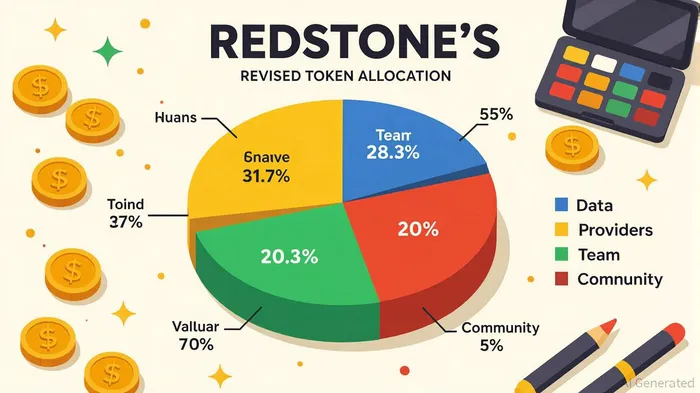
Redstone's REDRED-- token has emerged as a pivotal asset in theTHE-- blockchain oracleADA-- space, but its tokenomics strategy has been a double-edged sword. While the project's structured approach to supply management and ecosystem incentives aims to stabilize value, recent controversies and strategic pivots raise critical questions about long-term sustainability. This analysis unpacks the mechanics of Redstone's token circulation strategy, evaluates its implications for RED's market dynamics, and assesses whether the project can rebuild trust while maintaining investor confidence.
Token Supply and Distribution: A Foundation for Stability or Volatility?
Redstone's RED token has a hard cap of 1 billion units, with 28% entering circulation at the February 2025 Token Generation Event (TGE) and an additional 2% unlocked upon Binance's Pre-Market listing [2]. The remaining 72% is locked and scheduled to unlock over four years, a design intended to prevent dumping and create predictable supply growth [1]. This gradual release aligns with broader DeFi trends prioritizing long-term value accrual over short-term speculation.
However, the token's utility as a staking asset for Redstone's EigenLayerEIGEN-- Actively Validated Service (AVS) introduces a critical variable. By incentivizing data providers and securing network participation, RED's demand is tied to the protocol's adoption rate. According to the RedstoneRED-- blog, 48.3% of the total supply is allocated to ecosystem growth, including airdrops and developer incentives [2]. While this fosters organic adoption, it also risks oversupply if demand for staking or governance participation fails to materialize.
Strategic Adjustments in Q3 2025: Balancing Supply and Demand
Redstone's Q3 2025 update introduced a more rigid framework for managing token circulation. The project announced a trial upward circuit breaker on Binance to mitigate volatility during the token's initial trading phase [2]. This mechanism, which temporarily halts trading if prices surge beyond a predefined threshold, reflects a proactive stance on market stability.
The four-year unlock schedule for 72% of the token supply further underscores Redstone's focus on controlled supply dynamics. By staggering releases, the team aims to align token availability with network growth, ensuring that increased supply is offset by rising demand from stakers and data providers. As stated by the Redstone blog, this approach is designed to “build investor confidence through sustainable and transparent token management” [1].
Airdrop Controversy and Its Aftermath: Trust Erosion and Market Reactions
The most contentious aspect of Redstone's token strategy has been its airdrop allocation. Initially promising 9.5% of the total supply to the community, the project abruptly reduced this to 5%, triggering backlash and prompting Binance to suspend the RED listing just hours before its scheduled launch [2]. Critics argued that the move prioritized early investors and team allocations over community engagement, undermining the project's decentralization ethos.
In response, Redstone committed to allocating an additional 2% to community contributors and distributing 4.5% over six months [2]. While this revised plan allowed Binance to resume the listing, the incident exposed vulnerabilities in the project's governance and communication. Trust, once fractured, is difficult to rebuild—a reality that could haunt Redstone's long-term value proposition.
Long-Term Implications: Can Redstone Deliver on Its Vision?
The success of Redstone's token strategy hinges on three factors: network adoption, market sentiment, and ecosystem resilience.
Network Adoption: RED's utility as a staking token is its strongest asset. If Redstone's AVS gains traction across multiple blockchains, demand for RED will rise, counterbalancing the gradual supply unlock. However, if adoption stalls, the token could face downward pressure from oversupply.
Market Sentiment: The airdrop controversy has left a lasting scar. While the revised allocation addresses immediate concerns, the project must demonstrate consistent transparency to regain community trust. A lack of trust could deter participation in staking and governance, further weakening RED's value proposition.
Ecosystem Resilience: Redstone's 48.3% allocation to ecosystem growth is a double-edged sword. While it fuels innovation and adoption, it also risks diluting value if incentives are misaligned with long-term goals. The project must balance short-term incentives with sustainable governance to avoid token inflation.
Conclusion: A Calculated Gamble
Redstone's token circulation strategy is a calculated gamble. The four-year unlock schedule and circuit breaker mechanisms signal a commitment to stability, but the airdrop controversy and reliance on ecosystem incentives introduce significant risks. For RED to thrive long-term, Redstone must prove that its tokenomics align with both network utility and community interests. Investors should monitor key metrics: staking participation rates, AVS adoption, and the project's ability to rebuild trust. In a market where trust is currency, Redstone's next moves will define its legacy.







Comentarios
Aún no hay comentarios