
Assessing POPCAT's Short-Term Volatility and Long-Term Investment Viability
The Volatility Conundrum: Technical Signals and Sentiment Swings
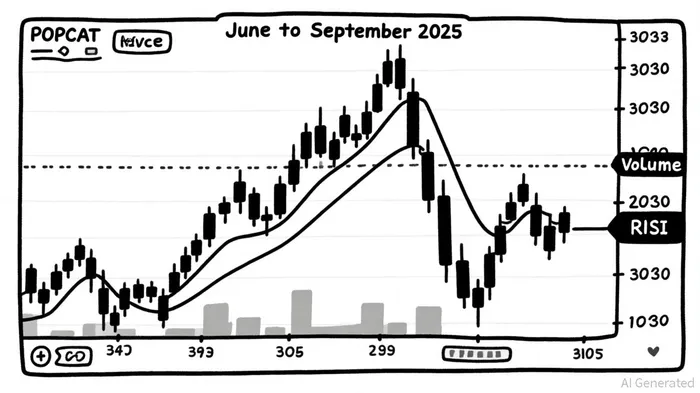
Popcat (POPCAT), the Solana-based memeBOME-- coin, has become a case study in short-term volatility and sentiment-driven price action. By September 2025, the token had fallen from a mid-June peak of $0.2904 to $0.2238, a 23% decline, despite intermittent surges in trading volume exceeding $86 million in July [1]. Technical indicators paint a mixed picture: while the RSI (Relative Strength Index) dipped to 34 in June—near oversold territory—suggesting potential rebounds, the price remained below both 20-day and 50-day moving averages, signaling sustained bearish pressure [1].
The Bollinger Bands model identified a critical support level at $0.285 in June, but subsequent price action failed to hold above $0.315, the 20-day moving average [1]. By September, POPCAT had settled into a descending triangle pattern, with key resistance at $0.59 and support at $0.33. Analysts caution that a break below $0.33 could accelerate the downtrend, while a rebound above $0.345 might trigger a short-term rally [3]. Meanwhile, on-chain metrics like Chaikin Money Flow (CMF) and On-Balance Volume (OBV) showed rising inflows, hinting at lingering institutional or retail interest [1].
Sentiment as a Double-Edged Sword
Social media sentiment and on-chain activity remain central to POPCAT's narrative. The token's Fear and Greed Index, which aggregates social media, news, and on-chain data, oscillated between “Extreme Fear” and “Greed” in late 2025, reflecting the emotional extremes typical of meme coins [2]. Community engagement, however, has remained robust, with 350,000 monthly visitors to POPCAT's ecosystem as of June 2025, driven by on-chain mini-games and NFT airdrops [1].
Yet, large holder activity suggests caution. A decline in addresses holding over 500,000 POPCAT tokens in June indicated profit-taking, potentially exacerbating short-term selling pressure [1]. Listings on platforms like Robinhood in March 2025 further amplified retail participation, but this accessibility also makes the token susceptible to sudden shifts in sentiment [3].
Long-Term Viability: Meme Utility or SolanaSOL-- Ecosystem Play?
While POPCAT lacks intrinsic utility compared to traditional cryptocurrencies, its role in the Solana ecosystem offers a unique value proposition. The token has been integrated into tipping, gaming, and social interactions, leveraging Solana's low-fee infrastructure to foster microtransactions [3]. Analysts at CoinLore project a 2025 price range of $1.11 to $1.77, contingent on broader crypto market conditions and Solana's adoption [3]. However, more conservative forecasts suggest a range of $0.38 to $0.55, emphasizing the risks of overvaluation in a speculative asset [3].
The token's long-term success hinges on its ability to transition from a meme-driven narrative to a utility-based one. While the Solana ecosystem's growth could benefit POPCAT, its lack of tangible use cases beyond virality remains a hurdle. As one analyst noted, “POPCAT's future depends on whether it can evolve from a viral joke to a functional asset within Solana's expanding ecosystem” [3].
Investment Strategy: Navigating the Volatility
For investors, POPCAT presents a high-risk, high-reward scenario. Short-term traders might focus on defined support ranges ($0.28–$0.33) with tight stop-loss orders, while long-term holders could consider dollar-cost averaging to mitigate volatility [1]. However, the token's susceptibility to macroeconomic trends—such as BitcoinBTC-- dominance and broader market sentiment—means external factors could override technical or on-chain signals [3].
In conclusion, POPCAT's short-term volatility is a product of its meme-driven nature and speculative trading, while its long-term viability depends on Solana's ecosystem growth and the token's ability to carve out a functional role. Investors must balance technical signals with sentiment analysis and macroeconomic context to navigate this high-stakes asset.







Comentarios
Aún no hay comentarios