
Assessing Political Stability and Executive Leadership in Trump's Second Term: Implications for U.S. Market Dynamics
The Trump administration's second term has been marked by a volatile mix of bold policy shifts, internal discord, and a leadership style that challenges conventional governance norms. At the center of this dynamic is Susie Wiles, the White House chief of staff, whose candid assessments of President Donald J. Trump's personality and decision-making processes have offered a rare glimpse into the administration's inner workings. For investors, Wiles' role in shaping policy and navigating internal tensions raises critical questions about political stability, regulatory risks, and long-term market implications across energy, technology, and defense sectors.
Wiles' Candid Insights and Governance Challenges
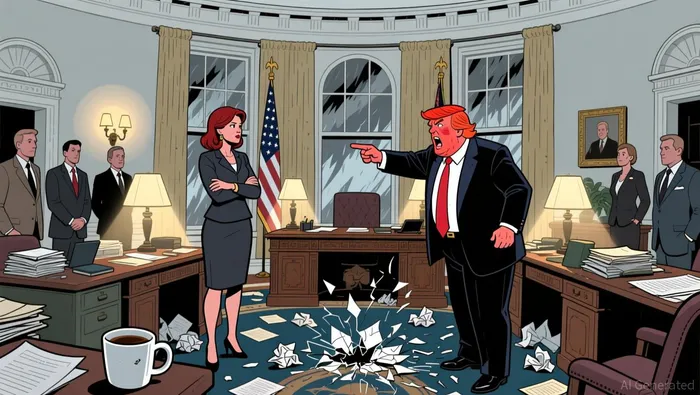
Wiles has described Trump's leadership style as akin to an "alcoholic's personality," emphasizing his belief in "no limits to his power" and a tendency to pursue retribution against political adversaries according to a Vanity Fair report. This characterization, while unorthodox, underscores a governance model where executive authority is exercised with little regard for institutional checks. Internal tensions are evident in her admission that Trump often "wins" in tied decisions, a dynamic that has led to contentious policy outcomes. For instance, Wiles reportedly dissuaded Trump from sweeping deportations and pardoning January 6 participants but ultimately conceded to his will as revealed in a Vanity Fair interview. Such inflexibility, combined with a lack of consensus-building, risks creating policy instability-a red flag for investors seeking predictable regulatory environments.
The administration's handling of the Jeffrey Epstein files further illustrates this instability. Wiles criticized Attorney General Pam Bondi for "completely whiffed" her early response, a misstep that alienated Trump's right-wing base and highlighted the fragility of interagency coordination according to Wiles' assessment. These internal rifts, while not uncommon in polarized administrations, are amplified by Trump's combative style, which prioritizes loyalty over expertise. For markets, this raises concerns about policy reversals and inconsistent enforcement, particularly in sectors like energy and defense, where regulatory clarity is paramount.
Sector-Specific Risks: Energy, Technology, and Defense
 Energy Sector: Trump's energy policies, championed by Energy Secretary Chris Wright, aim to reverse the Biden administration's focus on renewable energy by promoting fossil fuels and rolling back green subsidies as reported by Politico Pro. However, Wiles' acknowledgment that tariffs on steel, aluminum, and clean energy technologies have been "more painful than expected" as cited in an NBC interview suggests unintended consequences. Tariffs on solar panels and wind turbines, for example, have disrupted supply chains and increased costs for infrastructure projects. According to a report by the Center for American Progress, over $8 billion in clean energy projects were canceled in early 2025 due to these tariffs as detailed in a policy brief. While the administration claims to address rising electricity costs, its reliance on fossil fuels risks long-term stranded asset risks as global markets pivot toward decarbonization.
Technology and AI: The administration's aggressive stance on China, including restrictions on U.S. investments in Chinese semiconductors and AI sectors, has created a bifurcated global tech landscape as outlined in a legal analysis. Wiles' role in shaping these policies is complicated by her past ties to Chinese firms like JinkoSolar and Hikvision, which have faced U.S. scrutiny for human rights violations as reported by UnHerd. Critics argue that such conflicts of interest could undermine the credibility of regulatory frameworks, leading to legal challenges under international investment law as detailed in the same report. For investors, the resulting uncertainty-coupled with Trump's use of the International Emergency Economic Powers Act (IEEPA) to impose sanctions-like measures-heightens compliance risks and deters cross-border capital flows.
Defense and National Security: The "America First Investment Policy" memorandum, which Wiles helped implement, seeks to tighten restrictions on Chinese investments in critical infrastructure while fast-tracking approvals for allied nations as detailed in the official memorandum. While this aligns with broader national security goals, the policy's reliance on CFIUS to block adversarial transactions has drawn criticism for lacking transparency. Past cases, such as the Ralls Corp v. CFIUS dispute, highlight concerns about arbitrary decision-making as reported by UnHerd. For defense contractors, the administration's focus on reshoring supply chains and securing critical minerals introduces both opportunities and risks. While subsidies for domestic production could boost margins, the associated regulatory complexity may delay projects and inflate costs.
### Investor Strategies and Market Sentiment
The Q2 2025 market outlook reveals a mixed response to these developments. Equity indices like the S&P 500 initially dropped following Trump's "Liberation Day" tariff announcement but rebounded after a 90-day pause was introduced according to a market analysis. However, bond and foreign exchange markets signaled deeper pessimism, with the 10-year Treasury yield declining and the U.S. Dollar Index dropping sharply-a sign of waning confidence in long-term economic growth as detailed in the same report. Investors are increasingly hedging against regulatory volatility by favoring sectors with less exposure to policy shifts, such as healthcare and consumer staples.
In the defense sector, firms are recalibrating strategies to align with the administration's China-focused policies. For example, companies like Lockheed Martin and Raytheon are accelerating investments in hypersonic technology and advanced manufacturing, sectors explicitly prioritized in the Trump policy memo as outlined in the official document. Meanwhile, tech firms are navigating a dual challenge: complying with outbound investment rules while avoiding reputational damage from associations with Chinese partners.
Conclusion: Navigating a High-Risk Political Landscape
Susie Wiles' candid assessments reveal a Trump administration defined by ideological fervor, internal discord, and a leadership style that prizes unilateral action over consensus. For investors, the implications are clear: political stability is contingent on Wiles' ability to mediate between Trump's autocratic tendencies and the practical demands of governance. While the administration's policies may offer short-term gains in sectors like energy and defense, the long-term risks-ranging from regulatory arbitrage to geopolitical friction-demand a cautious approach. As markets grapple with the "Trump era" narrative, the key to resilience lies in diversification, agility, and a keen awareness of the interplay between executive leadership and institutional checks.







Comentarios
Aún no hay comentarios