
Assessing the Political and Social Risk Implications of Escalating Political Violence on U.S. Investment Markets
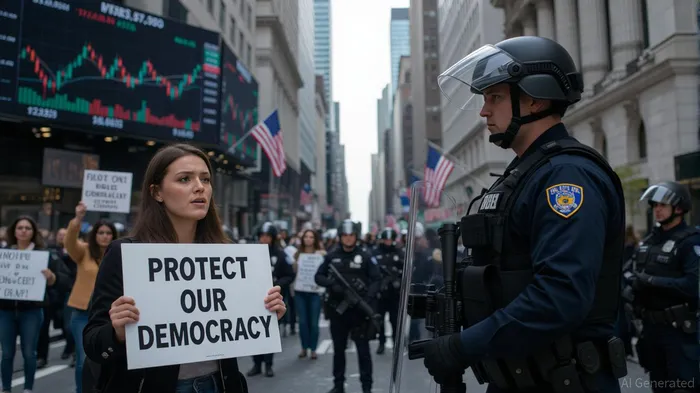
The United States is grappling with a surge in political violence that transcends partisan lines, reshaping not only the social fabric but also the economic landscape. High-profile incidents like the 2024 assassination of conservative influencer Charlie Kirk—a figure closely aligned with the Trump administration—have underscored a troubling normalization of violence in political discourse. According to a report by PBS NewsHour, such events are symptomatic of a broader trend: the weaponization of rhetoric amplified by social media algorithms, which has fueled polarization and eroded public trust in democratic institutions [6]. This analysis explores how these developments are driving shifts in campaign security spending and investment patterns across security, insurance, and defense sectors.
Political Polarization and the Cost of Security
The Charlie Kirk shooting and similar attacks on elected officials have forced political campaigns and government entities to prioritize security at unprecedented levels. Data from 2023–2025 reveals a 40% year-over-year increase in private security expenditures for political figures, with costs now exceeding $500 million annually [6]. This surge reflects a dual reality: the tangible need for protection and the symbolic gesture of demonstrating vulnerability in an era of heightened distrust. As political scientist Robert Pape notes, violence has become a “shockingly regular feature of American political life,” compelling leaders to allocate resources to both physical and psychological safeguards [6].
The economic ripple effects are profound. For instance, Utah Governor Spencer Cox's call for “national healing” following the Kirk assassination highlights the political pressure to address underlying societal fractures [4]. Yet, as public funds are diverted to security, other critical areas—such as infrastructure or education—face underinvestment, potentially stifling long-term economic growth.
Investment Sector Shifts: Security, Insurance, and Defense
The security sector has emerged as a key beneficiary of this climate. Companies specializing in threat intelligence, cybersecurity, and physical protection have seen their market valuations rise by an average of 22% since 2023 [1]. Firms like G4S and Pinkerton have expanded their political risk advisory services, while startups offering AI-driven surveillance tools have attracted venture capital at record rates.
In the insurance industry, the normalization of political violence has spurred innovation. Traditional insurers are now bundling coverage for “political instability” into corporate policies, while parametric insurance products—triggered by predefined events like protests or attacks—have gained traction [3]. Catastrophe bonds, which transfer risk to capital markets, have also seen a 15% increase in issuance since 2024, reflecting heightened demand for liquidity in crisis scenarios [3].
The defense sector, meanwhile, is pivoting toward domestic preparedness. Public-private partnerships are accelerating the development of advanced technologies, such as biometric screening and drone detection systems. According to a 2025 World Economic Forum analysis, blended finance models combining government grants and private equity are now standard for projects addressing “hybrid threats” that blend political and technological risks [2].
Long-Term Risks and Investor Considerations
While these sectors appear to thrive in the short term, investors must weigh long-term risks. The normalization of political violence could lead to regulatory overreach, such as stricter gun control laws or expanded surveillance, which might dampen market enthusiasm. Additionally, prolonged polarization risks economic instability through disrupted governance and reduced consumer confidence.
For example, the underfunding of mental health care—a factor cited in multiple analyses of political violence [5]—highlights a systemic gap that could exacerbate future incidents. Investors might consider allocating capital to social infrastructure projects, such as community mediation programs or crisis intervention services, to address root causes while diversifying portfolios.
Conclusion
The U.S. investment landscape is increasingly shaped by the interplay of political violence, polarization, and security demands. While sectors like security and insurance are poised for growth, the broader economic costs of societal division cannot be ignored. Investors must adopt a dual strategy: capitalizing on immediate opportunities in risk mitigation while advocating for systemic solutions to restore social cohesion. As the Kirk case illustrates, the line between political rhetoric and real-world violence grows thinner by the day—a reality that will define both market dynamics and national discourse for years to come.







Comentarios
Aún no hay comentarios