
Assessing Political Risks in U.S. State-Level Markets: Implications for Investors
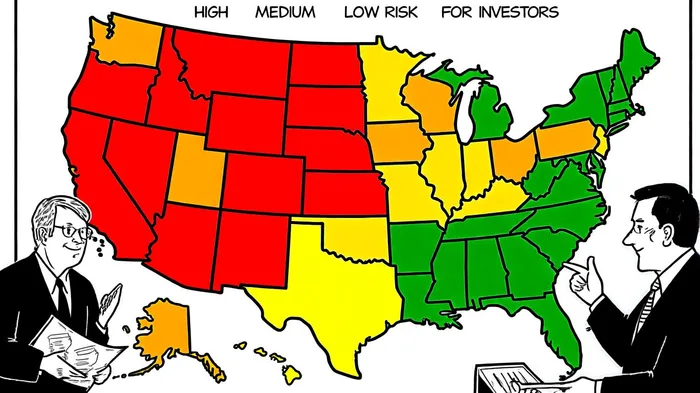
Federal interventions in state affairs have become a defining feature of U.S. economic and political dynamics since 2020. From Medicaid reforms to infrastructure funding freezes and education policy shifts, federal actions have created a patchwork of opportunities and risks for investors. This analysis examines how these interventions shape state-level economies and investment strategies, with a focus on sector-specific and geographic variations.
Federal Medicaid Reforms and Health Care Sector Volatility
The 2025 Budget Reconciliation Bill and the One Big Beautiful Bill Act have introduced sweeping changes to Medicaid, including eligibility restrictions, work requirements, and reduced federal matching rates. According to a JAMA Health Forum analysis, these reforms are projected to reduce federal Medicaid spending by $698 billion between 2026 and 2034, with enrollment dropping by 10.3 million by 2034. The economic fallout includes 302,000 job losses and $135.3 billion in reduced GDP annually by 2034, the JAMA analysis found.
Investors in the health care sector are recalibrating strategies. Companies like Molina HealthcareMOH-- and Centene CorporationCNC--, which rely heavily on Medicaid enrollment, face revenue risks. Conversely, opportunities are emerging in telehealth and rural infrastructure. For instance, rural hospitals at risk of closure-101 in total by 2034-could attract capital for alternative care models, such as AI-driven diagnostics and home-based services, the JAMA analysis estimates. States like Oregon and Illinois, anticipating $490 million and $7 billion in federal funding losses by 2031, respectively, are prioritizing contingency budgets and private-sector partnerships, according to a Pew analysis.
Infrastructure Policy Shifts and Regional Disparities
Federal infrastructure funding has been a double-edged sword. The Infrastructure Investment and Jobs Act (IIJA) initially allocated $52 billion for clean energy and transportation projects, but funding freezes under the Trump administration have stalled initiatives like the National Electric Vehicle Infrastructure Formula Program, according to a TechLearning review. The Brookings Institution's Brookings Hutchins Center measure notes that federal purchases declined by 0.4 percentage points in Q2 2025, though state-level spending partially offset this.
Investors are now focusing on states with stable policy environments. California and New York, for example, continue to advance clean energy targets despite federal rollbacks, creating opportunities in energy storage and grid modernization. Private capital is also targeting "virtual power plants" and advanced inverters to address grid reliability, according to a Del Morgan report. Conversely, states reliant on federal infrastructure grants, such as West Virginia and Alaska, face heightened risks due to delayed project approvals and funding uncertainty, as the TechLearning review notes.
Education Policy Divergence and EdTech Opportunities
Federal education policy under the Trump administration has emphasized decentralization, with proposed cuts to Title I funding and the elimination of the $12 billion Head Start program, as reported in an Education Week article. These changes threaten to exacerbate disparities in low-income and rural schools, where federal funds cover 30–50% of operating budgets, the Education Week article also notes. However, state-level innovation is creating new investment avenues.
For example, California's climate disclosure laws and clean electricity standards are driving demand for edtech tools that manage compliance and track emissions, according to a CSE analysis. Similarly, private school tax credits in states like Florida and Texas are expanding the market for supplemental educational services. Investors are backing AI-driven platforms like Duolingo, which leverages personalized learning to adapt to regulatory shifts, as described in a Forbes article.
Environmental Deregulation and Clean Energy Paradoxes
Federal environmental policies have shifted toward deregulation, with the Council on Environmental Quality (CEQ) streamlining NEPA reviews and suspending offshore wind leases, according to a Morgan Lewis briefing. While this reduces permitting delays for fossil fuel projects, it also undermines long-term clean energy growth. That Morgan Lewis briefing also points out that states like Washington and Michigan are maintaining momentum through clean fuel standards and energy storage targets.
Investors are adopting a "dual-track" strategy: hedging against federal policy risks by focusing on state-level clean energy mandates while capitalizing on AI-driven efficiency gains in renewable deployment. For instance, companies specializing in direct air capture (DAC) technologies are securing state grants to offset federal funding gaps, according to the Deloitte outlook.
Tax Policy Uncertainty and Sectoral Realignments
Tax cuts and incentives under federal and state policies are reshaping business climates. The 2025 tax reforms for higher education, which include college savings incentives and student loan repayment aid, are expected to boost institutional funding, according to an ACE analysis. However, proposed cuts to K-12 education budgets-such as the $5 billion reduction in Title I funding-could strain local economies, as highlighted in the Education Week article.
Investors are prioritizing sectors with stable tax environments. For example, tech firms in states with favorable corporate tax rates, like Texas and Nevada, are expanding operations, while manufacturing firms are diversifying supply chains to mitigate federal policy risks, as noted in a Foley insight.
Conclusion: Navigating a Fragmented Policy Landscape
Federal-state policy interactions are creating a mosaic of risks and opportunities for investors. While Medicaid cuts and infrastructure freezes pose systemic threats, state-level innovation in education, clean energy, and tax incentives offers resilience. Investors must adopt flexible strategies, prioritizing sectors with adaptive capacity-such as AI-driven health care, state-aligned clean energy projects, and edtech platforms-and avoiding regions overly reliant on volatile federal funding. As the 2025–2030 period unfolds, the ability to navigate this fragmented landscape will define long-term success.





Comentarios
Aún no hay comentarios