
Assessing the Political and Economic Implications of Venezuela's Prisoner Releases for U.S.-Linked Investors
The release of political prisoners in Venezuela in 2025 has emerged as a pivotal moment in the country's fraught political and economic trajectory, with profound implications for U.S.-linked investors. This development, occurring amid U.S. military intervention and the capture of former President Nicolás Maduro, signals a potential de-escalation of tensions but also underscores the complex interplay of geopolitical risk and emerging market recovery. For investors, the stakes are high, as Venezuela's oil-dependent economy and strategic position in Latin America make it a focal point for both opportunity and volatility.
Geopolitical Risk: A Double-Edged Sword
The U.S. military's capture of Maduro in early 2026 and the subsequent prisoner releases have recalibrated regional dynamics. According to a report by the Atlantic Council, the U.S. action has drawn strong condemnation from China and Russia, allies of the Maduro regime, and raised fears of broader geopolitical escalation. While the prisoner releases may signal Venezuela's cooperation with U.S. demands, they also highlight the fragility of the interim government led by Delcy Rodríguez. Analysts warn that the precedent set by U.S. intervention could embolden further military actions in other regions, such as Greenland or Taiwan, exacerbating global tensions.
For U.S. investors, this volatility translates into heightened geopolitical risk. The International Monetary Fund (IMF) has noted that emerging markets are particularly sensitive to such shocks, with Venezuela's sovereign and PDVSA bonds experiencing significant rallies in early 2026 as markets priced in potential debt restructuring and sanctions relief. However, the long-term stability of these gains remains uncertain, as geopolitical flashpoints-such as U.S.-China tensions-could disrupt investor confidence.
Economic Implications: A Fragile Path to Recovery
Venezuela's economy remains in dire straits, with GDP contracting by over 80% since its 2013 peak and inflation reaching 2,000% as of 2025. The recent prisoner releases, while a symbolic gesture toward normalization, do not address the structural challenges of a country where oil production has plummeted due to underinvestment and sanctions. According to Bloomberg, the U.S. plans to sell 30–50 million barrels of seized Venezuelan oil, with proceeds allocated to fund reforms. However, major energy firms like ChevronCVX-- and Exxon MobilXOM-- have expressed reluctance to invest without assurances of regulatory clarity and long-term policy support.
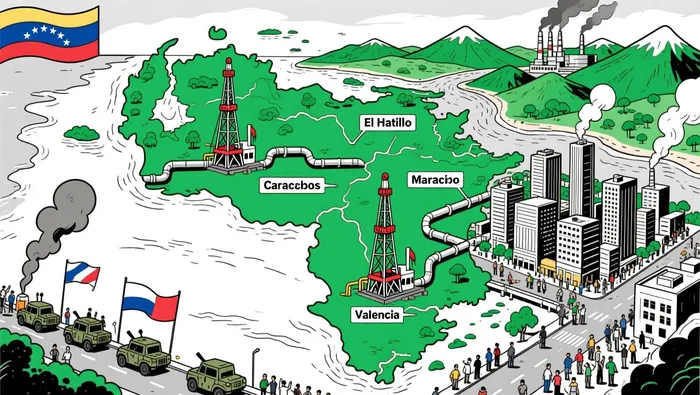
The oil sector's revival is projected to require up to $100 billion in capital, with production increases unlikely before 2030. This timeline creates a critical gap for U.S. investors, who must weigh short-term geopolitical gains against the long-term risks of infrastructure decay and political instability. Meanwhile, the U.S. Gulf Coast refiners stand to benefit from potential crude imports, but Canadian producers face heightened competition, illustrating the uneven distribution of economic opportunities.
U.S. Investment Trends: Appetite for Risk Amid Uncertainty
The U.S. intervention in Venezuela has tested investor appetite for geopolitical risk. According to Reuters, gold prices surged over 2.7% in early 2026 as markets sought safe-haven assets amid heightened uncertainty. Similarly, U.S. defense stocks rose on the prospect of further military involvement, while emerging market equities remained mixed. The Trump administration's threefold strategy-stabilization, recovery, and transition-has been marketed as a pathway to attract Western corporate investment, but skepticism persists. As stated by a report from the Atlantic Council, "Major reforms are needed to restore investor confidence, and the interim government's credibility remains untested."
For U.S.-linked investors, the key question is whether Venezuela's political transition will lead to a sustainable economic recovery or deepen existing fractures. The World Bank has highlighted that Venezuela's external debt of $150–$170 billion and a debt-to-GDP ratio of 180–200% pose significant challenges. While the IMF projects 0.5% real GDP growth for 2026, this figure is contingent on continued U.S. support and the resolution of geopolitical tensions.
The Role of International Institutions
The IMF and World Bank are likely to play a pivotal role in Venezuela's economic reorganization. According to the IMF's 2026 outlook, emerging markets could benefit from trade recovery and structural reforms, but inflationary pressures and U.S. monetary policy remain risks. The World Bank has emphasized that Venezuela's oil sector requires multilateral financing and debt restructuring to attract private investment. For U.S. investors, this means that success in Venezuela will depend not only on political stability but also on the alignment of international financial institutions with U.S. strategic interests.
Conclusion: Navigating a High-Stakes Landscape
Venezuela's prisoner releases and political transition present a paradox for U.S.-linked investors: a potential opening for economic engagement amid a backdrop of geopolitical uncertainty. While the U.S. has signaled its commitment to reshaping Venezuela's political landscape, the path to recovery is fraught with challenges, from oil sector underinvestment to regional instability. Investors must adopt a hedged approach, balancing short-term opportunities in sovereign bonds and energy equities with long-term risk management strategies. As the IMF and World Bank navigate Venezuela's debt crisis, the ultimate success of U.S. policy will hinge on its ability to stabilize the country without exacerbating global tensions-a delicate balancing act with far-reaching implications for emerging markets.







Comentarios
Aún no hay comentarios