
Assessing the National Security Risks of Bitmain's Dominance in the Bitcoin Mining Sector
Geopolitical Risks: A Federal Spotlight on Bitmain
Bitmain's hardware is no longer just a tool for mining Bitcoin; it has become a focal point for U.S. national security concerns. In 2025, the Department of Homeland Security launched "Operation Red Sunset," an investigation into whether Bitmain's devices could be remotely manipulated for espionage or sabotage against critical infrastructure, such as military bases or power grids according to reports. These fears are not hypothetical: similar concerns were raised in 2017 and 2019 over potential backdoors in its hardware. The Biden administration's 2024 block of a Wyoming mining facility near a nuclear missile base, citing risks from foreign-sourced hardware, underscores the gravity of these issues.
Compounding these concerns is Bitmain's AI subsidiary, Sophgo Technologies, which was blacklisted by the U.S. Commerce Department in January 2025 for alleged ties to Huawei. This move highlights the U.S. government's broader strategy to restrict Chinese tech firms with perceived links to state actors. Meanwhile, a July 2025 Senate Intelligence Committee report warned of "disturbing vulnerabilities" in Bitmain devices, urging caution about their proximity to sensitive U.S. facilities. For investors, this regulatory scrutiny signals a growing risk of export controls, sanctions, or operational restrictions that could disrupt Bitmain's global footprint.
Supply Chain Vulnerabilities: A Strategic Rebalancing
Bitmain's supply chain has long been a double-edged sword. While its ASICs are engineered for efficiency, the company's reliance on Chinese manufacturing and global logistics has exposed it to geopolitical friction. In response, Bitmain announced plans to establish its first U.S. factory by late 2025, with production slated for Texas or Florida by early 2026. This shift aims to bypass U.S. tariffs that increased machine costs by 24-36% when manufactured in Southeast Asia. By localizing production, Bitmain hopes to reduce delivery times, lower repair costs, and mitigate scrutiny over its hardware's security profile.
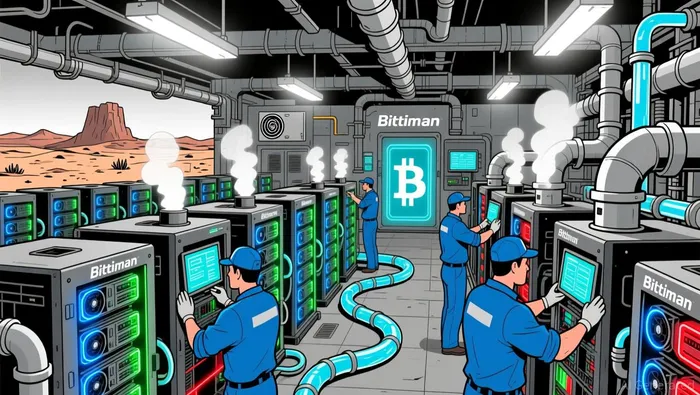 Yet, this move is not without challenges. The U.S. factory will require significant capital investment and hiring of 250 local workers, while the company must navigate a regulatory environment increasingly hostile to Chinese tech firms. Additionally, Bitmain's reliance on advanced cooling technologies-such as its Antminer S23 Hydro model- introduces new dependencies on specialized components that could be subject to export controls. For investors, these dynamics highlight a tension between Bitmain's efforts to adapt and the persistent risks of geopolitical interference in its supply chain.
The Broader Implications for Crypto Infrastructure
Bitmain's dominance in the ASIC market- projected to grow to $22.63 billion by 2033-means its vulnerabilities could ripple across the entire Bitcoin network. If U.S. regulators impose stricter controls on Bitmain's hardware, miners may face higher costs or operational delays, potentially centralizing mining power in jurisdictions with fewer regulatory constraints. Conversely, Bitmain's U.S. factory could serve as a model for diversifying crypto infrastructure, reducing reliance on Chinese manufacturing, and aligning with domestic security priorities.
For investors, the key question is whether Bitmain can balance innovation with geopolitical realities. While its S21 XP and S21 Pro models remain industry benchmarks, the company's future will depend on its ability to navigate export restrictions, address security concerns, and adapt to a fragmented global regulatory landscape.
Conclusion: A High-Stakes Game of Chess
Bitmain's position at the intersection of crypto infrastructure and geopolitics makes it both a critical player and a potential liability. Its U.S. factory and energy-efficient hardware represent strategic moves to mitigate risks, but the shadow of "Operation Red Sunset" and the Senate's warnings suggest that national security concerns will linger. For investors, the lesson is clear: the Bitcoin mining sector's growth is inextricably tied to the stability of its supply chains and the geopolitical climate. Diversification-whether through alternative hardware providers or jurisdictional hedging-may be the only way to navigate this volatile landscape.







Comentarios
Aún no hay comentarios