
Assessing Mexico Equity Investment Opportunities: The Mexico Fund, Inc. as a Confidence Signal
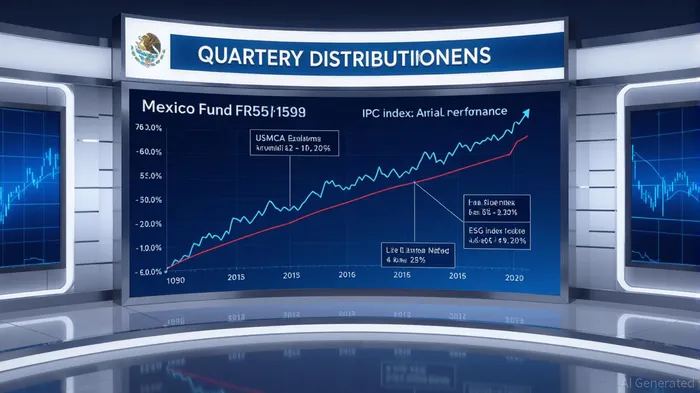
The Mexico FundMXF--, Inc. (MXF) has long served as a barometer for investor sentiment toward Mexican equities. Its recent distribution patterns—most notably the $0.25 per share payout in July 2025[4]—and the insider purchase by director Luis de la Calle[3] suggest a nuanced picture of market confidence amid a backdrop of economic uncertainty. To assess whether MXF's distributions signal an optimal entry point for equity investments in Mexico, one must dissect the interplay between the fund's performance, broader market dynamics, and structural shifts in trade and sustainability trends.
The Fund's Performance and Distribution Signal
MXF has maintained a consistent quarterly distribution schedule, with its annualized yield of 5.41%[2] outpacing many emerging market peers. This stability, even as Mexico's economy grapples with political transitions and judicial reforms[4], reflects the fund's ability to navigate volatility. The recent $0.25 distribution, sourced primarily from net investment income[4], underscores management's confidence in the fund's underlying assets. Such consistency is rare in emerging markets, where cash flows often fluctuate with macroeconomic shocks.
However, distributions alone are not sufficient to gauge market confidence. A deeper analysis reveals that MXF's performance is tied to the broader Mexican equity index (IPC), which currently trades at a 12.37 P/E ratio—a historically “fair” valuation[2]. While the IPC's correlation with U.S. indices has weakened (ranging between +0.2 to +0.6[4]), its sectoral tilt toward consumer staples and materials makes it sensitive to domestic consumption and global commodity cycles. For instance, nearshoring-driven industrial demand has cushioned some sectors against U.S. tariff pressures[2], a trend that MXFMXF-- likely captures through its portfolio.
Broader Market Dynamics and Structural Shifts
Mexico's equity market is undergoing a quiet transformation. Private equity deal values are projected to hit $14.22 billion in 2025[5], driven by tech startups and digital transformation—a shift that aligns with MXF's focus on diversified exposure. Meanwhile, ESG criteria are reshaping investor behavior. The S&P/BMV Total Mexico ESG Index[5] has gained traction, reflecting a growing appetite for sustainable investments. Though MXF's direct ESG alignment is not explicitly detailed, the fund's resilience amid policy uncertainty suggests it benefits from the same structural strengths as ESG-favored firms: governance transparency and long-term value creation.
Trade policy remains a double-edged sword. U.S. tariffs on Mexican exports have stoked short-term jitters[1], yet nearshoring investments—bolstered by lower labor costs and established supply chains[2]—are mitigating some risks. The IPC's historical outperformance in local currency terms (relative to the S&P 500) from 2000–2012[4] hints at untapped potential, particularly if the U.S. dollar weakens further.
Risks and Cautionary Signals
Despite these positives, red flags persist. Mexico's fiscal sustainability is under scrutiny, with analysts warning of potential credit rating downgrades[4]. The government's reliance on foreign capital—now strained by declining bond market participation[4]—heightens vulnerability to global liquidity shifts. Additionally, judicial reforms have clouded legal predictability[2], deterring foreign direct investment. For MXF, this means distributions could face pressure if portfolio companies encounter earnings volatility.
The sentiment-based risk indicator derived from Twitter[1], which has proven effective in forecasting financial stress in Mexico, adds another layer of caution. While current readings are stable, spikes in negative sentiment could precede market corrections, particularly if U.S. trade policy hardens further.
Entry Timing: Balancing Signals
For investors, the Mexico Fund's distributions offer a mixed signal. On one hand, consistent payouts and insider confidence[3] suggest a degree of stability. On the other, macroeconomic headwinds—particularly in trade and governance—warrant a measured approach. A prudent strategy might involve dollar-cost averaging into Mexican equities via MXF, leveraging its diversification benefits while hedging against currency risk.
The fund's yield, combined with the IPC's attractive valuation and nearshoring tailwinds, makes it a compelling candidate for those with a medium-term horizon. However, entry timing should align with improvements in policy clarity and ESG adoption—a shift that could accelerate if Mexico's next administration prioritizes institutional reforms.
Conclusion
The Mexico Fund, Inc. embodies both the opportunities and risks inherent in Mexican equities. Its distributions reflect a resilient asset base, yet they must be contextualized within a landscape of trade uncertainties and fiscal challenges. For investors, the fund serves as a partial signal—useful but insufficient on its own. Combining MXF's performance with real-time sentiment analysis[1] and ESG trends[5] offers a more robust framework for timing entry into Mexico's dynamic but volatile market.







Comentarios
Aún no hay comentarios